
 Menu
Menu
How New Mexico Monsoon Season Affects Evaporative Cooler Performance in Albuquerque
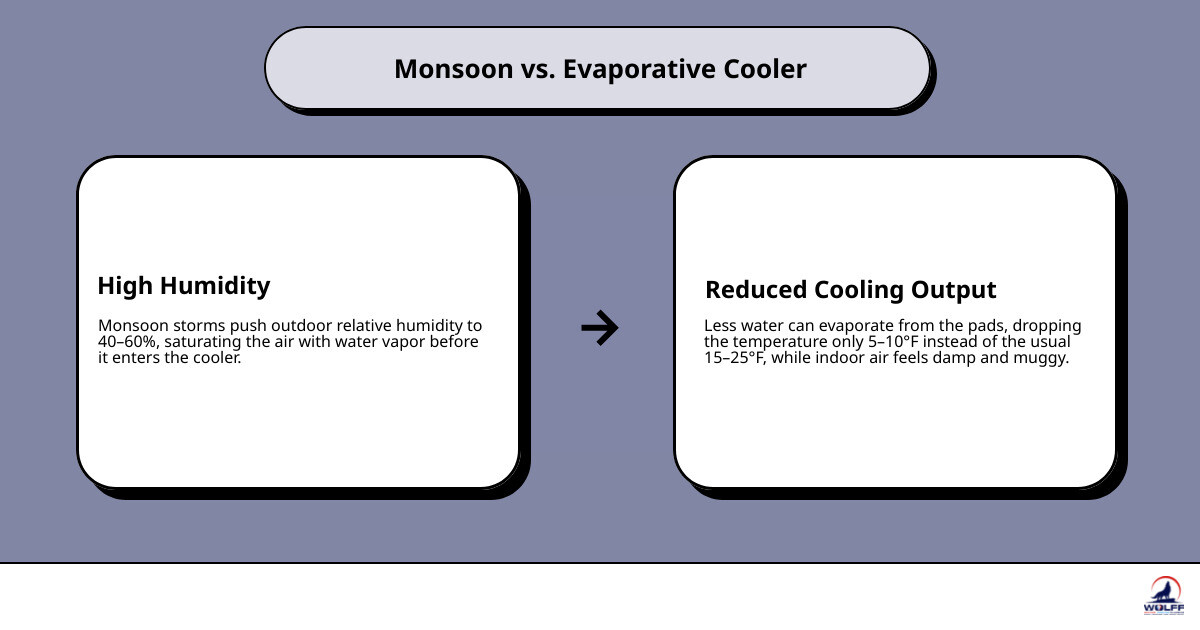
how new mexico monsoon season affects evaporative cooler performance comes down to humidity: when rain-soaked air already holds more water vapor, less water can evaporate from your cooler’s pads. For homeowners in Albuquerque, New Mexico, that means an evaporative cooler that felt strong in June may deliver warmer, damper air during July through September storms. The system is not always broken. It may be reaching a weather limit. Afternoon humidity can rise into the 40% to 60% range, reducing the temperature drop available while outdoor heat remains high. Knowing this difference helps you spot a normal monsoon limitation versus an evaporative cooler service issue.
Learn more about humidity and evaporative cooling | Schedule cooling service
I am Joe Wolff, and next we’ll explain why humid monsoon air changes what your evaporative cooler can realistically do for indoor comfort.
Contact Wolff Heating, Cooling and Plumbing for help with your cooling system.
Understanding How New Mexico Monsoon Season Affects Evaporative Cooler Performance
Every summer, residents across the middle Rio Grande Valley look forward to the dramatic thunderheads rolling over the Sandia Mountains. While monsoon rains bring welcome moisture to our high desert soil, they present a distinct challenge for home HVAC systems. To grasp how new mexico monsoon season affects evaporative cooler performance, we first need to look at the underlying physics of how swamp coolers create chilly air.
Evaporative coolers operate on the principle of adiabatic saturation. In clear, dry weather—like typical May or June conditions in Albuquerque, Rio Rancho, and Corrales—the air is thirsty for moisture. A standard swamp cooler draws hot, dry outdoor air through water-saturated pads. As liquid water evaporates into water vapor, it absorbs sensible heat from the air, dropping the air temperature significantly before blowing it into your living area. In peak dry conditions, an evaporative cooler can lower incoming air temperatures by up to 40 degrees Fahrenheit.
However, during the monsoon season (which traditionally runs from July through September), massive plumes of tropical moisture sweep into New Mexico from the Gulf of California and the Gulf of Mexico. This influx dramatically spikes our local relative humidity. When ambient air already holds a high percentage of water vapor, its ability to absorb additional water from the cooler pads drops sharply. As a result, the natural cooling process stalls out.

To explore these atmospheric changes deeper, check out A Comprehensive Guide to Humidity & Evaporative Cooling.
Technical Breakdown of How New Mexico Monsoon Season Affects Evaporative Cooler Performance
To quantify this phenomenon, HVAC engineers look at wet-bulb depression—the difference between the dry-bulb temperature (what a normal thermometer reads) and the wet-bulb temperature (the lowest temperature achievable purely through evaporative cooling). In ideal low-humidity conditions, wet-bulb depression in central New Mexico can exceed 30 degrees. During monsoon afternoons, relative humidity frequently jumps from a crisp 10–15% to 40%, 50%, or even 60% or more.
When relative humidity climbs, the wet-bulb temperature rises toward the dry-bulb temperature, compressing the wet-bulb depression. This compression severely caps the temperature drop your unit can produce.
Furthermore, ambient heat adds another complication. When outdoor temperatures exceed 95°F during extreme heat events, swamp coolers face a double hurdle. At 95°F and above, water can evaporate off the pad surfaces so rapidly or unevenly that the pads fail to remain uniformly saturated, or the incoming air is simply too hot and humid for the system to absorb heat effectively. When severe afternoon heat blends with monsoon humidity, supply air coming out of your vents may only be 8 to 12 degrees cooler than the outside air.
For a deeper dive into why your swamp cooler struggles under these exact circumstances, read Why Swamp Coolers Work in Dry NM Heat but Struggle in Monsoon.
Indoor Relative Humidity Outcomes and Mold Risks
When an evaporative cooler continues running full blast while pushing saturated air into a home, that unevaporated moisture has to end up somewhere. Under normal dry operations, direct evaporative cooling increases indoor relative humidity to a comfortable 30% to 50% range. However, during monsoon surges, operating a direct evaporative cooler when outdoor relative humidity is 55% at 95°F dry-bulb can push indoor relative humidity levels to 70% or higher.
When indoor humidity sits at 70% or above, it creates conditions associated with elevated mold growth risks per ASHRAE Standard 62.1. Homeowners often notice:
- Persistent dampness on wall finishes, interior glass, and wooden trim.
- Musty odors originating from ductwork, carpets, or upholstered furniture.
- Uncomfortable indoor temperatures lingering around 80°F to 85°F with heavy, muggy air.
- Sluggish mental focus, daytime fatigue, and respiratory irritation.
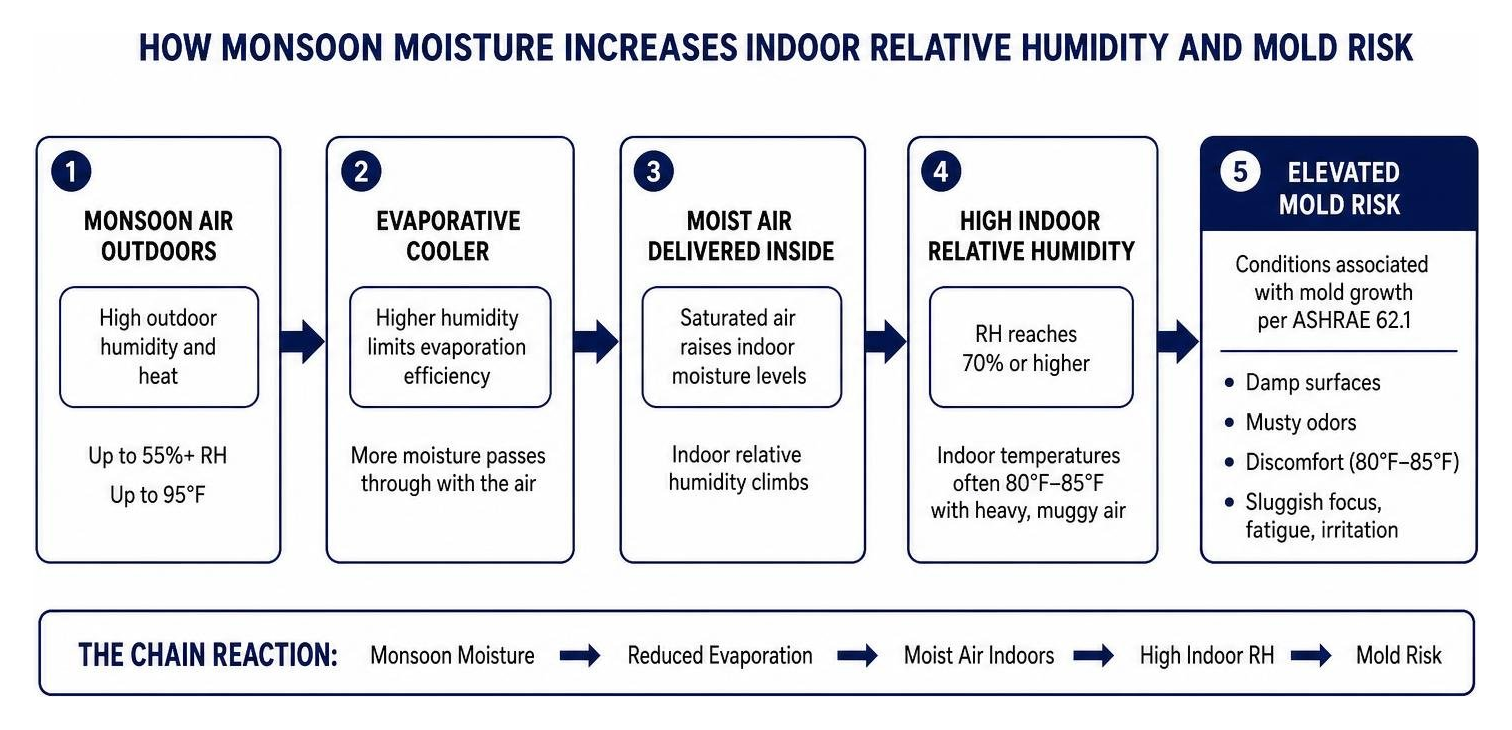
When high humidity settles inside your house, it transforms your living room into a tropical enclosure. Protect your home and air quality by reading New Mexico Monsoons: Don’t Let the Rain Turn Your Home Into a Petri Dish.
Environmental, Elevation, and Air Quality Challenges
Living in communities like Albuquerque, Placitas, Cedar Crest, and Tijeras means enjoying stunning high-desert geography. However, high elevation introduces unique mechanical considerations for both evaporative and refrigerated HVAC systems during monsoon weather.
Elevation Impact Across New Mexico Climate Zones
Central New Mexico spans distinct climate zones (such as Zone 4B in the Albuquerque metro area and surrounding foothills). Elevation plays a direct role in air density and equipment performance:
- Air Density Reduction: Albuquerque sits at roughly 5,312 feet above sea level, while communities in the East Mountains like Cedar Crest and Tijeras range even higher. At these elevations, the air density is approximately 17% to 20% lower than at sea level.
- Equipment Capacity De-rating: Thinner air carries less heat mass per cubic foot. This means standard HVAC equipment must be properly sized and de-rated. A cooling load that requires a 3-ton unit at sea level may require a 3.5-ton rated unit at high elevation to move enough air mass.
- Thermal Mass Lag: Local building traditions, including adobe and thick masonry construction, act as thermal batteries. They delay outdoor heat absorption during the hottest afternoon hours, shifting peak indoor cooling demand late into the evening—right when monsoon storms often drop ambient temperatures while locking in surface humidity.
To understand how high humidity interacts with high altitude, check out The Ultimate Guide to Swamp Cooler Limitations in High Humidity.
Wildfire Smoke Hazards and Indoor Air Quality
Another seasonal complication in the Southwest is the overlap of monsoon weather with regional wildfire activity. Early monsoon lightning strikes can ignite dry forest timber across western states and high mountain ranges, sending dense plumes of smoke directly into our river valleys.
Because direct evaporative coolers rely on drawing 100% fresh outdoor air into your dwelling, running a swamp cooler during a smoke advisory pulls fine particulate matter (PM2.5), ash, and volatile organic compounds directly into your bedrooms and living spaces. Standard swamp cooler media pads are designed to absorb water, not trap microscopic smoke particles. Wet pads can capture larger soot debris, but this creates a dirty slurry that fouls cooler pads, clogs water distribution lines, and breeds unpleasant odors inside your ductwork.
During combined wildfire smoke and high-humidity events, running an evaporative cooler becomes a lose-lose proposition: you introduce both heavy humidity and dangerous smoke particles into your home.
Evaporative Cooling vs. Refrigerated Air Conditioning During Monsoons
When evaluating residential cooling choices, comparing traditional evaporative systems against refrigerated air conditioning (or modern heat pumps) reveals drastic performance differences during monsoon conditions.
| Performance Factor | Evaporative Cooler (Monsoon Conditions) | Central Refrigerated AC / Heat Pump |
|---|---|---|
| Cooling Reliability in High Humidity | Low (Supply air temp rises as humidity spikes) | High (Maintains precise setpoint regardless of outdoor humidity) |
| Indoor Humidity Control | Elevates indoor RH (Can exceed 70% RH) | Dehumidifies air (Maintains comfortable 40-50% RH) |
| Energy Efficiency | High baseline (Uses 25% to 50% less energy than standard AC) | Moderate to High (SEER2 rated efficiency; uses more electricity) |
| Water Consumption | 3 to 15 gallons per hour | 0 gallons direct water usage (Condensate removed from air) |
| Indoor Air Quality During Smoke Events | Low (Pulls 100% unfiltered outdoor air/smoke inside) | High (Recirculates and filters indoor air through MERV/HEPA filters) |
If you are unsure whether your current unit is underperforming due to humidity or a mechanical breakdown, review How to Know When Your Swamp Cooler Stops Working Effectively.
Energy Efficiency and Water Consumption Tradeoffs
The primary advantage of evaporative cooling has always been energy efficiency. In dry weather, swamp coolers use 25% to 50% less electricity than traditional vapor-compression refrigerated air conditioners or heat pumps running in cooling mode. For decades, this low electrical demand made swamp coolers the dominant cooling choice across Albuquerque and Rio Rancho.
However, water usage and seasonal performance shifts complicate this comparison:
- Water Consumption: An evaporative cooler consumes anywhere from 3 to 15 gallons of water per hour of continuous operation. During hot monsoon weeks when units run non-stop to combat humidity, household water usage climbs sharply.
- Hard Water Scale: Local groundwater contains high mineral content. Running large volumes of water through cooler pads leads to heavy mineral scaling on pumps, pans, and media pads, requiring frequent seasonal maintenance and bleed-off flushing.
- Efficiency Loss: While the electrical draw of a swamp cooler motor remains low during monsoon season, the effective cooling output plummets. You pay for electricity and water while gaining very little indoor temperature reduction.
Urban Microclimates and Infrastructure Solutions
Local municipal efforts across the Albuquerque metro area are helping offset extreme heat islands that exacerbate cooler failures. Microclimates dramatically affect neighborhood temperatures:
- Tree Canopy Impact: Neighborhoods with mature shade trees and expanded urban canopies can measure up to 17°F cooler than canopy-deficient urban heat islands. Lowering ambient outdoor temperatures immediately surrounding a home helps lower dry-bulb heat, giving evaporative coolers a better starting point.
- Cool Pavements and Reflective Surfaces: Infrastructure programs implementing light-colored, reflective road coatings and cool roofs lower surface heat retention. Reducing asphalt heat storage helps prevent heat from radiating back into rooftop evaporative cooler intakes late into the evening.
Hybrid Strategies, System Conversions, and Financial Rebates
Homeowners who want reliable comfort without surrendering energy efficiency are increasingly looking at hybrid cooling strategies or full conversion to refrigerated air conditioning.
Upgrades and Solutions: How New Mexico Monsoon Season Affects Evaporative Cooler Performance
If you want to maintain your evaporative cooler for dry May and June weather while surviving July and August humidity, several practical options exist:
- Ductless Mini-Split Systems: Installing a ductless heat pump in primary living areas (such as a master bedroom or main living room) provides targeted, energy-efficient refrigerated cooling and dehumidification during humid monsoon weeks. You can turn off your swamp cooler when rain rolls in and rely on the mini-split.
- Portable or Window AC Units: Using localized supplemental air conditioners in key rooms offers temporary relief during peak humidity surges without needing a full system overhaul.
- Full Refrigerated AC Conversion: Converting from a rooftop or ground-mounted swamp cooler to a central heat pump or high-efficiency refrigerated AC system provides year-round climate control, automatic indoor humidity management, and advanced air filtration during wildfire smoke events.
Converting a home from evaporative cooling to refrigerated air involves modifying ductwork to handle higher static pressure requirements and upgrading electrical service (such as adding a dedicated 240V circuit).
Before making a decision, learn how to evaluate your current setup with Is Your New Mexico Swamp Cooler Actually Working?.
Available Energy Incentives and Rebate Programs
Upgrading your home’s cooling system is made more accessible through various federal, state, and utility programs designed to promote energy efficiency:
- Utility Rebates: Public Service Company of New Mexico (PNM) offers attractive customer rebates for qualifying high-efficiency central air conditioners and electric heat pump upgrades.
- Federal 25C Tax Credits: Homeowners who install qualified high-efficiency heat pumps can claim federal tax credits under Section 25C, helping offset overall project investments.
- Income-Qualified Assistance: Programs like the New Mexico Home Electrification and Appliance Rebates (HEAR) program provide substantial grant support for qualifying lower- and moderate-income households transitioning to energy-efficient electric heat pumps.
- Gas Utility Rebates: New Mexico Gas Company offers rebates when pairing new cooling installations with high-efficiency gas furnaces.
At Wolff Heating, Cooling, and Plumbing, we assist homeowners in identifying and stacking all eligible local utility rebates and federal tax incentives to maximize your investment in year-round home comfort.
Frequently Asked Questions About New Mexico Monsoon Cooling
At what humidity level does a swamp cooler stop working effectively?
An evaporative cooler begins losing noticeable cooling efficiency when outdoor relative humidity reaches 40% to 50%. Once ambient relative humidity crosses 50% to 60%, the air’s wet-bulb depression becomes so compressed that the system can generally only lower incoming air temperatures by a few degrees, causing indoor humidity to surge.
Can running an evaporative cooler during the monsoon cause mold?
Yes. Operating a direct evaporative cooler during humid monsoon conditions can push indoor relative humidity levels past 70%. According to ASHRAE Standard 62.1 guidelines, prolonged indoor relative humidity above 60–70% creates ideal conditions for mold spore germination on drywall, wooden framing, carpets, and air vents.
What supplemental cooling options work best during monsoon season?
Ductless mini-split heat pumps are the most effective long-term supplemental cooling option. They allow homeowners to run evaporative cooling during dry early-summer months, then switch over to localized refrigerated air and dehumidification during humid monsoon weeks. Dedicated dehumidifiers and high-efficiency portable AC units also provide localized comfort relief.
Conclusion
Understanding how new mexico monsoon season affects evaporative cooler performance empowers you to make smart choices for your home’s comfort, air quality, and energy consumption. While swamp coolers excel in our crisp, dry Southwestern spring, high atmospheric humidity during monsoon season inevitably reduces their ability to lower indoor temperatures, leading to muggy rooms and indoor air quality concerns.
Whether you need routine seasonal maintenance on your existing evaporative cooler, wish to explore hybrid mini-split options for targeted monsoon relief, or are ready to convert your home to high-efficiency central refrigerated air, our team at Wolff Heating, Cooling, and Plumbing is here to help. With over 25 years of local experience serving Albuquerque, Rio Rancho, Placitas, Corrales, Cedar Crest, Tijeras, and Bernalillo, we deliver honest estimates, superior workmanship, and tailored solutions built specifically for New Mexico’s unique high-desert climate.
Learn how to achieve high-performance cooling without indoor humidity problems or call our friendly experts today to schedule your home cooling consultation!