
 Menu
Menu
Why Knowing When Your Swamp Cooler Stops Working Effectively Can Save Your Summer
When does a swamp cooler stop working effectively is one of the most important questions an Albuquerque homeowner can ask before the heat peaks. The short answer: your swamp cooler starts losing its battle when outdoor humidity climbs and temperatures push past certain thresholds.
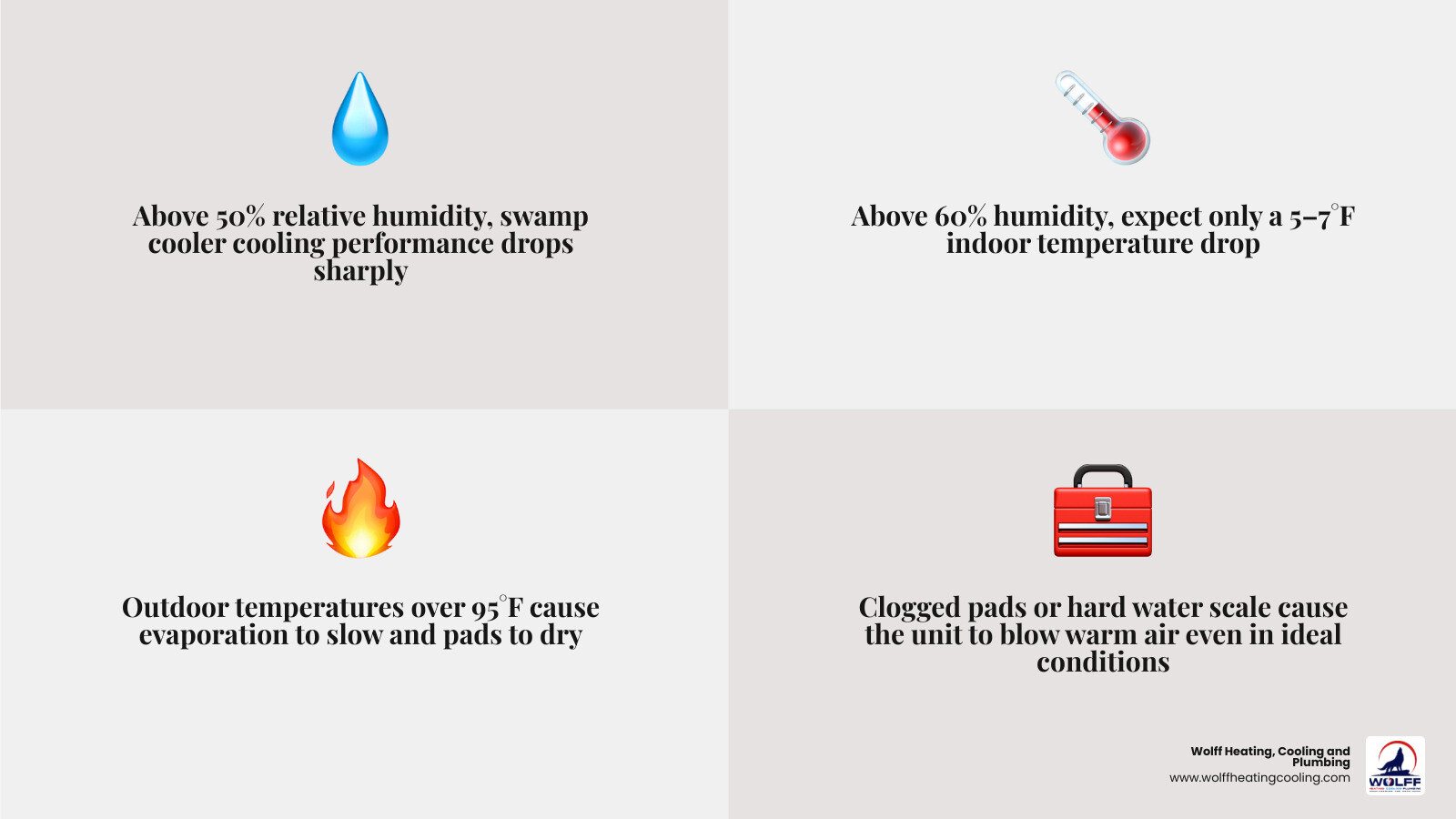
Here’s a quick breakdown of the key failure points:
| Condition | What Happens |
|---|---|
| Relative humidity above 50% | Cooling performance drops significantly |
| Relative humidity above 60% | Expect only a 5–7°F temperature drop |
| Relative humidity at 80% | A 75°F room barely cools to 72°F |
| Outdoor temps above 95°F | Evaporation slows too much to keep pads wet |
| Clogged or dry pads | Unit blows warm air even in ideal conditions |
| Hard water scale on distribution lines | Water can’t reach pads evenly, cutting cooling capacity |
In a place like Albuquerque, swamp coolers can be incredibly effective for most of the dry season — dropping indoor air temperatures by 15 to 30 degrees when humidity stays low. But the moment conditions shift, whether that’s a monsoon rolling in or a triple-digit heat wave, performance can fall off fast.
One Albuquerque resident described sitting in an 85°F house with her swamp cooler running on high, feeling brain fog and unable to work — a situation that’s becoming more common as summer heat records break year after year across the Southwest. It’s not always the unit that’s broken. Sometimes it’s the environment working against it. And sometimes it’s a maintenance issue quietly stealing your cooling power.
Understanding exactly where those limits are — and what to do about them — keeps you comfortable and helps you make smarter decisions about your home’s cooling setup.
Similar topics to when does a swamp cooler stop working effectively:
Environmental Limits: When Does a Swamp Cooler Stop Working Effectively?
To truly grasp when does a swamp cooler stop working effectively, we have to look closely at the laws of physics. Unlike refrigerated air conditioning systems, which rely on chemical refrigerants and compressors to pull heat out of the air, an evaporative cooler relies entirely on the natural process of water evaporation.
To understand how this process can fail, we have to look at three key atmospheric measurements:
- Dry-bulb temperature: This is the ambient air temperature measured by a standard thermometer.
- Relative humidity (RH): The amount of water vapor present in the air, expressed as a percentage of the maximum amount the air could hold at that same temperature.
- Wet-bulb temperature: This is the lowest temperature that can be reached by evaporating water into the air. It represents the absolute physical limit of how cool your swamp cooler can make the incoming air.
If you want to dive deeper into the basic mechanics of these systems, check out A simple guide to how your swamp cooler actually works.
For an evaporative cooler to work, the dry-bulb temperature must be significantly higher than the wet-bulb temperature. The greater the difference between these two numbers (known as the “wet-bulb depression”), the more cooling potential your system has. When the air is dry, water evaporates rapidly from the cooler’s pads, absorbing heat energy from the air and lowering its temperature. However, when the air is already laden with moisture, the evaporation rate slows down to a crawl. Without rapid evaporation, heat cannot be removed from the air, and your swamp cooler effectively turns into a very large, very noisy window fan.
Humidity Thresholds: When Does a Swamp Cooler Stop Working Effectively in High Moisture?
Relative humidity is the single most important factor determining swamp cooler performance. As a general rule of thumb, evaporative cooling is most effective when the relative humidity is below 40%. Once the outdoor humidity crosses the 50% threshold, you will notice a significant drop in cooling capacity.
When we reach the 60% relative humidity limit, the air is already so saturated with water vapor that it can barely absorb any more. At this point, the evaporation process stalls. Instead of a refreshing breeze, your swamp cooler will blow warm, sticky, and highly humid air into your home, making your living spaces feel like a greenhouse.
This humidity barrier is a major point of discussion in the classic Dry heat dilemmas and whether AC or swamp coolers win debate. In high-humidity climates, swamp coolers are completely useless. In New Mexico, we are blessed with incredibly dry air for most of the spring and early summer, allowing these systems to run at peak efficiency. However, when local moisture levels spike, the system’s ability to lower temperatures evaporates.
Temperature Limits: When Does a Swamp Cooler Stop Working Effectively in Extreme Heat?
While humidity is the primary limiting factor, extreme ambient heat also poses a major challenge. In Albuquerque and surrounding areas like Rio Rancho and Bernalillo, swamp coolers perform beautifully when temperatures are 90 degrees Fahrenheit and below. However, once outdoor temperatures reach 95°F and beyond, the system faces an uphill battle.
At 95°F and above, the rate of water evaporation required to cool the air increases dramatically. Many standard residential systems simply cannot pump water fast enough or distribute it evenly enough to keep the cooling pads fully saturated in these extreme conditions. The hot, dry air passing through the unit dries out the pads faster than the pump can wet them.
Furthermore, even if the system is operating at maximum theoretical efficiency, a 20-degree drop on a 100°F day still leaves your indoor air at a warm 80°F. When deciding on the best setup for our local climate, it helps to read up on whether Is a swamp cooler better than AC for high desert living? to understand how these temperature limits impact daily comfort during our hottest months.
Real-World Performance: Temperature Drops You Can Expect
To help you visualize exactly how environmental factors dictate your indoor comfort, we have put together a quick-reference guide. The table below demonstrates the direct relationship between outdoor relative humidity and the realistic temperature drop you can expect from a properly functioning, well-maintained evaporative cooling system.
| Outdoor Temperature (°F) | Relative Humidity (%) | Expected Temperature Drop (°F) | Resulting Vent Temperature (°F) |
|---|---|---|---|
| 95°F | 10% | 20°F to 30°F | 65°F – 75°F |
| 95°F | 30% | 15°F to 20°F | 75°F – 80°F |
| 95°F | 50% | 10°F | 85°F |
| 95°F | 60% | 5°F to 7°F | 88°F – 90°F |
| 80°F | 80% | 3°F | 77°F |
As you can see, the cooling capacity of your system is entirely at the mercy of the weather. Under absolute peak conditions—such as a scorching but bone-dry day of 125°F with only 2% humidity—an industrial-grade evaporative cooler can drop the air temperature by an astonishing 42 degrees, bringing the air down to 83°F. But in New Mexico, our typical summer challenges look a bit different.
When the outdoor relative humidity is sitting at a comfortable 10%, you can easily walk over to your thermostat and see a refreshing 20- to 30-degree drop from the outdoor ambient temperature. But if a summer storm rolls through and pushes the humidity up to 50%, that drop shrinks to just 10 degrees. If the humidity climbs to 60%, you are looking at a meager 5- to 7-degree difference, which is barely enough to take the edge off.

Seasonal Challenges: The Impact of the New Mexico Monsoon
For homeowners living in Albuquerque, Rio Rancho, Corrales, and Bernalillo, the summer season is divided into two distinct halves: pre-monsoon and monsoon. This seasonal shift perfectly illustrates when does a swamp cooler stop working effectively.
During the late spring and early summer (May and June), the relative humidity in the high desert regularly hovers around a bone-dry 10% to 15%. During this period, swamp coolers are in their prime. They provide incredibly cost-effective cooling while simultaneously adding a comfortable amount of moisture to our otherwise parched indoor air.
However, everything changes around July and August when the New Mexico monsoon season officially arrives. Atmospheric winds shift, pulling moist, humid air up from the Gulf of Mexico and the Gulf of California. Suddenly, afternoon thunderstorms become a daily occurrence, and the relative humidity levels regularly climb past 50% or 60%.
During these muggy monsoon weeks, your swamp cooler will struggle. The air coming out of your vents will feel heavy, damp, and lukewarm. This seasonal frustration is one of the primary reasons local homeowners find themselves Choosing between refrigerated air and swamp coolers in the desert. While a swamp cooler is incredibly cheap to run when the weather is dry, it simply cannot keep up when the monsoon moisture rolls into town.
Maintenance Issues That Mimic Environmental Failure
Sometimes, your swamp cooler stops blowing cold air even when the outdoor weather is perfectly hot and dry. When this happens, it is easy to blame the climate, but the real culprit is usually a mechanical or maintenance issue.
A swamp cooler relies on a delicate balance of constant airflow and complete water saturation. If either of these components is compromised, the cooling process breaks down. Common mechanical culprits include:
- A failing water pump that cannot lift enough water to the top of the unit.
- A loose, worn, or slipping blower belt that reduces airflow.
- A misadjusted float valve causing the water pan to dry out or overflow.
- Clogged water distribution lines restricting water flow.
To learn how to identify and fix these mechanical issues before they ruin your summer, take a look at The ultimate guide to evaporative cooler troubleshooting.
Hard Water and Clogged Distribution Lines
If you live in Albuquerque or Rio Rancho, you are well aware of our local hard water. Albuquerque water averages about 12 grains of hardness, while Rio Rancho water can reach an extreme 25 grains. This means our municipal water is heavily loaded with dissolved minerals like calcium and magnesium.
As water continuously evaporates inside your swamp cooler, it leaves these minerals behind. Over time, thick, white calcium scale builds up inside your system. This mineral scale is especially dangerous for your water distribution lines (often called “spider lines”).
Even if the exterior holes of the water lines look clear, hard water scale can build up inside the tubes, severely restricting water flow. When water cannot reach the cooling pads evenly, you get “dry spots.” Hot desert air will always take the path of least resistance, rushing through these dry spots directly into your home without being cooled.
To keep your system running cleanly and avoid that swampy, stale smell that comes with mineral buildup and stagnant water, we recommend reading up on how to achieve Evaporative cooling without the moldy aftertaste.
Worn Out or Dry Cooling Pads
Your swamp cooler pads are the heart of the entire evaporation process. Whether your system uses traditional aspen wood fiber pads or modern, thick cellulose honeycomb media (like Mastercool pads), they must be in pristine condition to work.
Over a busy summer season, cooling pads act like giant air filters, trapping dust, pollen, and cottonwood seeds from the outdoor air. Combined with hard water mineral buildup, the pads eventually become clogged, stiff, and heavily encrusted with scale.
Once a pad is clogged with minerals and dirt, it loses its ability to absorb and hold water. The water simply runs off the surface instead of soaking in, resulting in poor water saturation. As a rule of thumb, standard aspen pads must be replaced at least once a year (typically during spring startup), and sometimes twice if we are having a particularly dusty or hot summer. Honeycomb cellulose pads last longer but still require thorough annual cleaning to strip away mineral deposits.
When to Transition from Evaporative Cooling to Refrigerated AC
While we love the energy efficiency of evaporative cooling, there comes a point for many New Mexico families where the limitations of a swamp cooler outweigh the utility savings.
You should seriously consider upgrading to a modern refrigerated air conditioning system if:
- You struggle with allergies: Swamp coolers pull outdoor air—along with dust, mold, and pollen—directly into your home. Refrigerated AC recirculates indoor air through high-efficiency filters, significantly improving indoor air quality.
- You want consistent temperature control: A refrigerated AC system will keep your home at a precise 71°F, regardless of whether it is 105°F outside or pouring rain.
- The monsoon humidity is unbearable: If you are tired of sticky, humid indoor air during July and August, refrigerated AC is the only solution that actively removes moisture from your home.
- Your home has multiple levels: Swamp coolers struggle to cool multi-story homes evenly, often leaving upstairs bedrooms hot and stuffy.
To help you weigh the pros, cons, and long-term comfort of both systems, we have created an in-depth comparison guide: Refrigeration vs evaporation which system wins.
Frequently Asked Questions about Swamp Cooler Effectiveness
At what humidity level does a swamp cooler become useless?
A swamp cooler becomes highly ineffective once the outdoor relative humidity reaches 60% to 70%. At this level of air saturation, water can no longer evaporate efficiently off the cooling pads. The system will fail to lower the air temperature by more than a few degrees and will instead pump warm, highly humid air into your home, creating a sticky, uncomfortable indoor environment.
Can I run my swamp cooler when it is raining?
You can run your swamp cooler when it is raining, but it will not provide much cooling because the outdoor relative humidity is close to 100%. If you choose to run it, we highly recommend switching the unit to “fan-only” or “vent” mode. This turns off the water pump and uses the system as a whole-house fan to pull the naturally cooler rainwater air through your home without adding unnecessary indoor moisture.
How long do swamp coolers typically last in New Mexico?
With proper seasonal maintenance and regular cleaning, a high-quality swamp cooler in New Mexico typically lasts between 10 and 15 years. However, because our local water is incredibly hard, failing to clean out mineral scale, replace worn pads, or properly winterize the unit can easily cut its operational lifespan in half.
Conclusion
Understanding when does a swamp cooler stop working effectively is the key to maintaining a comfortable home in the high desert. Whether your system is struggling against the high humidity of the New Mexico monsoon or battling heavy mineral buildup from our notoriously hard local water, you don’t have to suffer through a hot, stuffy summer.
At Wolff Heating, Cooling, and Plumbing, we have spent over 25 years helping our neighbors in Albuquerque, Rio Rancho, Corrales, Bernalillo, Placitas, Tijeras, and Cedar Crest stay comfortable all year long. From professional spring startups and thorough mineral descaling to complete swamp-cooler-to-refrigerated-AC conversions, our licensed, bonded, and insured technicians are here to provide honest estimates and superior service.
If your cooler is blowing lukewarm air or you are ready to explore your home cooling options, check out our Swamp cooler Albuquerque NM service page or give us a call today to schedule your professional system inspection!