
 Menu
Menu
Why Swamp Coolers Work Well in Dry New Mexico Heat but Struggle in Monsoon Season
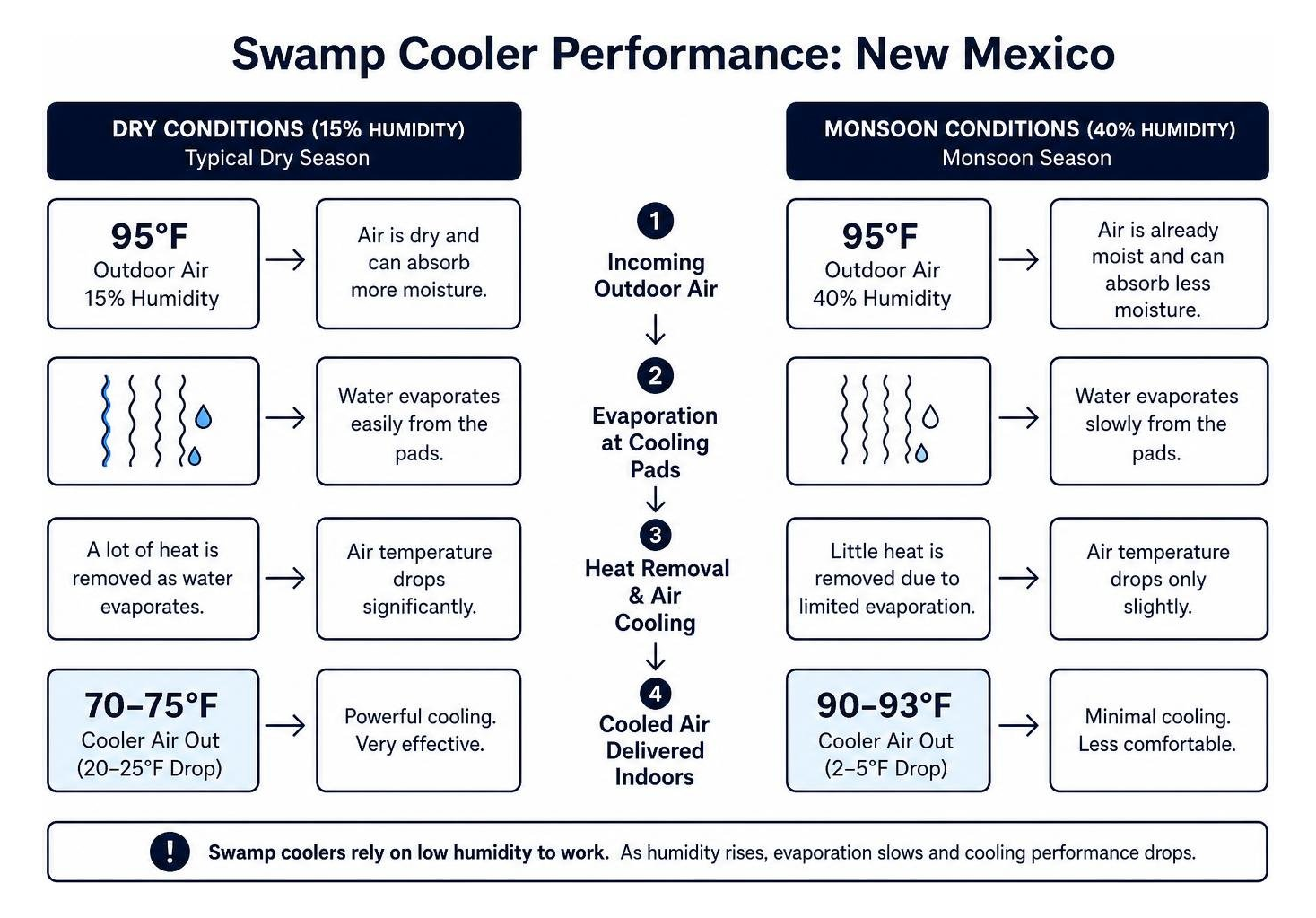
Why swamp coolers work well in dry new mexico heat but struggle in monsoon season comes down to one thing: humidity. Swamp coolers cool your home by evaporating water into hot, dry air. When the air is dry, that process works beautifully — dropping indoor temperatures by 15 to 30 degrees. But when New Mexico’s monsoon season arrives in mid-July and pushes outdoor humidity from a typical 5–15% up to 25–40% or higher, the air can’t absorb much more moisture. Evaporation slows down, and so does the cooling.
Here’s the short answer:
- Dry conditions (humidity below 30%): A swamp cooler can drop incoming air temperature by 20–25°F — very effective
- Moderate humidity (30–50%): Cooling drops to roughly 5–15°F — noticeably less comfortable
- Monsoon humidity (above 50%): Cooling falls to just 2–5°F — barely effective
- Above 70% humidity: Swamp coolers provide no meaningful cooling benefit at all
- Above 95°F: Even in dry air, extreme heat can overwhelm the evaporation process on the pads
Every summer in Albuquerque, HVAC companies field a wave of calls from homeowners convinced their swamp cooler broke — when in reality, the monsoon simply arrived. One Albuquerque resident described the experience as feeling like she was “working in a jungle,” with her home stuck at 85 degrees despite the cooler running all day. Her swamp cooler wasn’t broken. It was just being asked to do something it physically cannot do in humid air.
If you’re heading into monsoon season relying solely on an evaporative cooler, understanding exactly why it struggles — and what your options are — can save you a very uncomfortable few weeks.
The Science of Why Swamp Coolers Work Well in Dry New Mexico Heat but Struggle in Monsoon Season
To understand why evaporative coolers perform so differently depending on the month, we have to look at the physics of evaporation. Unlike refrigerated air conditioning, which uses a closed-loop chemical refrigerant cycle to actively extract heat and squeeze moisture out of the air, swamp coolers rely entirely on the natural process of “latent heat of vaporization.”
When warm, dry air passes over water-soaked cooling pads, the water absorbs heat from the air to transition from a liquid to a gas. This phase change naturally lowers the “dry-bulb” temperature of the air while increasing its moisture content.
In the dry, early summer months of May and June, our local high-desert atmosphere is incredibly thirsty. Relative humidity levels in Albuquerque, Rio Rancho, and Corrales frequently hover between a bone-dry 5% and 15%. This creates a massive “wet-bulb depression”—the difference between the dry-bulb temperature (what you read on a standard thermometer) and the wet-bulb temperature (the lowest temperature air can reach via evaporative cooling).
Because our dry air has so much room to absorb water vapor, evaporation happens rapidly and efficiently. According to the U.S. Department of Energy, a swamp cooler operating under these ideal, low-humidity conditions can lower indoor temperatures by up to 40 degrees Fahrenheit. Our high altitude of over 5,000 feet further accelerates evaporation rates, making swamp coolers incredibly efficient during the first half of the cooling season.
To see if your system is currently running as it should, you can read our guide on Is Your New Mexico Swamp Cooler Actually Working? to diagnose its performance.
What Happens When the July Monsoons Arrive
Sometime around the second week of July, New Mexico’s wind patterns shift, drawing in a steady stream of subtropical moisture from the Gulf of Mexico and the Gulf of California. This marks the official arrival of the North American Monsoon, which typically runs through early September.
Suddenly, the bone-dry air we enjoyed in June is replaced by heavy, moisture-laden air currents. Relative humidity levels in the Middle Rio Grande Valley spike from a comfortable 10% to 25%, 40%, or even higher on storm days.
When the outdoor humidity rises, the air’s capacity to absorb additional water vapor plummets. Think of the air like a sponge: when it is dry, it can quickly soak up water from the swamp cooler’s pads, cooling your home in the process. When the “sponge” is already saturated with monsoon rain, it can barely absorb any more water.
As a result, the evaporation process slows to a crawl. The air passing through the wet pads doesn’t lose much heat, but it still picks up whatever residual moisture it can. Instead of pumping crisp, cool air into your living room, your swamp cooler begins acting more like a humidifier, blowing warm, sticky, muggy air into your home. This spike in moisture doesn’t just ruin your comfort; it can also lead to indoor mold growth if not managed properly. You can learn more about protecting your property in our guide, New Mexico Monsoons: Don’t Let the Rain Turn Your Home Into a Petri Dish.

The Physical Limitations of Evaporative Cooling in High Humidity
While swamp coolers are a brilliant, cost-effective invention for arid regions, they are bound by hard physical laws. They simply cannot cool a home when the outdoor air is already saturated.
To help visualize how performance drops as humidity climbs, consider these real-world thresholds:
- Below 30% Relative Humidity: This is the sweet spot. Evaporative cooling is highly effective, easily dropping the air temperature by 15 to 30 degrees.
- 30% to 50% Relative Humidity: Performance begins to degrade. At 30% humidity, a swamp cooler might drop incoming air by 20–25°F. By the time humidity reaches 50%, that cooling capacity drops to a modest 10 degrees or less.
- 50% to 70% Relative Humidity: The system struggles immensely. According to data from the Climate Assessment for the Southwest (CLIMAS), once humidity exceeds 50%, swamp cooler performance drops to a meager 2 to 5 degrees of actual cooling.
- Above 70% Relative Humidity: The physical limit is reached. The air is too saturated to allow for evaporation, meaning the cooler provides absolutely no cooling benefit and only increases indoor dampness.
For a deeper look at these physical thresholds and how they affect your home, check out The Ultimate Guide to Swamp Cooler Limitations in High Humidity.
Why Extreme Heat and Humidity Create a Double Whammy
The trouble during New Mexico summers is that we don’t just deal with humidity; we also face increasingly extreme heat. Over the last several years, our region has experienced unprecedented temperature spikes. In 2023, Albuquerque hit triple-digit temperatures 17 times, and we saw 100-degree days arrive earlier than ever in 2024. As we move through the summer of 2026, these extreme heat trends continue to challenge traditional cooling methods.
When outdoor temperatures climb above 95°F, swamp coolers hit another physical wall. At these extreme temperatures, water evaporates off the cooling pads at an incredibly rapid pace. The system often cannot supply water quickly enough to keep the pads fully saturated, causing dry spots to form.
When you combine 95°F+ heat with monsoon-level humidity, you get a double whammy. The high ambient heat demands maximum cooling power, but the humid air prevents the system from delivering it. The result is a hot, sticky indoor environment that makes daily life incredibly uncomfortable.
Comparing Swamp Coolers vs. Refrigerated Air Conditioning in New Mexico
Because our summers are divided into a bone-dry phase and a humid monsoon phase, choosing the right cooling system requires weighing several trade-offs. Swamp coolers and refrigerated air conditioning systems operate on completely different principles, resulting in distinct differences in energy use, comfort, and maintenance.
| Feature | Swamp Cooler (Evaporative) | Refrigerated Air Conditioning (AC) |
|---|---|---|
| Cooling Method | Open system; evaporates water to cool outdoor air | Closed system; recirculates and dehumidifies indoor air |
| Ideal Climate | Hot and dry (humidity below 30%) | Works in all climates, including high humidity |
| Energy Consumption | Low (uses up to 75% less electricity than AC) | Moderate to High (uses a compressor to cool air) |
| Water Usage | High (uses 3 to 15+ gallons of water per day) | None |
| Ventilation Requirement | Requires open windows to exhaust air | Requires closed windows to maintain a sealed loop |
| Air Quality | Brings in fresh air but can pull in dust and pollen | Filters and recirculates air, keeping allergens out |
| Lifespan in NM | 8 to 10 years (shortened by hard water scaling) | 12 to 17 years with regular maintenance |
One of the greatest advantages of a swamp cooler is its energy efficiency. Evaporative coolers typically use only 15 to 35 watts of electricity per 1,000 cubic feet of air moved because they only need to run a blower fan and a small water pump. This means they use up to 75% less electricity than a conventional air conditioner, which relies on an energy-hungry compressor.
However, this efficiency comes at a cost. Because swamp coolers are open systems, they require you to keep several windows cracked open to allow warm, moist air to escape. If you close your windows, the indoor air will quickly become saturated, and the cooling will stop. Unfortunately, keeping windows open means you are constantly introducing outdoor allergens, dust, and wildfire smoke into your living spaces.
Furthermore, New Mexico’s environmental conditions present unique maintenance challenges. Approximately 95% of homes in our area have hard water, which contains high levels of dissolved calcium and magnesium. As water evaporates inside a swamp cooler, these minerals are left behind, forming a hard white crust on the cooling pads and pan. This mineral scaling reduces airflow and cooling efficiency, requiring homeowners to clean the pan and replace the pads at least once or twice a season. Over time, this severe mineral buildup can corrode the metal casing, reducing the typical lifespan of a local swamp cooler to just 8 to 10 years.
Homeowner Solutions for Why Swamp Coolers Work Well in Dry New Mexico Heat but Struggle in Monsoon Season
If you love the low energy bills of your swamp cooler during the dry spring but dread the sticky, sleepless nights of monsoon season, you don’t have to suffer through the humidity. There are several practical strategies you can use to stay cool.
1. The Hybrid Cooling Approach
Many homeowners in Albuquerque, Rio Rancho, and Corrales use a hybrid setup to get the best of both worlds. They run their swamp cooler from April through June to keep electricity bills low. When the monsoons arrive in July, they switch off the swamp cooler, close their windows, and turn on a supplemental cooling system—such as a ductless mini-split or a window unit—to handle the humid weeks.
2. Ductless Mini-Split Systems
Ductless mini-splits are an exceptional solution for New Mexico’s unique architecture. Many of our historic or older adobe homes in places like Corrales and Placitas have thick walls and lack the built-in ductwork required for traditional central air conditioning. Mini-splits don’t require ducts; instead, they use small, wall-mounted indoor units connected to an outdoor compressor. They provide highly efficient, room-by-room temperature control and active dehumidification, making them perfect for surviving the monsoon season.
3. Converting to Refrigerated Air
If you are tired of the constant maintenance, open windows, and seasonal humidity struggles, converting your home to refrigerated air is a permanent solution. Modern air conditioners are incredibly efficient compared to older models, offering high SEER2 ratings that help keep utility bills manageable. A conversion provides consistent, thermostat-controlled comfort all summer long, regardless of how humid it gets outside.
To explore how a conversion works and whether it is right for your home, read our guide on A Practical Guide to Swamp Cooler to AC Conversion.
While some homeowners try to get by using temporary window AC units alongside a struggling swamp cooler, this is highly inefficient. Window units often struggle to cool an entire home, and running them while your swamp cooler is adding moisture to the air forces both systems to work twice as hard, leading to premature equipment failure. A professional HVAC evaluation can help you determine the most efficient, comfortable setup for your specific home layout.
Frequently Asked Questions About Monsoon Cooling Limitations
At what humidity level do swamp coolers stop working effectively?
Swamp coolers begin to lose their cooling efficiency when outdoor relative humidity climbs above 30%. Once humidity levels reach 50%, the evaporation process slows down so much that the system can only lower the air temperature by 2 to 5 degrees, which is rarely enough to keep a home comfortable. When relative humidity exceeds 70%, evaporative cooling stops working entirely because the air is completely saturated with moisture.
Can I run a swamp cooler and a mini-split AC together in New Mexico?
Yes, using a hybrid approach is a popular and highly effective strategy in our region. Homeowners often run their swamp cooler during the dry spring and early summer to maximize energy savings. Once the monsoon season hits in mid-July, they shut down the swamp cooler, close their windows, and rely on their ductless mini-split system to cool and dehumidify the home. This prevents the indoor air from becoming sticky and muggy.
How does New Mexico’s hard water affect swamp cooler lifespan?
Because 95% of New Mexico homes have hard water, mineral scaling is a major issue for local swamp coolers. As water evaporates, calcium and magnesium deposits build up on the cooling pads and inside the water pan. If this scale isn’t cleaned regularly, it restricts airflow, reduces cooling efficiency, and can corrode the metal components of the unit. This heavy mineral buildup often reduces the average lifespan of a swamp cooler in our area to just 8 to 10 years, compared to the 12 to 15 years seen in areas with softer water.
Conclusion
Understanding why swamp coolers work well in dry new mexico heat but struggle in monsoon season is the key to maintaining a comfortable home all summer long. While evaporative cooling is an incredibly efficient, budget-friendly option for our dry spring months, the physical limits of the system make it difficult to stay comfortable once the July humidity arrives.
Whether you want to optimize your existing swamp cooler, install a hybrid mini-split system for monsoon season, or convert your home to refrigerated air, we are here to help. At Wolff Heating, Cooling, and Plumbing, we bring over 25 years of local experience to every job. We proudly serve homeowners in Albuquerque, Rio Rancho, Placitas, Corrales, Cedar Crest, Tijeras, and Bernalillo with licensed, bonded, and insured HVAC services, honest estimates, and superior workmanship.
If you’re ready to explore your options and find the perfect cooling solution for your home, read our detailed comparison on Choosing Between Refrigerated Air and Swamp Coolers in the Desert or reach out to our friendly team today to schedule a professional home consultation!