
 Menu
Menu
Why Humidity Is the Most Important Factor in Evaporative Cooling
How humidity levels affect evaporative cooling is one of the most practical questions any homeowner in Albuquerque or the surrounding New Mexico area can ask before relying on a swamp cooler to beat the summer heat. The short answer: the drier the air, the harder your evaporative cooler works — and the cooler your space gets.
Here is a quick breakdown of what to expect at different humidity levels:
| Relative Humidity | Expected Temperature Drop | Performance Level |
|---|---|---|
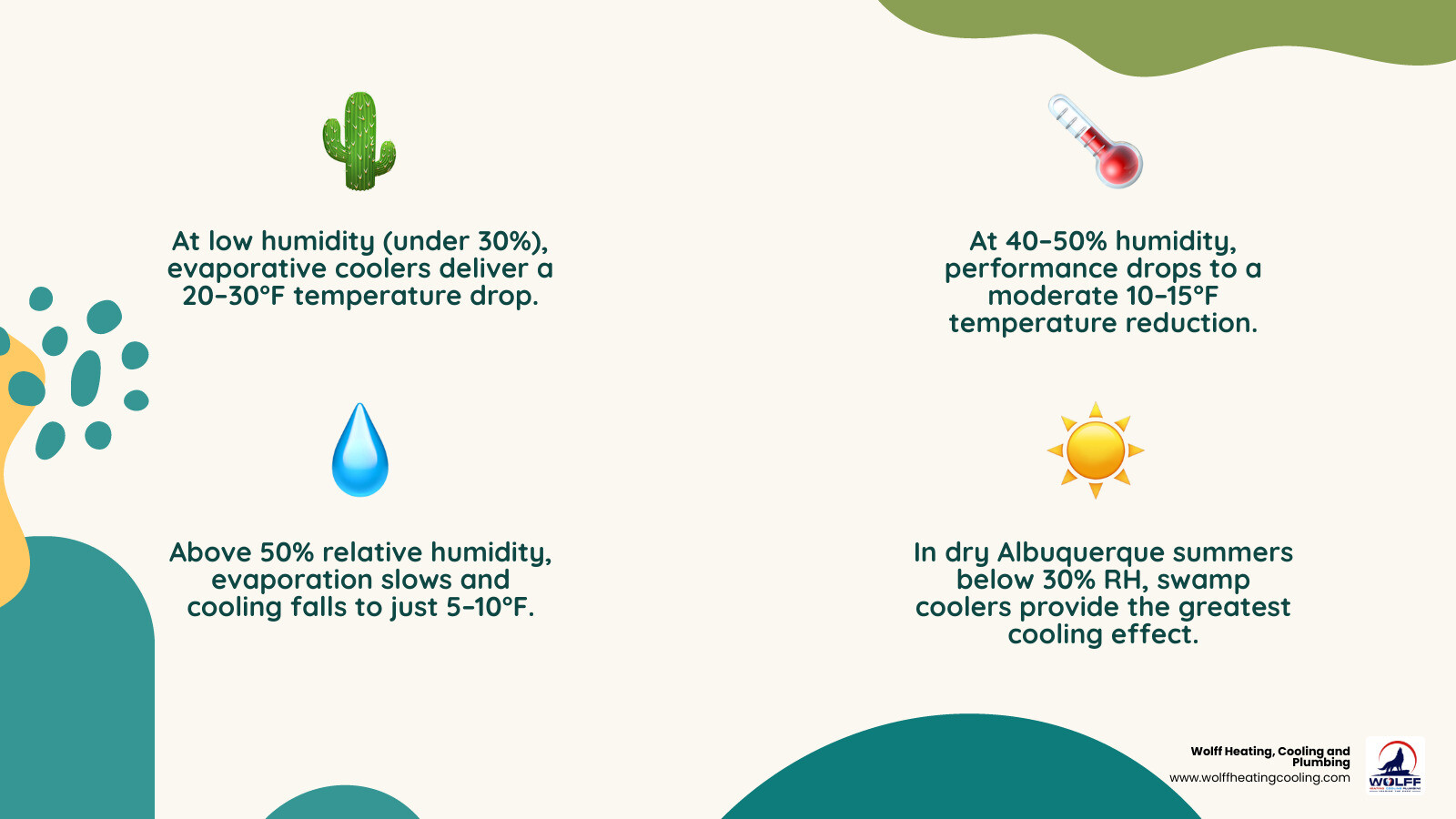
| Below 30% | 20–30°F | Excellent |
| 30%–40% | 15–20°F | Very Good |
| 40%–50% | 10–15°F | Moderate |
| 50%–60% | 5–10°F | Limited |
| Above 70% | 5°F or less | Ineffective |
Evaporative coolers work by pulling warm outside air through water-soaked pads. As water evaporates, it absorbs heat from the air — dropping the temperature before that air enters your home. But this process depends entirely on how much moisture the air can still absorb. When humidity is already high, the air is close to its saturation point, and very little additional evaporation can occur. The result? Minimal cooling and air that can feel sticky or muggy indoors.
In a dry climate like Albuquerque’s, where summer afternoons often sit well below 30% relative humidity, swamp coolers can deliver dramatic temperature drops — sometimes as much as 30°F. That same cooler in a humid coastal city might barely move the needle.
This guide walks through everything you need to know: the science behind the numbers, what performance to expect at different humidity levels, how system type and maintenance factor in, and when it makes sense to rethink your cooling strategy altogether.
How Humidity Levels Affect Evaporative Cooling
At its core, evaporative cooling is simple: water changes from liquid to vapor, and that phase change pulls heat out of the air. That heat transfer is called latent heat. The trick is that evaporation happens fastest when the air is dry and slows down when the air is already carrying a lot of moisture.
That is the heart of how humidity levels affect evaporative cooling.
If outdoor air is dry, it has more room to absorb water vapor as it passes through the cooler pads. More evaporation means more heat removed and a bigger temperature drop. If outdoor air is humid, the air is already closer to saturation, so less water evaporates and less cooling happens.
Why low humidity creates bigger temperature drops
Low relative humidity gives an evaporative cooler its sweet spot. In dry climates, air can soak up a lot of moisture, so the cooler pads can do their job efficiently.
That is why swamp coolers are such a natural fit for Albuquerque and nearby communities like Rio Rancho, Corrales, Placitas, Bernalillo, Cedar Crest, and Tijeras. Our region regularly sees hot afternoons with low humidity, which creates the ideal conditions for strong evaporation.
In those drier conditions, homeowners may see temperature drops in the 20 to 30 degree range. Research consistently shows that at around 10% relative humidity, some evaporative coolers can lower air temperature by 20 to 30 degrees. In a 90°F example, supply air may drop to roughly 63°F, a 27°F reduction.
That impressive drop comes from a larger wet-bulb depression, which we will explain in the next section. For now, think of it this way: dry air is thirsty air.
Why high humidity reduces evaporative cooling performance
As relative humidity rises, cooling power falls.
At around 50% relative humidity, many evaporative coolers only deliver about a 10°F temperature drop. At 60% humidity, a more realistic expectation is often just 5 to 7°F. By 70% relative humidity, performance can drop to about 9°F or less, and comfort can start to feel questionable because the extra moisture makes the air feel clammy.
Why? Because humid air is already carrying a lot of water vapor. There is not much room left for more evaporation. When that happens, the system starts acting less like a cooler and more like a damp fan. A fan has its place, but most people do not get excited about paying for “slightly wetter breeze.”
Wet Bulb vs. Dry Bulb: The Numbers That Predict Cooling
To really understand how humidity levels affect evaporative cooling, we need two measurements: dry-bulb temperature and wet-bulb temperature.
If you want a basic refresher on the cooling process itself, our article A Simple Guide to How Your Swamp Cooler Actually Works is a helpful companion read.
What dry bulb temperature tells you
Dry-bulb temperature is the regular air temperature you see on a thermostat or weather app. It tells you how hot the air is before any evaporative cooling happens.
So if it is 95°F outside in Albuquerque, that 95°F is the dry-bulb temperature. It is the starting point.
What wet bulb temperature tells you
Wet-bulb temperature tells you how cool the air could get through evaporation. It reflects both heat and moisture content.
A lower wet-bulb temperature means the air still has strong evaporative potential. A wet-bulb temperature closer to the dry-bulb temperature means humidity is high and there is less room for cooling.
This matters because an evaporative cooler can only cool air toward the wet-bulb temperature. It usually does not reach it perfectly, but it gets somewhere in that neighborhood depending on system design, pad condition, and airflow.
Why the wet-bulb depression matters for real-world results
Wet-bulb depression is the difference between dry-bulb and wet-bulb temperature. The bigger the gap, the more cooling potential you have.
Here is a practical way to look at it:
| Outdoor Condition | Approximate Cooling Result |
|---|---|
| 90°F at 10% RH | About 63°F supply air, 27°F drop |
| 90°F at 50% RH | Around 10°F drop is common |
| 90°F at 70% RH | About 81°F supply air, 9°F drop |
That spread explains why the exact same cooler can feel fantastic one day and underwhelming the next. The machine did not suddenly lose its mind. The weather changed.
Best Humidity Ranges for Evaporative Coolers
Not every humidity range gives the same result. There are clear performance zones.
If you are weighing your options, our guide Is a Swamp Cooler Better Than AC for Your Home? can help you compare cooling approaches for New Mexico homes.
Best performance: under 40% relative humidity
This is the ideal range.
Below 30% relative humidity, evaporative coolers often deliver their best results, with temperature drops of 20 to 30°F possible in the right conditions. Between 30% and 40%, performance is still very good, and many homes remain comfortable with proper airflow and window relief.
This is why evaporative cooling shines in desert climates. You get cooling plus fresh air exchange, which many homeowners enjoy.
Moderate performance: 40% to 50% relative humidity
This is still usable, but expectations need to be adjusted.
In the 40% to 50% range, cooling is more modest. A 10 to 15°F drop may be possible, but comfort depends more heavily on air movement, shade, home layout, and ventilation. On these days, your swamp cooler may provide relief rather than that “ahhh” moment.
This range can still work during shoulder periods or in homes that are well ventilated and not overloaded by internal heat.
Marginal to ineffective performance: above 50% to 70%+
Once outdoor humidity climbs above 50%, evaporative coolers lose efficiency quickly. At 60%, many systems offer only 5 to 7°F of cooling. Above 70%, most direct evaporative systems become largely ineffective.
That does not always mean zero benefit, but it often means too little temperature reduction and too much moisture added indoors. If rooms feel muggy, windows are sweating, or the house feels cooler but somehow also swampier, humidity is probably winning.
Expected Temperature Drop at 20%, 50%, and 70% Humidity
Let us put real numbers on it. Using a 90°F outdoor temperature as an example gives a realistic snapshot of performance.
For a broader comparison of cooling methods, see Refrigeration vs Evaporation: Which System Wins?.
What to expect around 20% humidity
At 20% relative humidity, a swamp cooler is in friendly territory. Temperature drops of roughly 20 to 30°F are possible, depending on pad efficiency and airflow.
That means 90°F outdoor air may be cooled into the mid-60s to low 70s before entering the home. This is one reason hot New Mexico afternoons can still be manageable with evaporative cooling even when the thermometer looks rude.
What to expect around 50% humidity
At 50% relative humidity, performance becomes moderate. Many homeowners can expect about a 10°F drop.
So 90°F air may come in around 80°F. That can still improve comfort, especially with moving air, but it is no longer the dramatic cooling many people associate with swamp coolers in dry climates.
What to expect around 70% humidity
At 70% relative humidity, cooling becomes limited. In the 90°F example, delivered air may only fall to around 81°F, about a 9°F drop. In real homes, that often feels underwhelming because the indoor air also gets more humid.
A simple summary:
- Around 20% RH: often 20 to 30°F of cooling
- Around 50% RH: often about 10°F of cooling
- Around 60% RH: often about 5 to 7°F of cooling
- Around 70% RH: often about 9°F or less, with comfort issues
Indoor Humidity, System Types, and Ways to Improve Performance
Humidity does not just affect outdoor cooling potential. It also affects indoor comfort after the cooled air enters your home.
For related reading, visit our Indoor Air Quality page and our article on the Importance of Ventilation Systems. If your system is not performing as expected, our The Ultimate Guide to Evaporative Cooler Troubleshooting can help.
Does evaporative cooling increase indoor humidity, and how can you manage it?
Yes. Direct evaporative cooling adds moisture to indoor air. That is part of how it works.
In Albuquerque and surrounding dry areas, that added humidity is not always a bad thing. A little extra moisture can make very dry air feel more comfortable. In fact, indoor humidity in the 40% to 60% range is often considered a healthy comfort zone.
The key is management. To keep humidity from building up too much:
- Open windows to provide relief air
- Use the right amount of opening, not just one tiny cracked window
- Promote cross-ventilation so moist indoor air can escape
- Use exhaust fans where appropriate
- Track indoor humidity with a hygrometer
A swamp cooler should move air through the home, not trap it. If the house is sealed too tightly, humidity rises and comfort drops.
Direct vs. indirect evaporative cooling in humid conditions
Direct evaporative systems cool air by passing it through wet pads, and that cooled air gains moisture before entering the home.
Indirect evaporative systems cool air through a heat exchanger, so the supply air is cooled without directly adding as much moisture. Two-stage systems combine indirect and direct cooling, lowering the air temperature first and then finishing with evaporative cooling. Research shows indirect/direct systems can reduce humidity increase significantly compared with direct-only systems.
In humid conditions, that matters. Two-stage systems are usually better at controlling comfort because they deliver cooler air with less added moisture than a basic direct system.
Maintenance practices that matter when humidity is a factor
Maintenance becomes even more important when humidity is part of the equation.
To keep an evaporative cooler working efficiently:
- Clean pads regularly during cooling season
- Replace pads at least annually, or sooner if they are clogged with minerals
- Clean the reservoir and water distribution system
- Prevent standing water that can encourage odors, mold, or algae
- Let the pads dry out periodically rather than running wet nonstop for endless stretches
Mineral buildup reduces pad efficiency. Dirty pads also hold moisture poorly and can lead to musty smells. In other words, neglected maintenance can make a humidity problem feel even worse.
Strategies for high-humidity days
Even in New Mexico, we can get stretches of monsoon moisture or humid weather. On those days, these steps can help:
- Run the system when outdoor humidity is lower
- Use cross-ventilation aggressively
- Open windows in the right rooms to balance airflow
- Use variable fan speeds if available
- Monitor indoor humidity rather than guessing
- Limit cooling to the most-used areas
- Consider supplemental air conditioning when moisture is high
The goal is to keep air moving and prevent indoor humidity from lingering.
When to Supplement or Replace Evaporative Cooling
Evaporative cooling is excellent in the right climate and conditions, but no system is perfect for every day or every home.
If you are also thinking about indoor moisture control across the seasons, these articles may help: How Humidifiers Turn Dry Winter Air into Pure Comfort, The Hidden Benefits of Humidifiers for Dry Climate Homes, and Why Your Desert Home Might Be Thirstier Than You Think.
Signs your swamp cooler is no longer the best fit
You may want to supplement or rethink your cooling setup if:
- Outdoor humidity is frequently above 50%
- Indoor air feels clammy instead of refreshing
- Temperature drop is small even with proper maintenance
- Rooms develop repeated moisture or musty issues
- Household members are sensitive to damp indoor conditions
- Your home layout makes ventilation difficult
In these situations, the issue may not be that the cooler is broken. It may simply be the wrong tool for current conditions.
When air conditioning makes more sense
Traditional air conditioning makes more sense when you need:
- Reliable cooling during humid weather
- Precise temperature control
- A more sealed home environment
- Consistent all-day performance regardless of outdoor moisture
- Better humidity removal indoors
For some homeowners in Albuquerque and nearby areas, the best approach is seasonal or hybrid use: evaporative cooling during dry stretches, and refrigerated air when humidity rises or indoor comfort demands tighter control.
Frequently Asked Questions About Humidity & Evaporative Cooling
Can you use a swamp cooler at 60% humidity?
Yes, but expectations should be modest. At 60% humidity, many systems only provide about a 5 to 7°F drop. That may still help with comfort if ventilation is strong, but it is no longer peak swamp-cooler weather.
Why do evaporative coolers work better in dry climates than humid climates?
Dry air can absorb more water vapor. That allows more evaporation, which removes more heat from the air. Humid air is already closer to saturation, so evaporation slows down and the cooling effect shrinks.
Is indoor humidity from a swamp cooler always a bad thing?
No. In dry climates, some added humidity can be beneficial and more comfortable. Problems start when indoor moisture becomes excessive. The goal is balance, not turning your living room into a greenhouse.
Conclusion
Humidity is the deciding factor in evaporative cooling performance. When relative humidity is low, swamp coolers can deliver impressive 20 to 30°F temperature drops and very comfortable fresh-air cooling. As humidity rises into the 40% to 50% range, performance becomes moderate. Above 50%, results become limited, and above 70%, most systems struggle to cool effectively.
That is why understanding how humidity levels affect evaporative cooling matters so much for homeowners in Albuquerque and surrounding New Mexico communities. It helps you set realistic expectations, operate your system correctly, maintain good ventilation, and know when another cooling strategy may be the better fit.
If you would like help evaluating your system or deciding whether evaporative cooling is still the right match for your home, learn more about swamp cooler services. At Wolff Heating, Cooling, and Plumbing, we bring over 25 years of experience serving Albuquerque, Rio Rancho, Placitas, Corrales, Cedar Crest, Tijeras, and Bernalillo with honest service and practical comfort solutions.