
 Menu
Menu
What to Know Before Your Tankless Water Heater Installation
If you’re researching tankless water heater installation what to expect, here’s a quick summary before we dive in:
Quick Answer: What to Expect During Tankless Water Heater Installation
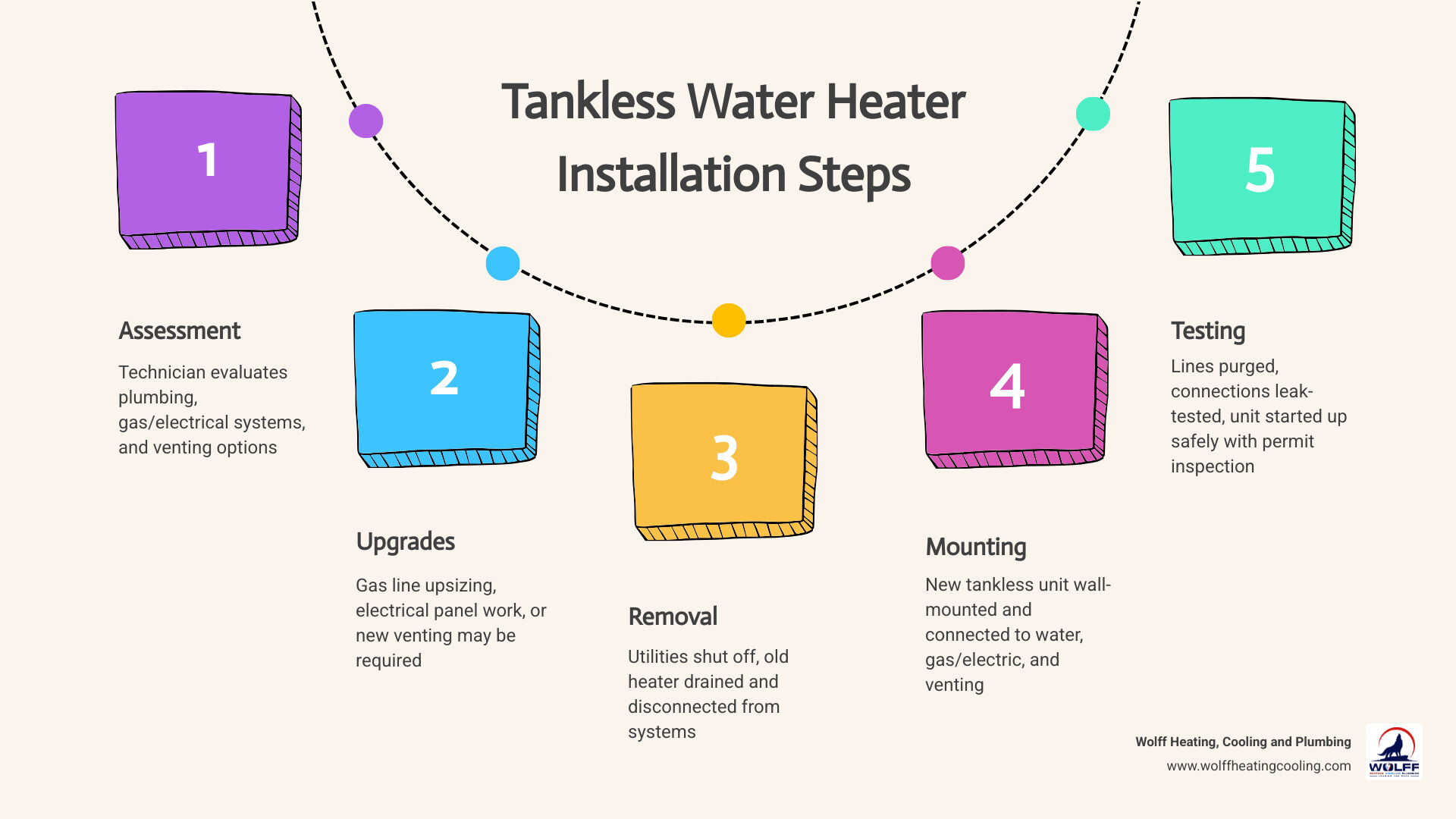
- Pre-installation assessment – A technician evaluates your existing plumbing, gas or electrical systems, and venting options
- Potential upgrades – Gas line upsizing, electrical panel work, or new venting may be required
- Old unit removal – Utilities are shut off, the old heater is drained and disconnected
- New unit mounting and connections – The tankless unit is wall-mounted and connected to water, gas or electrical, and venting systems
- Testing and commissioning – Lines are purged, connections are leak-tested, and the unit is started up safely
- Permits and inspection – Most jurisdictions, including Albuquerque, require permits and a final inspection
- Total time – Expect 4 to 10 hours for a full tankless installation, compared to 2 to 4 hours for a standard tank replacement
Upgrading to a tankless water heater is one of the most impactful improvements you can make to your Albuquerque home. These on-demand systems heat water only when you need it, which means no more standby heat loss and no more cold showers when the tank runs dry. According to the U.S. Department of Energy, tankless water heaters can be 24% to 34% more energy efficient than traditional storage tank models for households using 41 gallons or less of hot water daily.
But unlike swapping out a like-for-like tank, a tankless installation is a more involved process. It often touches your gas lines, venting system, electrical panel, and plumbing all in one job. Knowing what’s involved before the technician arrives helps the whole process go smoothly — and helps you avoid surprises along the way.
Easy tankless water heater installation what to expect glossary:
- I’m looking for companies that do affordable water heater installation in Albuquerque, NM. Can you give me a few options with good reviews?
- how does a tankless water heater work
- how long does a tankless water heater last
Tankless Water Heater Installation: What to Expect Regarding Timelines
When planning this home upgrade, one of the most common questions we hear is: “How long will my home be without hot water?”
It is helpful to understand that while a standard, like-for-like tank replacement is a relatively straightforward swap that takes about 2 to 4 hours, converting your system to a tankless setup is a more detailed engineering project. For a first-time installation or a switch from a traditional tank to a tankless unit, the process typically takes anywhere from 4 to 10 hours of active labor.
Because we are retrofitting your home’s existing infrastructure to support a completely different style of heating technology, our two-technician crews often spend a full working day making sure every connection, vent, and safety valve is placed with absolute precision. If you are comparing options for your home, you can read our guide on Comparing Types Water Heaters or look over The Definitive Guide to Tankless Water Heater Value to see how this time investment translates into long-term efficiency and performance.
To help you visualize the process, here is a quick breakdown of how installation times compare:
| Installation Type | Average Timeframe | Key Requirements |
|---|---|---|
| Traditional Tank Replacement | 2 to 4 Hours | Standard plumbing connections, basic venting check, same utility footprint. |
| Tank-to-Tankless Conversion | 6 to 10 Hours | Utility line retrofitting, new venting routes, wall-mounting, system calibration. |
| New Construction Tankless Install | 4 to 8 Hours | Setup of pre-planned lines, mounting, direct venting, and system testing. |
Factors That Influence Your Tankless Water Heater Installation What to Expect Timeline
No two homes in the Albuquerque metro area are identical, and several local variables can shift where your project falls on the timeline:
- Fuel Type: Upgrading a gas-powered system requires careful pressure testing and potential gas line modifications, which naturally takes longer than connecting an electric unit.
- Unit Location and Accessibility: If your old water heater is tucked away in a tight crawlspace, a hard-to-reach utility closet, or an attic, maneuvering materials and routing new lines will take extra time.
- Venting Paths: Gas models need direct access to the outdoors to exhaust combustion gases safely. If we have to route complex vent piping through exterior walls or up through the roof, it adds to the labor hours.
- Existing Infrastructure Quality: Older homes in historic areas of Albuquerque or Bernalillo may require updated piping or electrical upgrades to meet modern building codes. For a deeper look at local installation standards, check out our Water Heater Installation Albuquerque Guide.
Key Differences Between Gas and Electric Tankless Setups
Choosing between a gas or electric tankless system is one of the first major decisions you will make. Both systems provide endless hot water, but their installation requirements are completely different. You can read more about these differences in our overview of Tankless Water Heaters Albuquerque NM.
Gas Tankless Water Heater Installation What to Expect
Gas tankless units are highly popular in our region because they deliver impressive flow rates, even during the coldest winter mornings when incoming groundwater temperatures drop. However, they require a robust infrastructure:
- Gas Pressure and Volume: A tankless gas burner requires a significant volume of fuel to flash-heat cold water instantly. Traditional tanks heat water slowly using a smaller gas burner (often around 30,000 to 40,000 BTUs). A whole-house tankless unit can demand up to 199,000 BTUs. This means we frequently need to upsize your gas line from a standard 1/2-inch pipe to a 3/4-inch pipe to prevent pressure drops.
- Combustion Venting: Non-condensing gas units must vent extremely hot exhaust through dedicated stainless steel piping. Condensing models are more efficient and allow us to vent cooler exhaust through affordable, durable PVC pipes, but they require a drain line to carry away the acidic condensation produced during operation.
- Safety Clearances: Gas units must be mounted with precise clearances from windows, doors, and electrical meters to comply with safety codes. For a detailed breakdown of these regional requirements, refer to our Tankless Water Heater Install Albuquerque Guide.
Electric Tankless Water Heater Requirements
Electric tankless units do not require gas lines or venting, which makes their physical placement much simpler. However, they are incredibly demanding on your home’s electrical system:
- Amperage Draw: While a traditional electric tank water heater runs on a single 30-amp, 240-volt breaker, a whole-house electric tankless unit can require up to three or four dedicated 40-amp double-pole breakers.
- Panel Capacity: Most older homes in our service area have a 100-amp or 150-amp electrical panel. Installing a whole-house electric tankless heater often requires upgrading your entire home electrical service to 200 amps or more to handle the massive electrical load.
- Point-of-Use Options: If a whole-house electric upgrade is not practical, smaller electric tankless units can be installed directly under sinks or in utility closets to serve individual fixtures.
Step-by-Step Professional Installation Process
When our licensed professionals arrive at your home, we follow a highly structured sequence to ensure the job is completed safely, cleanly, and efficiently. Our goal is to minimize the time your home is without water while delivering a system built to last for decades. For rapid service options, you can read about our Same Day Hot Water Rapid Water Heater Installation in ABQ.
Here is the step-by-step process of what happens on installation day:
- Site Assessment and Preparation: We protect your floors and walls, verify the mounting location, and confirm that all necessary permits are ready.
- Utility Shut-Off: We safely turn off your home’s main water supply, gas line, and electrical breakers associated with the water heater.
- Draining and Removing the Old Tank: We connect a hose to your old tank, drain the water safely to an appropriate outdoor area or drain, disconnect the plumbing and venting, and haul the heavy old tank away for recycling.
- Mounting the New Unit: Because tankless water heaters are compact and wall-mounted, we secure heavy-duty mounting brackets directly to wall studs or backing boards.
- Installing Plumbing and Isolation Valves: We run new copper or PEX water lines to the unit. We always install a specialized isolation valve kit on both the cold water inlet and hot water outlet. These valves are critical because they allow us to isolate the unit for annual maintenance without shutting off water to the rest of your house.
- Connecting the Fuel/Power Source: We hook up the upsized gas line (including a sediment trap to protect the burner) or make the heavy-duty electrical connections to your panel.
- Routing the Venting System (for Gas Units): We install the correct venting pipes through the wall or roof, ensuring airtight seals to prevent carbon monoxide from entering your living space.
- Condensate Line Setup: For high-efficiency condensing units, we run a drain line with a condensate neutralizer to safely dispose of the mild acid produced by the heating process.
Testing, Commissioning, and Safety Inspections
Once the physical installation is complete, we do not simply turn the unit on and leave. The testing and commissioning phase is the most critical part of the day:
- Purging Air: We open your household faucets and run water through the tankless unit before turning on the power. This purges all trapped air from the lines, preventing the heating elements or heat exchangers from dry-firing and sustaining damage.
- Pressure and Leak Testing: We check every water and gas joint. For gas lines, we use specialized pressure gauges and bubble solutions to verify there are absolutely zero micro-leaks.
- Gas Pressure Checks: We measure the incoming and manifold gas pressure to ensure your unit receives the exact fuel volume required for clean combustion.
- Local Permits and Code Compliance: Whether you live in Albuquerque, Rio Rancho, or Bernalillo, local building codes require permits and post-installation inspections. This process protects your family and ensures your homeowner’s insurance remains valid. You can learn more about our commitment to local standards by visiting our page on Bernalillo Water Heater Installation Expert Services for Your Home.
How Homeowners Should Prepare for Installation Day
To help our technicians work as efficiently as possible and keep your installation on schedule, there are a few simple steps you can take before we arrive:
- Clear the Work Area: Please remove any storage boxes, tools, or household items from around your current water heater. Our team needs a clear, safe path to move the old tank out and bring the new tools and equipment in.
- Provide Clear Access Paths: Ensure that hallways, stairwells, and doorways leading to the utility closet, garage, or basement are clear of obstructions.
- Coordinate Utility Shut-Offs: Let everyone in the household know that the water, power, and gas may be temporarily turned off during the day. It is a good idea to complete laundry, dishwashing, and morning showers before our team arrives.
- Secure Your Pets: The installation process involves open doors, heavy equipment, and some noise. Keeping your furry family members in a quiet, secure room ensures they stay safe and stress-free.
- Review Your Plumbing System: If you want to understand how your water heater integrates with the rest of your home’s infrastructure, take a look at our Plumbing Albuquerque Complete Guide.
Frequently Asked Questions About Tankless Upgrades
Why is professional installation recommended over DIY?
While a DIY approach is tempting for many home projects, installing a tankless water heater is not one of them. Working with high-voltage electricity, gas lines, and venting systems carries significant safety risks. A minor mistake in a gas connection can lead to leaks or carbon monoxide exposure.
Furthermore, almost all major tankless manufacturers require professional installation by a licensed technician to keep the warranty valid. If a self-installed unit fails, you could be left covering the entire cost of repairs or replacement out of pocket.
What are the most common infrastructure challenges during installation?
When converting from a tank to a tankless system, the most common surprises involve utility lines. Many older homes require gas line upsizing because the existing pipes cannot deliver enough fuel volume to run the tankless burner at full capacity.
Similarly, electric models frequently demand an electrical panel upgrade. Finally, routing new venting through solid adobe, brick, or stucco walls common in the Albuquerque area requires specialized masonry tools and professional sealing to prevent water intrusion.
What maintenance is required after a tankless installation?
Because New Mexico groundwater contains high levels of dissolved minerals, hard water scale is the number one enemy of tankless water heaters in our area. As water is flash-heated, calcium and magnesium deposits build up inside the copper heat exchanger. Over time, this scale acts as an insulating barrier, forcing your heater to run hotter and work harder, which reduces efficiency and shortens its lifespan.
To keep your system running optimally for its full 20+ year life expectancy, we recommend:
- Annual Flushing: Circulating a food-grade descaling solution through the isolation valves to dissolve mineral buildup.
- Filter Cleaning: Checking and cleaning the inline water filter to maintain proper flow rates.
- Professional Inspections: Having our team perform an annual safety and performance check.
For complete care instructions, read our guides on Tankless Water Heater Maintenance Rio Rancho NM and Tankless Water Heater Care for Homes.
Conclusion
Upgrading to a tankless water heater is an investment in your home’s comfort, efficiency, and long-term value. While the installation process is more detailed than a standard tank swap, knowing what to expect ensures you can prepare your home and enjoy a seamless transition to endless hot water.
At Wolff Heating, Cooling, and Plumbing, we bring over 25 years of local experience to every job. Our licensed and insured technicians serve homeowners across Albuquerque, Rio Rancho, Placitas, Corrales, Cedar Crest, Tijeras, and Bernalillo with superior craftsmanship and honest estimates.
Ready to make the switch? Schedule a professional tankless water heater installation with Wolff Heating, Cooling, and Plumbing today, and let our family take care of yours.