
Will Your Tankless Water Heater Outlive Your Car?
Discover how long does a tankless water heater last: 15-20+ years vs. 8-12 for tanks. Maintenance tips to maximize lifespan!

Is Your Tankless Water Heater Built to Last Longer Than You Think?
How long does a tankless water heater last is one of the most practical questions a homeowner can ask before making the switch — and the short answer is: a lot longer than the traditional tank sitting in most basements right now.
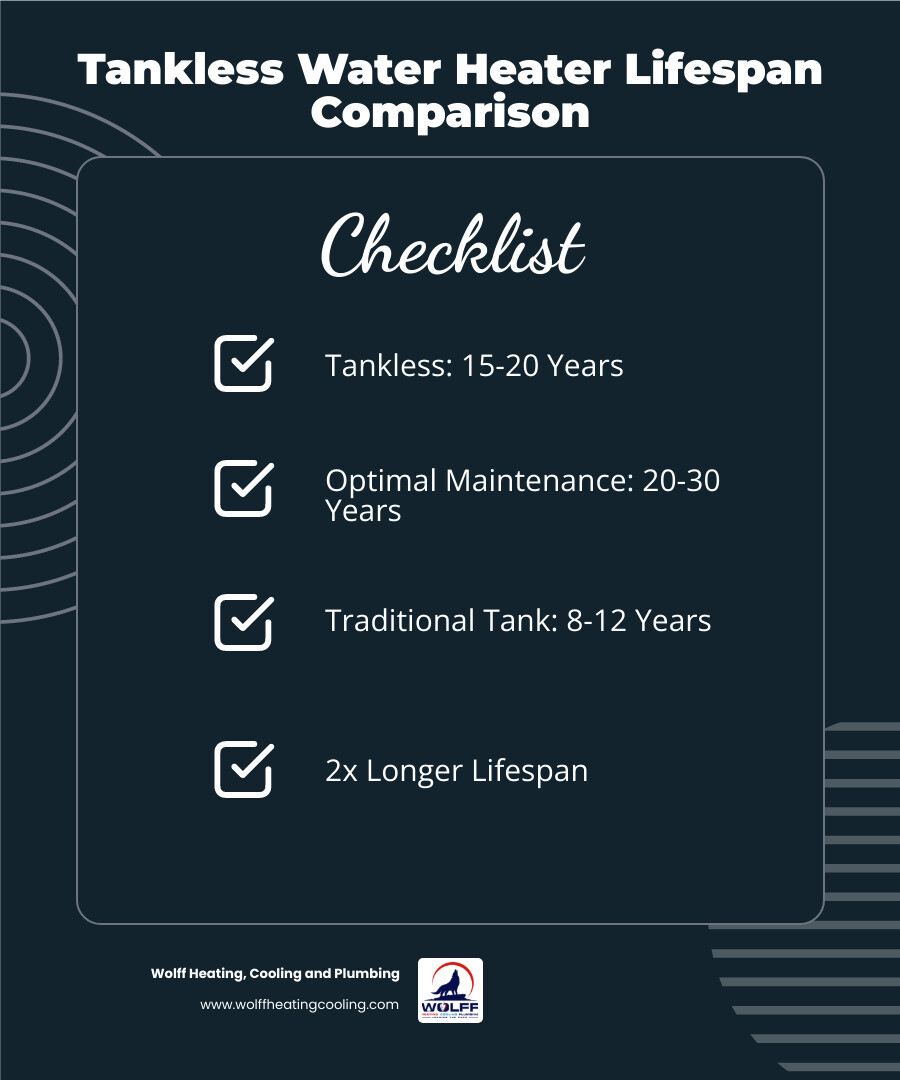
| Water Heater Type | Average Lifespan | With Optimal Maintenance |
|---|---|---|
| Tankless | 15-20 years | 20-30 years |
| Traditional Tank | 8-12 years | Up to 15 years |
Most tankless units deliver somewhere between 15 and 20 years of reliable service. With consistent maintenance and favorable water conditions, some high-quality models push well past the 20-year mark — occasionally reaching 25 to 30 years. That’s roughly twice the lifespan of a conventional tank-style water heater, which typically needs replacing every 8 to 12 years.
So yes — a well-maintained tankless water heater can absolutely outlive your car.
But “how long it can last” and “how long it will last in your home” are two different questions. Water quality, installation quality, maintenance habits, and the materials inside the unit all play a major role. This guide breaks down every factor that affects tankless water heater lifespan, so you know exactly what to expect — and what to do to get the most years out of your investment.
Basic how long does a tankless water heater last glossary:
- Affordable water heater installation companies in Albuquerque, NM
- Reliable plumbing services in Albuquerque
How Long Does a Tankless Water Heater Last?
When we talk about the longevity of these systems, the consensus in the industry is clear: tankless technology is built for the long haul. On average, a tankless water heater lasts 15 to 20 years. However, this isn’t a hard ceiling. In the right environment—specifically one where the water is soft and the owner is diligent about service—these units can easily cross the 20-year threshold, with some reaching 25 or even 30 years.
This durability makes them a favorite for homeowners in Albuquerque and Rio Rancho who are tired of the “8-year itch” associated with traditional tanks. Because tankless units only heat water on demand, their components aren’t under constant thermal stress 24/7. They don’t have a giant steel drum that spends its entire life trying not to rust through. This fundamental design difference is why they generally outlast traditional models by a decade or more.
How long does a tankless water heater last in a typical home?
In a typical household, the service life range usually settles right around the 20-year mark. Several things influence where your unit falls on that spectrum. If you have a large family in Bernalillo using hot water for back-to-back showers, laundry, and the dishwasher, the unit works harder, but it still doesn’t face the same “standby” corrosion that kills tank heaters.
The maintenance history is the biggest “X-factor” here. A unit that is ignored for ten years might start failing at year 12, whereas the same unit, flushed annually, could still be running strong in 2046.
How long does a tankless water heater last compared to a tank model?
The comparison is almost unfair. Traditional tanks suffer from a “ticking clock” known as the sacrificial anode rod. This rod is designed to corrode so the tank doesn’t, but once it’s gone, the tank itself begins to rust. Within 8 to 12 years, most tanks develop a leak that cannot be repaired, necessitating a full replacement.
Tankless units don’t store water, so they don’t have a tank to rust out. They are modular, meaning if a sensor or a heating element fails, we can often replace just that part. To learn more about how these two systems stack up in daily life, check out our guide on tankless vs tank water heaters and why your shower cares.
What Makes a Tankless Water Heater Last Longer or Fail Sooner?

While the engineering is robust, a tankless heater isn’t invincible. Several environmental and installation factors can either accelerate its retirement or keep it running like a champ. In our 25+ years of experience in New Mexico, we’ve seen how our local conditions specifically impact these units.
Why hard water and mineral buildup shorten lifespan
Hard water is the “silent killer” of tankless systems. In areas like Albuquerque and Corrales, mineral content is high. When water is heated, calcium and magnesium precipitate out and latch onto the heat exchanger. Think of this scale like “cholesterol” for your water heater.
As the layer of scale gets thicker, the heat exchanger has to get much hotter to transfer heat to the water. This leads to overheating, metal fatigue, and eventually, a cracked heat exchanger. Scale also restricts water flow, leading to that frustrating “cold water sandwich” effect. You can read more about tankless water heater scale issues to see how it affects your system’s health.
Why proper sizing and installation matter
If a unit is undersized for a home, it will constantly run at its maximum capacity to meet the temperature rise requested. This overworking leads to premature wear and tear. Furthermore, improper venting can lead to acidic condensate backing up into the unit, which eats away at internal components.
A professional installation ensures the gas line is the correct diameter and the electrical load is balanced. For a deep dive into getting the setup right, see our tankless water heater install Albuquerque guide.
Does gas vs electric or indoor vs outdoor affect durability?
Both fuel types are durable, though gas-fired units generally have a slightly longer potential lifespan (20+ years) compared to electric models (15-20 years), primarily because electric heating elements can be more sensitive to water quality issues.
Location also matters. In New Mexico, outdoor installations are common to save space, but they must be properly shielded. While these units have built-in freeze protection, extreme cold snaps can pose a risk if the unit loses power. Indoor units are generally protected from the elements, which can add a few years to the exterior casing’s “freshness,” but the internal life remains largely dependent on water quality.
Maintenance Habits That Add Years to Tankless Life
If you want to know how long does a tankless water heater last when it’s pampered, the answer is “decades.” Maintenance isn’t just a suggestion; it’s the bridge between a 10-year lifespan and a 25-year lifespan.
How annual flushing and descaling protect the heat exchanger
Flushing the system involves circulating a food-grade descaling solution (usually a concentrated vinegar or citric acid) through the heat exchanger for about an hour. This dissolves the “cholesterol” (mineral scale) and restores the metal’s ability to transfer heat efficiently. Not only does this prevent the unit from burning itself out, but it also keeps your energy bills low. Many manufacturers actually require proof of annual flushing to honor their heat exchanger warranties. Learn more about how to extend tankless water heater’s life through these simple steps.
How often should maintenance be done in hard water areas?
In Albuquerque, Rio Rancho, and Bernalillo, “standard” maintenance might not be enough. If you don’t have a water softener, we often recommend a flush every 6 to 12 months. If you have a high-quality whole-home water softener, you might be able to stretch that to every two years.
Ignoring this in our region is a recipe for a 7-year failure. For local homeowners, we’ve put together a specific tankless maintenance Albuquerque NM guide to help you stay on track.
Technologies that can extend operational life
Modern technology is helping us fight back against scale. Some manufacturers now offer scale prevention technology, like the A.O. Smith X3® system, which can extend the unit’s life significantly by preventing scale from forming in the first place. Other options include:
- Water Softeners: The gold standard for protecting all your plumbing.
- Scale Inhibitors: Inline cartridges that add a sequestering agent to the water.
- Pressure Reducing Valves (PRV): Keeping your home’s water pressure within a safe range (usually 50-60 psi) prevents stress on the internal seals of the heater.
Which Parts Matter Most to Lifespan?
The “heart” of a tankless water heater is the heat exchanger. This is where the magic happens—and where the most common failures occur.
Copper vs stainless steel heat exchangers
Most entry-level and mid-range tankless heaters use copper heat exchangers. Copper is a fantastic heat conductor, but it is susceptible to corrosion from “aggressive” water (low pH) and scale buildup. These typically last 12 to 15 years.
Stainless steel heat exchangers are the premium choice. Stainless steel is much more resistant to corrosion and the acidic condensate produced by high-efficiency (condensing) units. While they are slightly less conductive than copper, they are much tougher. A stainless steel unit is the one most likely to reach that 20 to 25-year “gold standard” lifespan.
Which homes benefit most from stainless steel?
If you live in an area with particularly hard water or if you plan on being in your home for the next 20 years, investing in a stainless steel model is a smart move. It offers a higher “tolerance” for local water conditions and generally comes with a longer manufacturer warranty, often up to 15 years on the heat exchanger itself.
Warning Signs Your Tankless Water Heater Is Nearing the End
Even the best systems eventually wear out. Knowing the signs of a failing unit can save you from a cold shower or, worse, a flooded mechanical room.
- Inconsistent Temperatures: If you’re experiencing the “cold water sandwich” or the water never seems to get as hot as it used to, the heat exchanger might be failing or heavily scaled.
- Reduced Water Pressure: Mineral buildup can physically clog the narrow passages inside the heater.
- Frequent Error Codes: If your unit is constantly shutting down with ignition or venting codes, internal sensors or the computer board may be failing.
- Unusual Noises: Banging, rumbling, or screeching sounds often indicate that the unit is overheating due to scale.
- Visible Leaks: Any moisture around the unit is a major red flag, potentially indicating a cracked heat exchanger.
Performance changes that should not be ignored
If your heater starts taking longer to “fire up” or if it struggles to provide enough hot water for two showers at once (when it used to handle three), it’s telling you something. These performance dips are often the first tankless water heater service signs that the end is near.
When repair makes sense and when replacement is smarter
Because tankless units are modular, many repairs are worth doing. Replacing a fan motor or a sensor is a no-brainer. However, if the heat exchanger cracks and the unit is over 15 years old, a replacement is almost always the more cost-effective choice.
The “50% Rule” is a good guide: if the repair costs more than half the price of a new unit and the system is in the latter half of its expected life, it’s time to upgrade. For help diagnosing your specific issue, check our guide on troubleshooting tankless water heaters.
Frequently Asked Questions About How Long Does a Tankless Water Heater Last
Can a well-maintained tankless water heater last 25 to 30 years?
Yes, it is absolutely possible. We have seen units in homes with meticulous maintenance and water filtration systems hit the 25-year mark and still look brand new inside. It requires a “perfect storm” of high-quality equipment (like a stainless steel heat exchanger), soft water, and annual professional service.
Will a water softener really help a tankless water heater last longer?
In Albuquerque and surrounding areas, a water softener is the single best investment you can make for your tankless heater. By removing the minerals before they ever reach the unit, you virtually eliminate the risk of scale-related failure. This can easily add 5 to 10 years to the life of the machine.
What should homeowners do first if their unit is acting old before its time?
Before you assume you need a new heater, schedule a professional flush and inspection. Often, a unit that “feels” old is simply choked with scale. A deep descale and a sensor cleaning can often restore “like-new” performance. If you’re in a pinch, you can find out who does repairs in Albuquerque to get an expert opinion.
Conclusion
So, how long does a tankless water heater last? With an average lifespan of 20 years, it is one of the most durable appliances you will ever own. By choosing the right material, ensuring a professional installation, and staying on top of annual maintenance, you can ensure your investment provides endless hot water for decades to come.
At Wolff Heating, Cooling, and Plumbing, we’ve spent over 25 years helping homeowners in Albuquerque, Rio Rancho, Corrales, and Bernalillo maximize the life of their plumbing systems. Whether you are looking to upgrade to a new energy-efficient system or need a professional flush to keep your current unit running strong, we are here to provide honest estimates and superior service.
Ready to secure your home’s hot water future? Explore our tankless water heater services in Albuquerque or contact us today to schedule your annual maintenance. Let’s make sure your water heater really does outlive your car!
Talk to a real Albuquerque technician.
Tell us what's going on and our Wolff team will reach out — usually within the hour during business hours. For emergencies, call us directly anytime.
Call us(505) 269-1429- Emergency Service Available
- Licensed & Insured
- 4.9★ from 130+ Google reviews
- Albuquerque, NM & 13 nearby towns
2420 Comanche Rd NE C3, Albuquerque, NM 87107
Request your service
No obligation. We never sell your info.