
How Tankless Water Heaters Work Without the Magic
Discover how does a tankless water heater work: on-demand heating, endless hot water, condensing tech & Albuquerque maintenance tips.

What It Actually Means When People Ask How Does a Tankless Water Heater Work
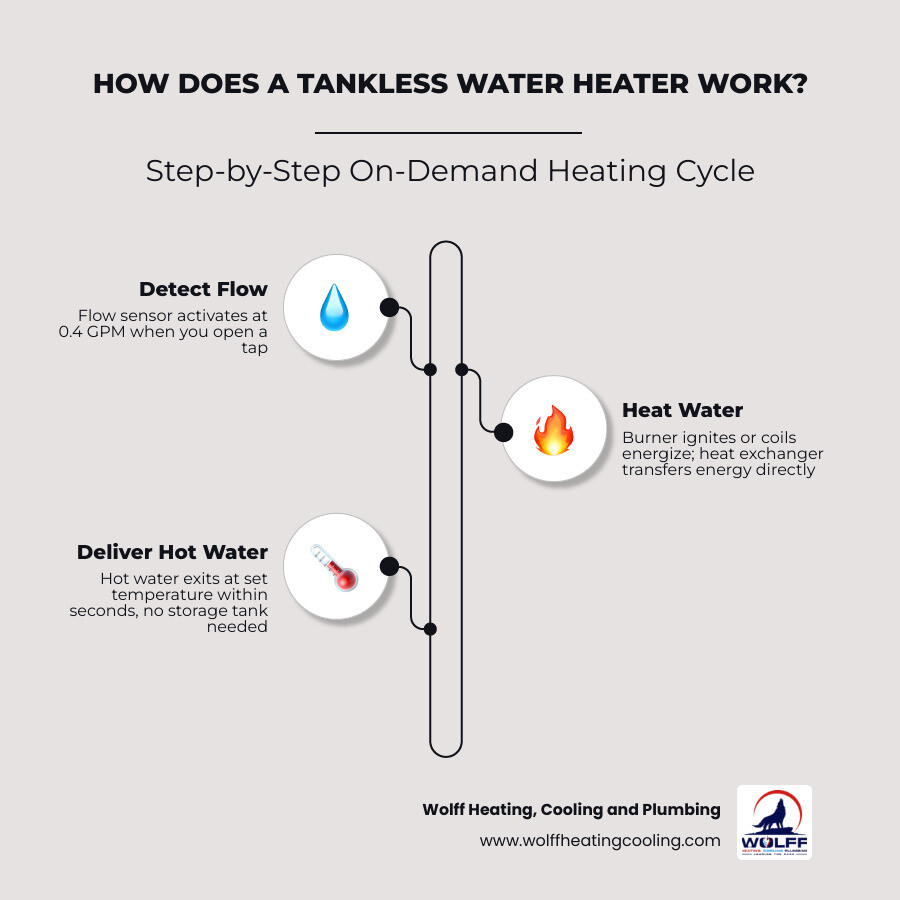
How does a tankless water heater work? Here’s the short answer:
- You open a hot water tap. This starts water flowing through the unit.
- A flow sensor detects the movement. Once flow reaches about 0.4 gallons per minute, the unit activates.
- A burner or heating element fires up. Gas models ignite a burner; electric models energize heating coils.
- Cold water passes through a heat exchanger. The heat exchanger transfers energy directly into the water as it flows through.
- Hot water exits at your set temperature. It reaches your tap within seconds.
- You close the tap. The unit shuts off completely — no stored water, no standby energy waste.
That’s the whole cycle. No tank. No reheating. No running out.
Most homes in Albuquerque still run on traditional tank water heaters — large, bulky appliances that keep 40 to 60 gallons of water hot around the clock, whether you need it or not. That constant reheating accounts for roughly 20% of a typical home’s energy budget. Tankless systems flip that model entirely. Instead of storing hot water, they heat it on demand, only when a tap is open. The result is continuous hot water, a smaller footprint, and significantly less wasted energy. If you’ve ever wondered what’s actually happening inside that compact gray box on your wall, this guide breaks it down step by step — no mystery required.
The Core Mechanics: How Does a Tankless Water Heater Work?
To understand how does a tankless water heater work, it helps to stop thinking of it as a “heater” and start thinking of it as a high-speed energy processor. In a traditional tank, water sits in a reservoir, losing heat through the tank walls (standby loss) and requiring a burner to kick on periodically just to maintain temperature.
A tankless unit, often called an “on-demand” or “instantaneous” heater, is a masterpiece of compact engineering. It contains no storage reservoir. Instead, it relies on a sophisticated internal assembly that only springs to life when it senses water movement. When you compare types of water heaters, the most striking difference is the footprint; because there is no 50-gallon tank, these units are about the size of a carry-on suitcase and mount directly to your wall.

Activation: How Does a Tankless Water Heater Work to Detect Demand?
The process begins with a component called the flow sensor. This is the “brain” that tells the system when to wake up. In modern units, such as those from Rheem or Rinnai, the sensor is incredibly sensitive. As soon as you crack open a faucet in your kitchen or bathroom, water begins to move through the inlet pipe.
For most residential models, the magic number is 0.4 GPM (Gallons Per Minute). Once the flow sensor detects this minimum threshold, it sends a signal to the control board to initiate the ignition sequence. This prevents the unit from firing up for a tiny drip or a leak, ensuring energy isn’t wasted. If you live in an older home in Albuquerque, we often recommend checking your faucet aerators to ensure they allow enough flow to trigger this sensor. You can learn more about local requirements in our Tankless Water Heater Albuquerque Guide.
The Role of the Heat Exchanger
If the flow sensor is the brain, the heat exchanger is the heart. This component is responsible for the actual thermal transfer. As cold water enters the unit, it travels through a series of tightly coiled pipes—usually made of copper for its high thermal conductivity or stainless steel for its resistance to corrosion.
Surrounding or sitting above these pipes is the combustion chamber (in gas models) or electric heating elements. The heat exchanger’s job is to take the intense heat from the burner and transfer it into the moving water. Because the water is moving through a narrow path, it heats up almost instantly. High-quality exchangers are designed with acid-resistant coatings to withstand temperatures that can reach up to 1000 °C. If you ever notice fluctuating temperatures, it’s often a sign that the exchanger needs a professional look, which we cover in our guide on troubleshooting tankless water heaters.
Condensing vs. Non-Condensing Technology
When you’re looking at how does a tankless water heater work, you’ll likely hear the terms “condensing” and “non-condensing.” This refers to how the unit handles exhaust gases.
- Non-Condensing Units: These are the traditional tankless models. They use a single heat exchanger and vent exhaust gases out at very high temperatures (around 199–210 °C). Because the exhaust is so hot, you must use specialized, expensive stainless steel venting.
- Condensing Units: These are the “ultra-efficient” models. They feature a secondary heat exchanger. Before the hot exhaust gases leave the unit, they pass through this second exchanger to pre-heat the incoming cold water. This captures “latent heat” that would otherwise be wasted.
By the time the exhaust leaves a condensing unit, it is cool enough (roughly 53–68 °C) to be vented through inexpensive PVC pipe. These units can achieve a Uniform Energy Factor (UEF) of up to 0.98, meaning 98% of the energy used goes directly into heating your water. For homeowners in Rio Rancho or Albuquerque looking for the highest efficiency, a condensing unit is often the best fit. Check out our Tankless Water Heater Install Albuquerque Guide for more on venting requirements.
Combustion: How Does a Tankless Water Heater Work with Gas?
In a gas-powered system, the combustion process is highly regulated. Once the flow sensor confirms water movement, the control board opens the gas valve and triggers the igniter.
Modern units use a negative feedback loop and a modulating gas valve. This means the system doesn’t just blast the heat at 100% every time. Instead, it calculates the difference between the incoming cold water temperature and your desired setpoint. If you’re just washing your hands, the burner stays low. If you’re running two showers at once, the burner ramps up to its maximum BTU output (often up to 199,000 BTUs). This precision is why tankless water heaters in Albuquerque, NM are so much more efficient than old-school tanks that only have two settings: “on” or “off.”
Why Tankless Systems Provide Endless Hot Water
The biggest “wow” factor for our customers in Placitas and Corrales is the “endless” supply. But how is that possible without a tank? It comes down to flow rate versus capacity.
| Feature | Traditional Storage Tank | Tankless Water Heater |
|---|---|---|
| Capacity | 40–80 Gallons | Unlimited (measured in GPM) |
| Recovery Time | 30–60 minutes | Instantaneous |
| Standby Loss | High (constant reheating) | Zero (only heats on demand) |
| Simultaneous Use | Limited by tank size | Limited by GPM capacity |
A tank is like a bucket of water; once you pour it out, you have to wait for the tap to refill and the heater to warm it up. A tankless unit is like a garden hose connected to a heater. As long as the water is flowing and the gas or electricity is on, the “hose” will keep providing hot water. This is why you can take a 45-minute shower without the water ever getting cold. We dive deeper into this in our article on tankless vs tank water heaters and why your shower cares.
Maintaining Your System in Albuquerque’s Hard Water
While the mechanics are impressive, they are not immune to New Mexico’s environment. Albuquerque, Rio Rancho, and Bernalillo are known for “hard water”—water that is rich in minerals like calcium and magnesium.
Inside a tankless unit, water passes through very small channels in the heat exchanger to ensure rapid heating. When that hard water is heated, minerals crystallize and stick to the walls of these channels, a process known as scaling. Over time, this scale acts as an insulator, making the heater work harder and eventually causing it to overheat or shut down.
To prevent this, we recommend:
- Annual Descaling: Flushing the unit with a food-grade vinegar solution to dissolve mineral buildup.
- Water Softeners: Installing a whole-home water softener can virtually eliminate tankless water heater scale issues.
- Filter Cleaning: Checking the internal water and air filters to ensure the unit can “breathe” properly.
Regular maintenance is the single most important factor if you want to extend your tankless water heater’s life.
Frequently Asked Questions about Tankless Operation
What is the minimum flow rate required for activation?
As mentioned, most modern units require a flow rate of 0.4 to 0.5 GPM to activate the burner. In practical terms, this means if you just barely crack the faucet to a trickle, the heater might not turn on. If you have ultra-low-flow fixtures, you might occasionally notice the water isn’t getting hot. If this happens frequently, it could be one of the tankless water heater service signs that your unit’s sensor needs adjustment.
How does the unit maintain consistent water temperature?
Tankless units use a modulating technology combined with a thermistor (a temperature sensor). The unit constantly monitors the outgoing water temperature. If it gets too hot, it throttles the gas burner down. If it’s too cold, it turns it up.
Some homeowners worry about the “cold water sandwich”—a brief burst of cold water if you turn the shower off and then back on quickly. High-end units solve this with “HotStart Programming” or small internal bypass buffers that keep the heat exchanger primed for a few minutes after the last use. If you’re experiencing temperature swings, it’s a common tankless heater issue in Albuquerque that can usually be fixed with a simple calibration.
How long do these units typically last in New Mexico?
One of the best reasons to go tankless is longevity. While a traditional tank might last 10 to 12 years before the tank itself corrodes and leaks, a tankless unit has a 20-year lifespan or more. Because they are modular, individual parts like the flow sensor or the heating element can be replaced without junking the whole unit. In our Tankless Maintenance Albuquerque NM Guide, we highlight how proper care in our dry climate can keep these units running efficiently for decades.
Conclusion
Understanding how does a tankless water heater work takes the “magic” out of the box and replaces it with appreciation for smart engineering. By eliminating the bulky tank and heating water only when you need it, these systems offer a more sustainable, space-saving, and reliable way to keep your home comfortable.
At Wolff Heating, Cooling, and Plumbing, we’ve been serving the Albuquerque, Rio Rancho, and Cedar Crest areas for over 25 years. We know the local water conditions, the venting requirements for New Mexico homes, and exactly how to size a system so you never have to choose between doing the laundry and taking a hot shower. If you’re ready to ditch the tank and enjoy the benefits of on-demand hot water, we’re here to help with honest estimates and superior service.
Upgrade Your Home with a Tankless Water Heater Installation in Albuquerque NM
Talk to a real Albuquerque technician.
Tell us what's going on and our Wolff team will reach out — usually within the hour during business hours. For emergencies, call us directly anytime.
Call us(505) 269-1429- Emergency Service Available
- Licensed & Insured
- 4.9★ from 130+ Google reviews
- Albuquerque, NM & 13 nearby towns
2420 Comanche Rd NE C3, Albuquerque, NM 87107
Request your service
No obligation. We never sell your info.