
Tankless vs Tank Water Heater at High Altitude: 101
Compare tankless vs tank water heater in high altitude performance, sizing, venting, and efficiency above 5,000 feet with expert Albuquerque tips.

Why Choosing Between a Tankless vs Tank Water Heater in High Altitude Matters More Than You Think
If you’re weighing a tankless vs tank water heater in high altitude conditions, here’s the short answer: both systems work, but tankless units need proper altitude adjustments to perform as advertised, while tank systems quietly lose efficiency the higher you go — and in Albuquerque and the surrounding New Mexico mountains, “higher” is the norm.
Quick comparison for high-altitude homeowners:
| Factor | Tank Water Heater | Tankless Water Heater |
|---|---|---|
| Altitude impact | Moderate — gradual efficiency loss | Higher — requires derating and adjustment kits |
| Energy efficiency | Baseline | Up to 30% more efficient when properly sized |
| Lifespan | 8–15 years | 20+ years |
| Hot water supply | Limited by tank size | Continuous (limited by flow rate) |
| Installation complexity | Simpler | Higher — especially at elevation |
| Best for high altitude | Straightforward replacement option | Better long-term value with proper setup |
Most homeowners don’t think much about their water heater until they’re standing in a cold shower. But at elevations above 5,000 feet — where much of the Albuquerque metro and surrounding New Mexico communities sit — altitude quietly works against both types of systems in ways that aren’t obvious until something goes wrong.
Gas appliances lose roughly 4% of their heating capacity for every 1,000 feet above sea level. That means at 6,000 feet, your water heater could already be operating at 20–24% below its rated output — before you’ve even accounted for cold incoming groundwater or venting challenges. Water also boils at a lower temperature at elevation (around 199°F at 7,000 feet instead of 212°F at sea level), which affects how your system manages heat and pressure. One homeowner in a high-altitude mountain community discovered their new tankless unit was delivering lukewarm water and driving up gas bills — only to find out the installer had skipped a critical altitude adjustment to the air intake. One small missed step, and the whole system underperformed.
Whether you’re replacing a failing unit or planning a new installation, understanding how elevation changes the rules is the first step to making the right call.
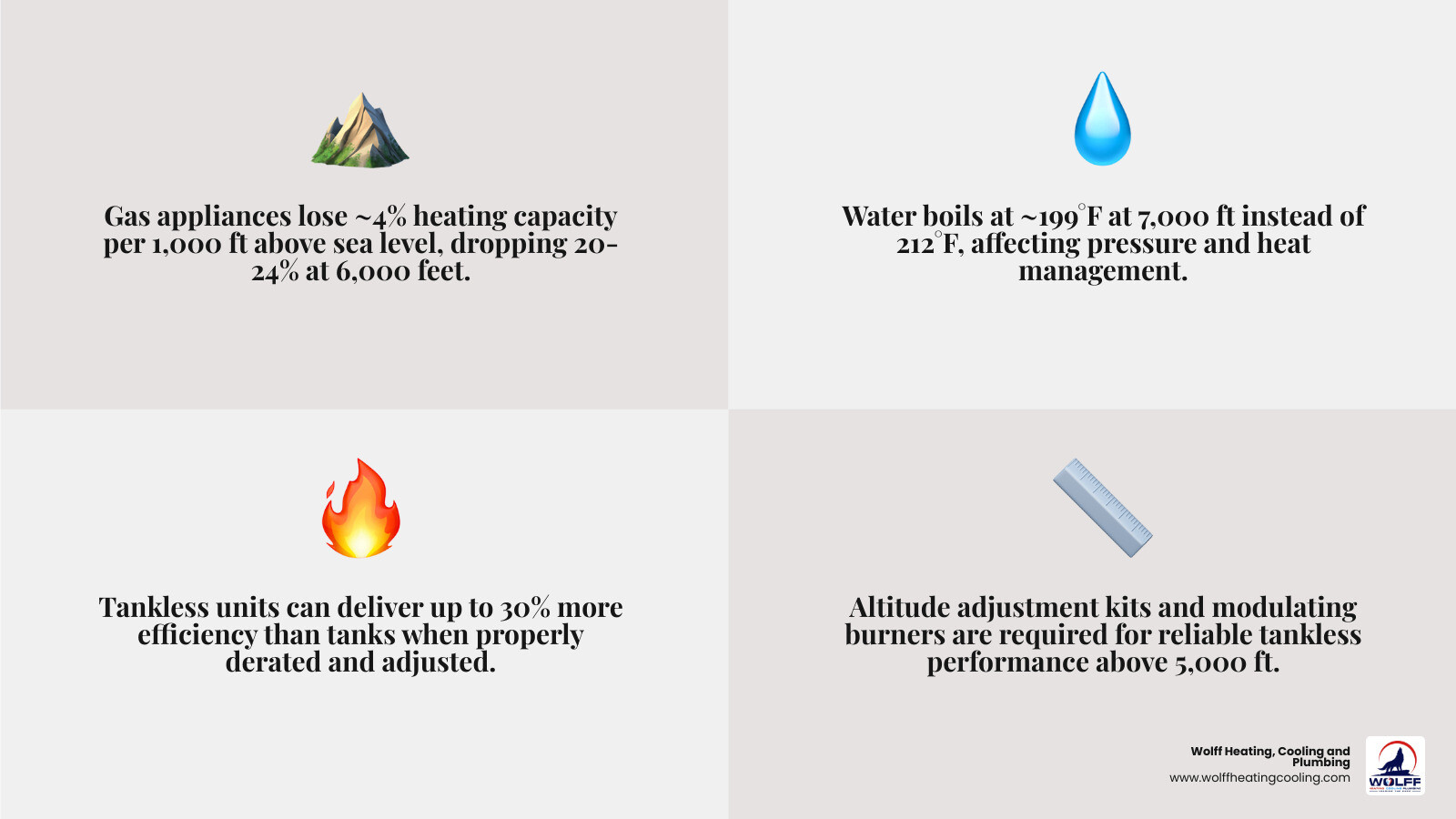
Tankless vs tank water heater in high altitude terms at a glance:
- affordable water heater installation in Albuquerque, NM
- reliable plumbing service in Albuquerque
- tankless water heater lifespan
How Elevation Affects Tankless vs Tank Water Heater in High Altitude Performance
Operating any gas-fired appliance in the high desert of New Mexico means dealing with the realities of physics. As you climb above sea level, atmospheric pressure drops. In Albuquerque (sitting around 5,300 feet), the air is noticeably thinner than it is at the coast. If you head up into the East Mountains to communities like Cedar Crest or Tijeras, you are easily crossing the 6,500 to 7,500-foot thresholds.
Thinner air contains less oxygen per cubic foot. Because fire requires oxygen to burn, this directly impacts the combustion process of gas water heaters. Without the right balance of fuel and air, your burner cannot generate the same amount of heat. This physical limitation leads to a predictable 4% capacity loss per 1,000 feet of elevation.

For a standard gas appliance, this means:
- At 5,000 feet (Albuquerque baseline): ~20% reduction in heating capacity.
- At 7,000 feet (Cedar Crest / Tijeras): ~28% reduction in heating capacity.
- At 9,000 feet (Sandia Crest foothills): ~36% reduction in heating capacity.
Additionally, because atmospheric pressure is lower, the boiling point of water drops from the sea-level standard of 212°F to approximately 199°F at 7,000 feet. While you do not heat domestic hot water to boiling temperatures, this pressure shift changes the behavior of thermal expansion, internal pressure dynamics, and how safety relief valves respond within your system.
To dive deeper into how high elevations affect other gas appliances in your home, check out our guide on High Elevation HVAC Tips for Mountain Living.
Sizing a Tankless vs Tank Water Heater in High Altitude for Cold Groundwater
When sizing a water heater for high-altitude New Mexico homes, the temperature of the water coming out of the ground is just as critical as the thin air. In mountain regions and high desert plains, winter groundwater temperatures can plunge to between 40°F and 45°F.
To deliver a comfortable shower temperature of 120°F, your water heater must achieve a “temperature rise” of 75°F to 80°F.
- Traditional Tank Water Heaters: These systems are limited by time. They store 40 to 80 gallons of water and heat it gradually. While the recovery rate (how fast it reheats cold groundwater) slows down significantly due to the 20% to 28% combustion capacity loss at altitude, you still have a buffer of preheated water ready to go.
- Tankless Water Heaters: These systems are limited by flow rate (measured in Gallons Per Minute, or GPM). Because they heat water instantly on demand, a tankless unit must perform that massive 80°F temperature rise in real-time as the water passes through the heat exchanger.
If your tankless unit is rated for 9 GPM at sea level, that rating is based on a mild temperature rise and full combustion capacity. Once you factor in the high-altitude capacity loss and the freezing New Mexico groundwater, that same unit’s real-world capacity might drop to 4.5 or 5 GPM. If multiple people try to run showers simultaneously, the system will reach its physical limits, resulting in a sudden drop in water pressure or a lukewarm “cold sandwich” effect.
To learn more about how flow rates and system types impact your daily routine, read our article on Tankless vs Tank Water Heaters and Why Your Shower Cares.
Combustion and Venting Challenges for a Tankless vs Tank Water Heater in High Altitude
Venting is where high-altitude installations get highly technical. Because the air is thinner, getting exhaust gases out of the house and pulling fresh combustion air in requires more physical effort from the appliance.
[Outside Air] ---> [Sealed Combustion Chamber] ---> [Category IV Venting (PVC/Poly)] ---> [Safe Exhaust]
 (Modulating Burner)
Modern high-efficiency condensing tankless systems utilize Category IV venting and sealed combustion. Instead of drawing air from inside the utility room, they pull fresh outdoor air directly into a sealed chamber and use a powerful, variable-speed fan to force the exhaust out. This design is highly advantageous at high altitudes because the unit can programmatically adjust its fan speed to compensate for the lower air density, ensuring the ideal gas-to-air ratio is maintained.
Traditional tank water heaters, on the other hand, often rely on natural draft venting (atmospheric venting). They depend on the natural buoyancy of hot exhaust air rising up a chimney. In high-altitude areas subject to extreme barometric swings and high winds — common in places like Rio Rancho and Corrales — natural draft systems can struggle with backdrafting, where dangerous combustion byproducts are pushed back into the home.
For more insights on managing mechanical systems in our unique high-desert climate, read our breakdown of Desert Survival 101 for Your High Desert HVAC.
Sizing, Venting, and Installation Challenges Above 5,000 Feet
Installing a water heater in the Albuquerque metro area or the surrounding mountain communities requires precise calibration. If you install a gas water heater straight out of the box without adjusting it for our local elevation, you will likely experience incomplete combustion. This leads to soot buildup, frequent system errors, wasted fuel, and a significantly shortened equipment lifespan.
Key challenges that must be addressed during a high-altitude installation include:
- De-rating and Gas Valve Adjustments: To prevent the burner from running “too rich” (too much gas, not enough oxygen), the gas valve must be calibrated to reduce the fuel flow. Many modern tankless units feature smart control boards where parameters can be adjusted digitally, while other systems require physical orifice changes.
- Venting Length Calculations: Thinner air increases resistance inside venting pipes. Manufacturers specify maximum vent lengths (including the number of elbows used), and these allowable lengths are strictly reduced at higher elevations.
- Condensate Management in Cold Climates: High-efficiency tankless systems produce acidic condensation as they extract heat from exhaust gases. In cold mountain winters, these drain lines can easily freeze if they are run along exterior walls or left unprotected, leading to system shutdowns.
- Freeze Protection: Because tankless units are often mounted on exterior walls or in tight utility closets, they require active freeze protection (such as internal electric ceramic heaters) and proper pipe insulation to prevent the heat exchanger from cracking during a hard freeze.
Long-Term Efficiency, Lifespan, and Reliability Comparison
When choosing between a tankless vs tank water heater in high altitude, evaluating the long-term return on investment is key.
Traditional tank systems suffer from “standby heat loss.” Because they hold 40 to 80 gallons of hot water constant, they must turn on periodically throughout the day and night to keep that water warm — even when you are asleep or away from home. In cold high-altitude climates, this standby loss is accelerated as cold air drafts into the utility space.
Tankless systems only burn gas when hot water is flowing, making them up to 30 percent more efficient than traditional tank systems in many homes.
| Feature | Traditional Tank System | Modern Tankless System |
|---|---|---|
| Average Lifespan | 8 to 15 years | 20+ years |
| Standby Heat Loss | High (continuous reheating) | None (on-demand heating) |
| Space Requirements | Large footprint (takes up floor space) | Compact (wall-mounted) |
| Susceptibility to Scale | Moderate (settles at the bottom) | High (can clog narrow heat exchangers) |
| Energy Savings | Baseline | 24% to 34% savings on water heating costs |
To explore how these efficiency gains translate to lower monthly utility bills, check out Stop Burning Cash with Tankless Water Heater Energy Savings.
While tankless systems offer superior efficiency and can last more than two decades, they do require consistent maintenance — especially in areas with hard water. Because tankless units heat water rapidly through narrow copper piping, mineral scale can bake onto the heat exchanger quickly, reducing efficiency and potentially causing premature failure if the system is not flushed annually.
To learn more about the long-term durability of on-demand systems, read our article: Will Your Tankless Water Heater Outlive Your Car?.
Frequently Asked Questions about High-Altitude Water Heaters
Do tankless water heaters work well above 5,000 feet?
Yes, modern tankless water heaters work exceptionally well above 5,000 feet, provided they are properly de-rated and adjusted during installation. Many premium manufacturers build automatic altitude adjustment or modulating burners into their units, which can self-compensate for lower oxygen levels. However, because of the natural capacity loss at high elevations, the unit must be carefully sized to ensure it can handle your household’s peak hot water demand.
How does cold mountain water affect water heater sizing?
Cold incoming groundwater requires your water heater to work much harder to reach comfortable household temperatures. In the winter, groundwater in high-altitude areas can drop to 40°F, meaning your system must achieve an 80°F temperature rise to deliver 120°F water. Because tankless systems heat water in real-time, this steep temperature rise reduces the maximum GPM of hot water the unit can produce at any given moment.
Do high-altitude water heaters require special maintenance?
Yes. High-altitude environments often feature mineral-rich water supplies. In a tankless system, hard water scale can quickly accumulate inside the narrow channels of the heat exchanger, acting as an insulator and forcing the burner to run hotter and work harder. To maintain efficiency and protect your warranty, tankless systems should be professionally flushed with a descaling solution at least once a year. Traditional tanks should also be drained and flushed annually to clear sediment from the bottom of the tank.
Conclusion
Choosing between a tankless vs tank water heater in high altitude environments ultimately comes down to your household’s hot water demands, space availability, and long-term efficiency goals. While traditional tank water heaters offer a lower upfront cost and a simpler installation process, properly configured tankless water heaters deliver unmatched energy savings, a compact footprint, and a continuous supply of hot water that can last for over 20 years.
At Wolff Heating, Cooling, and Plumbing, we have spent more than 25 years helping homeowners in Albuquerque, Rio Rancho, Corrales, Placitas, Bernalillo, Tijeras, and Cedar Crest navigate the unique mechanical challenges of high-elevation living. Our licensed, bonded, and insured plumbing experts understand the precise calculations, venting codes, and gas valve calibrations required to make your water heater perform flawlessly in our thin mountain air.
Ready to upgrade your home’s comfort and start saving on your energy bills? Schedule your high-altitude water heater consultation with Wolff Heating, Cooling, and Plumbing today.
Talk to a real Albuquerque technician.
Tell us what's going on and our Wolff team will reach out — usually within the hour during business hours. For emergencies, call us directly anytime.
Call us(505) 269-1429- Emergency Service Available
- Licensed & Insured
- 4.9★ from 130+ Google reviews
- Albuquerque, NM & 13 nearby towns
2420 Comanche Rd NE C3, Albuquerque, NM 87107
Request your service
No obligation. We never sell your info.