High Elevation HVAC Tips for Mountain Living
Discover how altitude and dry air stress your heating and cooling. Get high-elevation HVAC tips for furnaces, AC , and humidifiers in Albuquerque!

Why High Altitude and Dry Air in Albuquerque, NM Put Extra Strain on Your HVAC System
How altitude and dry air stress your heating and cooling is a real and measurable problem for homeowners in Albuquerque, NM. At roughly 5,300 feet above sea level, the air here is thinner, drier, and harder on every component in your heating and cooling system — from your furnace burners to your AC compressor.
Here is a quick summary of the key ways altitude and dry air affect your HVAC:
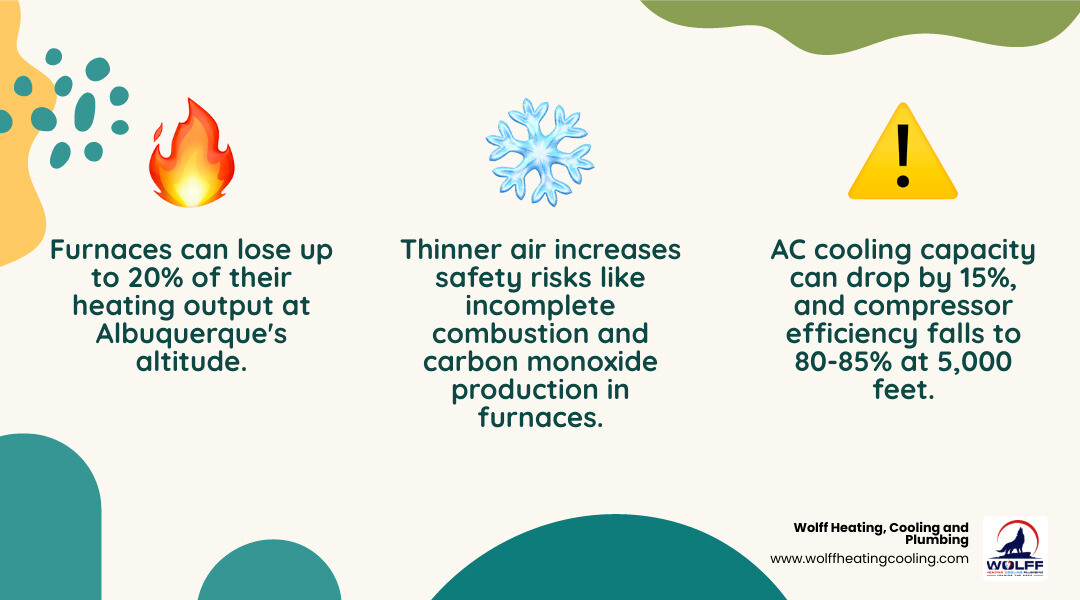
- Furnaces lose output — roughly 4% for every 1,000 feet of elevation, meaning an Albuquerque furnace may produce about 20% less heat than the same unit at sea level
- AC systems struggle — compressor efficiency drops to 80-85% at 5,000 feet, and overall cooling capacity can fall by up to 15%
- Dry air makes it worse — Albuquerque winters can see indoor humidity drop well below 20%, making your home feel colder than the thermostat reads and forcing your system to run longer
- Safety risks increase — thinner air disrupts the fuel-to-air ratio in gas furnaces, raising the risk of incomplete combustion and carbon monoxide production
- Components wear faster — motors, blowers, and compressors all work harder in thin air, shortening equipment lifespan without proper adjustments
Most HVAC systems are designed and tested at sea level. That means your system is already working against the odds the moment it is installed here. Without the right calibration, adjustments, and maintenance, you are likely paying more on energy bills, losing comfort, and putting extra wear on expensive equipment.
The good news? These challenges are well understood and fixable with the right approach.
How Altitude and Dry Air Stress Your Heating and Cooling Systems
Living in the Land of Enchantment means enjoying breathtaking views and crisp mountain air. However, that “crisp” air is actually quite thin. To understand how altitude and dry air stress your heating and cooling, we have to look at the physics of air density.
At sea level, the atmosphere is heavy. It presses down with about 14.7 pounds per square inch (PSI). In Albuquerque, that pressure drops to roughly 12 PSI. This might not seem like a huge jump, but for your HVAC system, it changes everything. Thinner air means there are fewer molecules per cubic foot to carry heat. Whether you are trying to move heat into your home during a snowy January night or pull heat out during a scorching July afternoon, your system has less “stuff” to work with.
When the air is less dense, your Air Conditioning In Albuquerque Nm/ has to move a much larger volume of air to achieve the same cooling effect as a unit on the coast. This leads to several Heat Pump Issues In Albuquerque/ where the system seems to run indefinitely without ever quite reaching the temperature you set on the thermostat.
Furthermore, the lack of moisture in our high-desert climate adds another layer of stress. Dry air doesn’t hold heat as well as humid air. It also causes moisture to evaporate off your skin faster, which makes you feel colder even if the room temperature is technically 70 degrees. This “perceived cold” often leads homeowners to crank up the heat, putting even more strain on a system already struggling with low air density.

Optimizing Furnace Performance and Combustion in Thin Air
Your furnace is essentially a controlled fire inside a box. Like any fire, it needs three things: fuel, heat, and oxygen. At 5,300 feet, oxygen is in shorter supply. If you take a standard furnace designed for sea level and install it in Rio Rancho or Corrales without adjustments, it will struggle to breathe.
This leads to a “fuel-rich” mixture. Imagine a car engine that is “flooded” or running with the choke on too long; it runs dirty and inefficiently. In a furnace, this results in incomplete combustion. We use a process called “derating” to fix this. Derating involves reducing the amount of fuel entering the burners so that it matches the available oxygen.
| Elevation (Feet) | Natural Reduction in Furnace Output |
|---|---|
| Sea Level | 0% |
| 2,000 Feet | 8% |
| 4,000 Feet | 16% |
| 5,300 Feet (Albuquerque) | ~21% |
| 7,000 Feet (Foothills/Mountains) | ~28% |
To optimize performance, we often perform orifice resizing. This involves replacing the small brass fittings that regulate gas flow with smaller versions. We also adjust the gas pressure to ensure the flame is stable and clean. If you have a Tankless Heater Issues In Albuquerque/, these adjustments are equally critical, as these units rely on high-precision combustion to provide “endless” hot water. Proper Ventilation Albuquerque Nm/ is also vital to ensure that exhaust gases are safely removed from the home despite the lower atmospheric pressure.
Combustion Safety and How Altitude and Dry Air Stress Your Heating and Cooling
Safety is our primary concern when dealing with high-altitude combustion. When a furnace doesn’t have enough oxygen to burn fuel completely, it produces carbon monoxide (CO) instead of harmless carbon dioxide. Carbon monoxide is an odorless, colorless gas that can be fatal.
Signs that your furnace is struggling with the altitude include:
- A yellow or flickering flame instead of a steady, crisp blue one.
- Soot buildup around the burners or on the exterior of the furnace cabinet.
- Frequent “cycling” where the furnace turns on and off rapidly.
- Unusual odors during startup.
Ensuring proper Ventilation For Indoor Air Quality/ is the best way to prevent CO buildup. At Wolff Heating, Cooling and Plumbing, we perform a professional combustion analysis during every high-altitude tune-up. We use specialized sensors to measure exactly what is coming out of your flue, ensuring your family stays safe while your system stays efficient.
Cooling Challenges and Efficiency at High Elevations
Summer in the Southwest is beautiful, but it is a marathon for your air conditioner. To understand how altitude and dry air stress your heating and cooling, you have to look at the outdoor condenser unit. This unit’s job is to “dump” the heat from inside your house into the outdoor air.
Because the air in Albuquerque is thinner, it is a poor conductor of heat. Your AC has to work significantly harder to reject that heat into the atmosphere. This causes refrigerant pressures to fluctuate differently than they would at sea level. If your technician uses sea-level charts to charge your system, you could end up with an overcharged or undercharged unit, leading to a compressor failure.
Many homeowners find themselves asking Why Ac Isnt Cooling In Albuquerque/ even when the unit is relatively new. Often, it’s because the system wasn’t Prepared Your Ac For Albuquerque Summer with altitude-specific calibration. The compressor, which is the “heart” of your AC, sees its efficiency drop to about 80% once you cross the 5,000-foot mark.
Maintaining Efficiency Despite How Altitude and Dry Air Stress Your Heating and Cooling
While the altitude presents challenges, modern technology offers solutions. High-efficiency systems with high SEER (Seasonal Energy Efficiency Ratio) ratings are often better equipped to handle the thin air. Specifically, variable-speed compressors and blower motors are a game-changer for mountain living. These systems can adjust their output in tiny increments, rather than just being “all on” or “all off,” which helps compensate for the reduced heat-carrying capacity of thin air.
If you are hearing Unusual Ac Sounds In Albuquerque/, such as clicking or hard-starting, it might be the compressor struggling with these pressure differentials. In some cases, a Ductless Hvac Albuquerque Nm/ system is a superior choice for high-altitude homes. Because they don’t rely on large duct networks (which create air resistance that is harder for thin air to overcome), they can often provide more direct, efficient cooling to specific zones of your home.
Combating Arid Air and Maintaining High-Altitude HVAC
The “dry” part of our dry heat is perhaps the most overlooked stressor on your HVAC system. In the winter, Albuquerque’s humidity can drop below 15%—that is actually drier than the Sahara Desert, which averages about 25%!
This ultra-dry air is a magnet for static electricity. Static isn’t just an annoyance when you touch a doorknob; it can actually “zap” the sensitive circuit boards inside your furnace or thermostat. Furthermore, dry air allows dust to stay airborne longer. This dust gets sucked into your system, coating the blower motor and sensors.
Maintaining good Indoor Air Quality/ becomes a battle against both dust and dryness. We highly recommend Humidifiers Albuquerque Nm/ as a standard part of any high-altitude HVAC setup. By adding moisture back into the air, you stop the “evaporative cooling” effect on your skin, allowing you to feel comfortable at a lower temperature setting.
Whole-Home Humidification Solutions
Portable humidifiers are fine for a single bedroom, but they can’t protect your entire HVAC system. A whole-home humidifier is installed directly into your ductwork. It uses a water panel to add controlled amounts of moisture to the air as it circulates.
The benefits of managing humidity include:
- Energy Savings: You can often lower your thermostat by 2–3 degrees without losing comfort, saving significantly on heating bills.
- System Longevity: Reduced static electricity protects your system’s electronics.
- Better Sleep: Proper moisture levels prevent dry throats and itchy skin.
- Protecting Your Home: Wood floors and furniture are less likely to crack or warp in a humidified environment.
When you Improve Your Homes Indoor Air Quality/, you are also making things easier on your furnace. You can find more details on our Hvac/Albuquerque Nm/Humidifiers/ service page to see which model fits your home’s square footage.
Frequently Asked Questions about High-Altitude HVAC
Why does my furnace run longer at high altitude?
This is one of the most common complaints we hear. Because the air is roughly 20% less dense, it carries 20% less heat per cubic foot. Your furnace has to move more air and run for longer cycles to deliver the same amount of BTUs (British Thermal Units) to your living room as it would at sea level. If you feel like your system is constantly running, it might also be due to Ac Thermostat Issues In Albuquerque/ where the sensor is struggling to read the temperature accurately in a drafty, dry environment.
Does dry air make my home feel colder?
Absolutely. This is due to “evaporative cooling.” When the air is dry, moisture on your skin evaporates almost instantly. Since evaporation is a cooling process, it pulls heat away from your body. This is why 70 degrees in Albuquerque can feel much chillier than 70 degrees in a humid place like Florida. If your home feels “hollow” or drafty, check your humidity levels. If they are below 30%, you might need to look into Dehumidifiers Albuquerque Nm/ (though in our climate, we almost exclusively install humidifiers to add moisture rather than remove it).
What is furnace derating?
Derating is the process of adjusting a gas appliance to account for the lack of oxygen at high elevations. Most manufacturers require derating for any installation above 2,000 feet. In Albuquerque, we typically derate systems by about 4% for every 1,000 feet of elevation. This ensures the fuel burns completely and safely. If your system is making strange sounds, we can help Solve Heat Pump Noises In Albuquerque/ or furnace rattles that often stem from improper combustion or vibrating components struggling with air resistance.
Conclusion
Living at a high elevation is a privilege, but it does mean your home’s mechanical systems have a tougher job to do. Understanding how altitude and dry air stress your heating and cooling is the first step toward a more comfortable, efficient home. By investing in professional calibration, derating, and humidification, you can offset the natural disadvantages of our 5,300-foot elevation.
At Wolff Heating, Cooling and Plumbing, we have spent over 25 years helping our neighbors in Albuquerque, Rio Rancho, and the surrounding mountain communities stay comfortable year-round. We know the “quirks” of high-altitude HVAC because we live and work here too. From ensuring your furnace is burning safely to optimizing your AC for the thin summer air, we are committed to superior work and honest service.
Don’t let the altitude wear down your system prematurely. Whether you are in Bernalillo, Corrales, or the East Mountains, our team is ready to provide the expert maintenance your high-altitude home deserves.
Schedule your high-altitude HVAC service today with Wolff Heating, Cooling and Plumbing and breathe easier knowing your system is calibrated for the heights.
Talk to a real Albuquerque technician.
Tell us what's going on and our Wolff team will reach out — usually within the hour during business hours. For emergencies, call us directly anytime.
Call us(505) 269-1429- Emergency Service Available
- Licensed & Insured
- 4.9★ from 130+ Google reviews
- Albuquerque, NM & 13 nearby towns
2420 Comanche Rd NE C3, Albuquerque, NM 87107
Request your service
No obligation. We never sell your info.