
 Menu
Menu
Why AC Sizing Matters More in a High Altitude Desert Climate Like Albuquerque
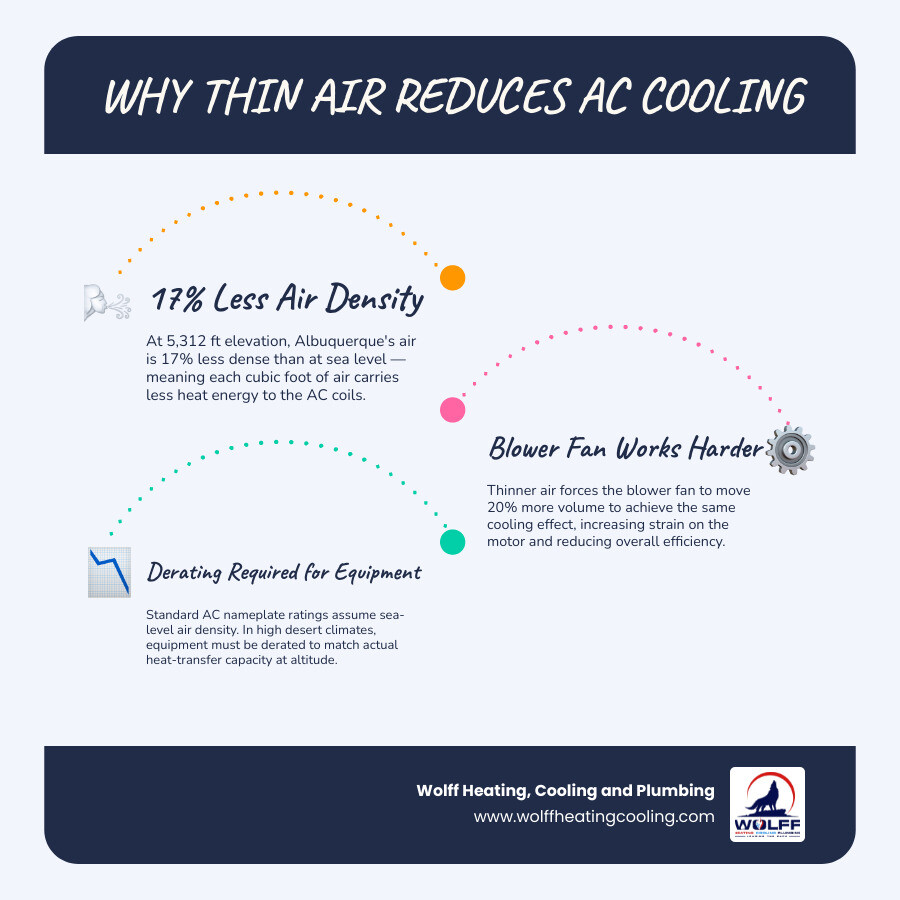
Why AC sizing matters more in a high altitude desert climate like Albuquerque comes down to one unavoidable fact: the air at 5,312 feet above sea level is roughly 17% less dense than at sea level. That thinner air carries less heat, forces your blower fan to work harder, and makes every standard sizing shortcut less reliable. Get the size wrong — even by half a ton — and you are looking at a system that either runs nonstop without keeping up, or one that short-cycles and fails years ahead of schedule.
Quick Answer: Why AC Sizing Is More Critical in Albuquerque’s High Desert
- Thin air reduces cooling capacity. At Albuquerque’s elevation, AC systems deliver less effective cooling than their nameplate rating suggests — equipment must be derated to account for lower air density.
- Standard rules of thumb fail here. The common “1 ton per 600 square feet” guideline ignores altitude, solar gain, insulation, and window orientation — all of which are extreme in New Mexico.
- Oversizing causes short-cycling. An oversized unit cools too fast, shuts off early, and never runs long enough to manage humidity — a real problem when monsoon season hits in July.
- Undersizing causes continuous runtime. A unit too small for the load runs nonstop on 100°F days, wearing out components far ahead of schedule.
- Albuquerque’s sensible heat ratio exceeds 0.90. Almost all of the cooling load here is about lowering temperature, not removing moisture — which changes how equipment should be selected and sized compared to humid cities.
- Manual J calculations are non-negotiable. Only a full load calculation that accounts for climate zone 3B, elevation, solar gain, and building envelope can produce a reliable equipment size.
Whether you are replacing an aging system or installing refrigerated air for the first time, understanding why proper sizing is so critical in this climate is the first step toward a home that stays comfortable all summer long — without burning through equipment or energy bills.
Living in the high desert of New Mexico presents a beautiful landscape, but it also brings some of the most intense climate conditions in North America. From the scorching, sun-drenched afternoons of June to the rapid evening temperature drops, our local weather demands a lot from our home comfort systems. When we discuss Desert Living 101: Keeping Your Cool When the Heat Is On, we have to talk about the physical reality of our environment.
Many homeowners believe that keeping a home cool is simply a matter of buying a powerful air conditioner, but high-altitude desert climates require a delicate balance. Squeezing maximum efficiency out of your system is only possible when the unit is perfectly matched to your home’s unique thermal profile. If you want to achieve peak comfort, checking out our Peak Performance Tips for High Altitude Desert Summer Efficiency is a great place to start, but everything ultimately hinges on the physical size and capacity of your air conditioner.
The Physics of Thin Air: Why AC Sizing Matters More in a High Altitude Desert Climate Like Albuquerque
To understand why standard air conditioning math fails in cities like Albuquerque, Rio Rancho, and Bernalillo, we have to look at the physics of thin air. At our standard local elevation of 5,312 feet (and even higher as you move toward the foothills or Tijeras), atmospheric pressure is about 17% lower than at sea level.
Air conditioning systems do not actually “create” cold; they absorb heat from the air inside your home and transfer it outdoors. This heat transfer relies entirely on the mass of the air passing over your indoor evaporator coil. Because our air is thinner, it has less mass.
Consider this comparison: a blower fan operating at sea level can move approximately 90,000 pounds of air per hour. Put that exact same fan in a home at 6,000 feet above sea level, and it will only move about 72,000 pounds of air per hour. This represents a massive 20% reduction in air-moving capacity.
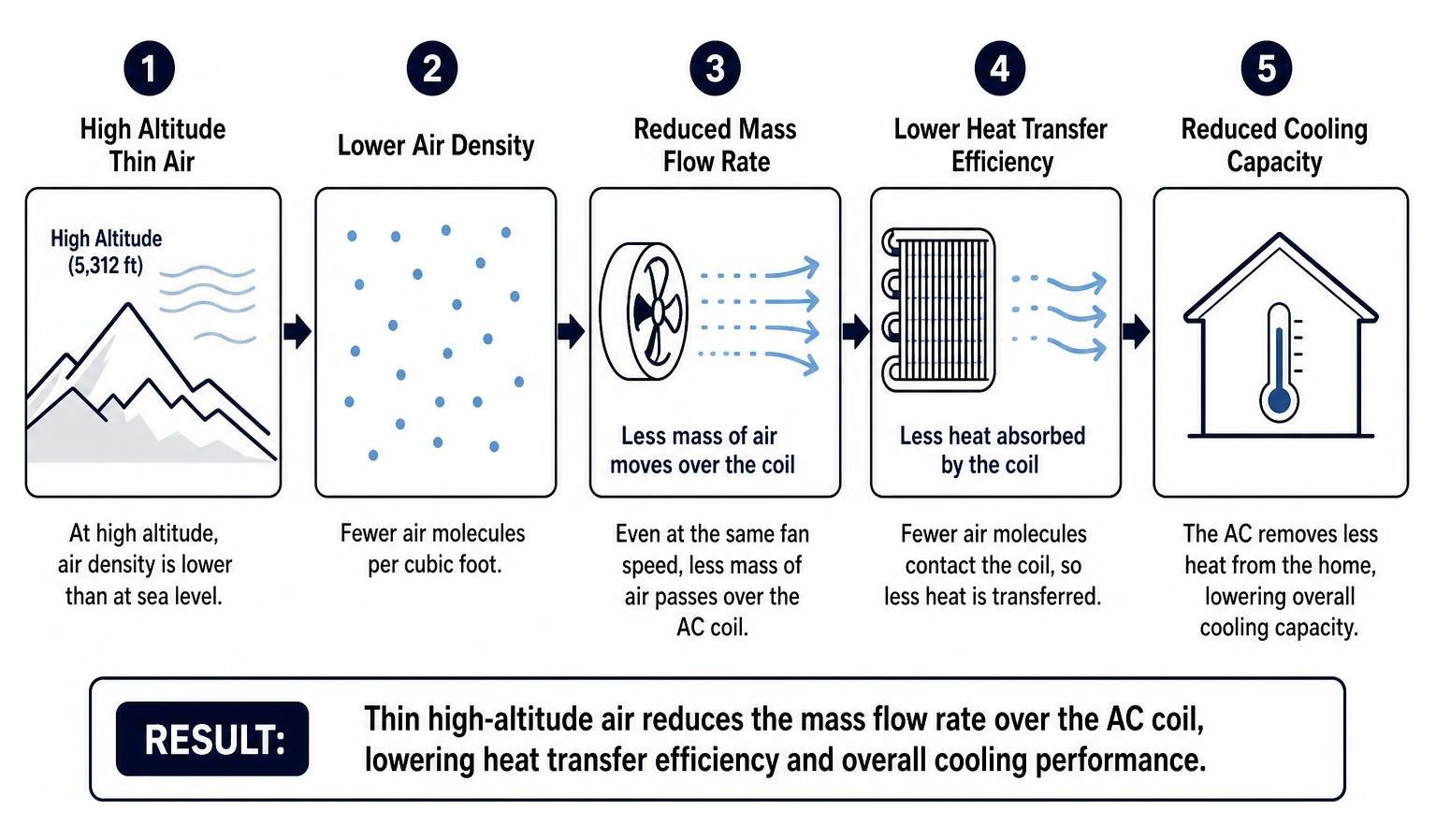
Because the air is thinner, your air conditioner’s blower fan has to work significantly harder to move the same mass of air. Furthermore, the refrigerant inside the coils cannot absorb heat as efficiently because there are fewer air molecules making contact with the metal fins. This physical limitation is why we emphasize High Elevation HVAC Tips for Mountain Living. If your contractor does not adjust the sizing calculations for this drop in air density, your brand-new system will perform as if it is chronically undersized.
Sensible Heat Ratio and Desert Humidity Dynamics
Another major factor that sets Albuquerque apart from humid coastal or midwestern cities is the Sensible Heat Ratio (SHR). The total cooling load of any building is made up of two parts:
- Sensible Heat Load: The energy required to lower the actual dry-bulb temperature of the air (what you see on your thermostat).
- Latent Heat Load: The energy required to remove moisture (humidity) from the air.
In highly humid climates like Houston or Miami, an AC system has to spend up to 30% of its energy simply pulling water out of the air (an SHR of 0.70 to 0.75). In Albuquerque, our typical summer air is incredibly dry. Our sensible heat ratio commonly exceeds 0.90 during peak summer conditions. This means that more than 90% of your air conditioner’s work is dedicated entirely to lowering the temperature of the air, with very little energy spent on dehumidification.
This high sensible heat ratio changes the way we must select and size equipment. If a contractor installs a system designed for a humid climate without adjusting for our high SHR, the system may struggle to drop the temperature on a hot 96°F day, even if its total BTUs look correct on paper.
However, we also have to account for the sudden shift that occurs during the July-to-September monsoon season. During these months, afternoon relative humidity can suddenly spike to 40% or 60%. If your system was sized incorrectly, this sudden influx of moisture will leave your home feeling damp and clammy, highlighting why local climate expertise is so critical.
The Failure of Square Footage Rules of Thumb
If a contractor walks into your home in Corrales or Placitas, looks around for five minutes, and tells you that you need a “3-ton system because your house is 1,800 square feet,” you should politely show them the door. Sizing an air conditioner based purely on square footage is a recipe for disaster in New Mexico.
The old “1 ton of cooling per 600 square feet” rule of thumb was created decades ago as a rough estimate for sea-level homes with moderate climates and average insulation. It completely ignores the unique architectural styles, high solar radiation, and extreme temperature swings of the high desert. Relying on generic online calculators or simple square footage charts will almost always result in an improperly sized system. To learn more about how we determine the exact capacity your home needs, read our guide on The Right HVAC Size for Your Home.
Manual J Calculations: Why AC Sizing Matters More in a High Altitude Desert Climate Like Albuquerque
The only accurate way to size an air conditioning system is by performing a professional load calculation using the Air Conditioning Contractors of America (ACCA) Manual J protocol. This is the industry gold standard, and it is especially critical in our local climate zone (Zone 3B).
A proper Manual J calculation does not just look at the floor area. It is a highly detailed mathematical assessment that evaluates:
- The exact local design temperatures (Albuquerque’s 1% summer cooling design dry-bulb is 96°F, with a mean coincident wet-bulb of only 60°F).
- The orientation of your home relative to the sun (solar azimuth).
- The total area and direction of all windows and glass doors.
- The insulation values (R-values) of your attic, walls, and floors.
- The rate of natural air infiltration through the building envelope.
- The height of your ceilings and total volume of the home.
Skipping this step is one of the biggest mistakes a homeowner can make. When we walk you through Selecting the Right AC System, a Manual J calculation is always our very first step. It ensures you do not buy more capacity than you need, nor do you end up with a system that leaves you sweating. For more local insights on system selection, check out our article on Choosing the Best AC in Albuquerque.
New Mexico Building Envelope Factors and Solar Gain
Our local architecture in places like Santa Fe, Albuquerque, and Rio Rancho is incredibly unique, but it presents specific challenges for air conditioning. Traditional adobe construction, for example, has massive thermal mass. Adobe walls absorb the intense desert heat all day long and slowly release that heat into the living space hours later — often long after the sun has gone down. This delayed heat release must be factored into your AC load calculation.
Furthermore, New Mexico experiences some of the highest solar radiation levels in the country. Our high elevation means there is less atmosphere to filter out ultraviolet and infrared rays. If your home has large south- or west-facing windows without a low Solar Heat Gain Coefficient (SHGC), the greenhouse effect inside your home will be immense.
Modern energy codes in New Mexico require high R-value insulation (such as R-49 in the attic) and high-performance double- or triple-pane windows. A home that has been upgraded to these standards will have a peak cooling load that is 35% to 50% lower than an identical home with R-19 attic insulation and old single-pane windows. If you size a new AC based on what the house used to need, you will end up with a massively oversized system.
The Consequences of Improper AC Sizing in the High Desert
When an air conditioner is improperly sized for an Albuquerque home, the consequences are immediate and costly. You will feel the impact on your monthly utility bills, your daily physical comfort, and the overall lifespan of your equipment. If you are already experiencing issues with your current system, scheduling a professional AC Service Albuquerque NM is the best way to diagnose whether a sizing mismatch is at the root of the problem.
What Happens When an AC System is Oversized?
There is a common misconception that “bigger is always better” when it comes to air conditioning. Many homeowners assume that a larger unit will simply cool the house faster and run less often, saving energy. In reality, the exact opposite is true.
When an AC system has too much capacity for the home, it cools the indoor air incredibly fast. The thermostat is satisfied within 5 to 10 minutes, and the system shuts down. This rapid starting and stopping is called short-cycling.
Short-cycling is highly damaging to an air conditioner for several reasons:
- High Energy Consumption: An electric motor draws the most current when it first starts up. A system that turns on and off four times an hour uses far more electricity than a properly sized system that runs a single, continuous, efficient cycle.
- Accelerated Compressor Wear: The compressor is the heart of your AC. Constant starting and stopping puts immense thermal and mechanical stress on the compressor, leading to premature failure.
- Poor Air Distribution: A short cycle does not run long enough to move air to the furthest rooms of your house, leaving you with severe hot and cold spots.
- Monsoon Humidity Failure: During our late-summer monsoons, the indoor air becomes humid. An oversized system will satisfy the thermostat so quickly that it won’t run long enough to pull moisture out of the air, leaving your home feeling like a cold, clammy cave.
To keep your system running smoothly regardless of size, be sure to follow our AC Maintenance Albuquerque Best Tips.
What Happens When an AC System is Undersized?
On the other hand, an undersized air conditioner is equally problematic. If a contractor fails to adjust for our 5,312-foot altitude and installs a system that lacks the necessary capacity, the system will struggle constantly.
On a typical 96°F or 100°F summer afternoon in Rio Rancho or Cedar Crest, an undersized system will run continuously without ever reaching your thermostat’s setpoint.
- Continuous Runtime: The system will run 24/7, driving your electric bills to record highs.
- Blower Motor and Compressor Strain: Because the system never gets a break, the blower motor and compressor operate under constant high thermal stress.
- Premature Component Failure: Operating continuously in dusty, hot desert conditions will rapidly degrade the system’s electrical contacts, capacitors, and fan motors, leading to frequent breakdowns when you need cooling the most.
Altitude Derating and Equipment Selection Standards
Because high altitude physically limits how much heat an air conditioner can transfer, manufacturers publish specific altitude derating tables. These tables tell us exactly how much capacity a system loses at various elevations. When you are planning a replacement, navigating these technical specifications is crucial, as outlined in our AC Replacement Albuquerque Guide 2025.
Gas Furnace and Heat Pump Derating Factors
The need for altitude derating is even more pronounced when we look at heating equipment. If your home uses a dual-fuel system (a heat pump paired with a gas furnace) or a standard central split system, both sides of the system must be derated for altitude.
Under American Gas Association (AGA) guidelines, non-altitude-compensated gas furnaces lose approximately 4% of their rated heating output for every 1,000 feet above sea level.
- At Albuquerque’s elevation of 5,312 feet, a standard gas furnace experiences a 21% reduction in its effective heating capacity.
- If your home requires a 100,000 BTU furnace at sea level, you must install a system rated for at least 121,000 BTUs at our altitude to deliver the same amount of heat.
For heat pumps and traditional air conditioners, we must adjust the blower speed and refrigerant charge to match the lower air density. If these adjustments are not made during your AC Installation Albuquerque NM, the system will operate highly inefficiently and may experience frequent coil freeze-ups.
Why the Old System Size is a Dangerous Benchmark
One of the most common mistakes homeowners make is assuming that their new AC system should be the exact same size as the old one. This is a dangerous assumption for several reasons.
First, the original builder of your home may have used a sloppy rule-of-thumb calculation, meaning the original system may have been improperly sized from day one. Second, your home’s thermal envelope has likely changed over the years. If you have added new energy-efficient windows, upgraded your attic insulation, sealed leaky ductwork, or planted shade trees, your home’s actual cooling load is likely much lower than it was when the house was built. Replacing your old unit with an identical “like-for-like” capacity without a new Manual J calculation will almost certainly leave you with an oversized, inefficient system.
Frequently Asked Questions About Albuquerque AC Sizing
| AC System Symptom | Oversized System | Undersized System |
|---|---|---|
| Cycle Length | Short cycles (5–10 mins) | Runs continuously without stopping |
| Indoor Humidity | Clammy, damp air during monsoons | Normal to dry, but air stays warm |
| Temperature Balance | Severe hot and cold spots | Consistent, but consistently too warm |
| Energy Bills | Spikes due to constant starting current | Spikes due to endless continuous runtime |
| Equipment Wear | High compressor and contactor wear | High blower motor and fan wear |
How does Albuquerque’s altitude affect my AC’s cooling capacity?
Because the atmospheric pressure at 5,312 feet is about 17% lower than at sea level, the air is thinner and contains less mass. Since air conditioning relies on the mass of the air flowing over the coils to transfer heat, your system cannot transfer heat as efficiently. This requires us to derate the equipment’s capacity and carefully adjust the indoor blower speed to ensure proper heat exchange without freezing the coils.
Why does my AC struggle in the late afternoon during monsoon season?
During our dry early summer, almost all of your AC’s capacity goes into lowering the temperature (sensible cooling). However, when the July-to-September monsoons arrive, the outdoor relative humidity rises. This introduces a latent heat load (moisture) that your system must now remove. If your system is oversized and short-cycles, it won’t run long enough to pull this moisture out of the air, leaving your home feeling humid and uncomfortable even if the thermostat says 72°F.
How can I verify my contractor performed a proper load calculation?
A reputable, licensed HVAC contractor should always be willing to show you their written ACCA Manual J load calculation report. This report should list your specific city (Albuquerque or Rio Rancho), the correct local design temperatures (96°F summer dry-bulb), and detailed inputs for your home’s window directions, insulation values, and total square footage. If a contractor refuses to provide this report or says they “just know” what size you need based on experience, they are cutting dangerous corners.
Conclusion
Sizing an air conditioning system in a high-altitude desert climate like Albuquerque is not a matter of guesswork — it is a precise science. The unique combination of thin air, intense solar radiation, high sensible heat ratios, and sudden monsoon humidity shifts means that standard rules of thumb simply do not apply here.
At Wolff Heating, Cooling, and Plumbing, we have over 25 years of experience serving our neighbors in Albuquerque, Rio Rancho, Corrales, Placitas, Bernalillo, Cedar Crest, and Tijeras. We understand the physics of high-altitude HVAC design, and we never cut corners. Every system installation we perform begins with an honest estimate and a precise, custom Manual J load calculation tailored to your specific home and neighborhood.
If you are ready to upgrade your home’s comfort, cut your energy bills, and ensure your new system is perfectly engineered for our unique high-desert climate, we are here to help. Contact us today to learn more about Choosing the Right AC System and schedule your professional home assessment.