Desert Living 101: Keeping Your Cool When the Heat Is On
Discover hvac maintenance tips for desert homeowners: Beat 110°F heat, dust, and strain with DIY, pro tune-ups, and efficiency hacks for reliable AC .

When the Desert Heat Is On, Your HVAC Can’t Afford to Slack
HVAC maintenance tips for desert homeowners are not optional — they’re the difference between a cool, comfortable home and a system that quits on the hottest day of the year.
Here in Albuquerque, your AC doesn’t get a break. Between relentless summer heat, dust storms, and months of near-constant operation, desert HVAC systems face wear and tear that homeowners in milder climates simply never deal with. A neglected system works harder, breaks down faster, and costs more to run — while a well-maintained one can last 15 years or more.
Quick answer: Top HVAC maintenance tips for desert homeowners
- Replace air filters monthly during peak cooling season (April–October)
- Clean the outdoor condenser unit regularly to remove dust and debris
- Flush the condensate drain line every three months to prevent clogs and water damage
- Schedule professional tune-ups twice a year — spring (March–April) before summer heat, and fall (October) before heating season
- Check refrigerant levels annually — low refrigerant signals a leak, not just a top-off need
- Calibrate or upgrade your thermostat to reduce unnecessary system strain
- Seal air ducts to prevent up to 30% energy loss through leaks
- Keep two feet of clearance around your outdoor unit at all times
- Use MERV 8–11 rated filters to capture fine desert dust without over-restricting airflow
- Know the 10-year and 50% rules to decide when repair no longer makes financial sense
According to industry data, a clean, well-maintained HVAC system can run up to 20% more efficiently than a neglected one — and regular inspections can prevent up to 85% of breakdowns. In a climate where your AC may run for eight months straight, that margin matters enormously.
Why HVAC Maintenance Tips for Desert Homeowners Are Essential
Living in the high-desert environment of Albuquerque and Rio Rancho means our homes are subject to environmental stressors that are uniquely aggressive. In April 2026, as we look toward another scorching summer, understanding these stressors is the first step in protecting your investment.
The Desert Stress Test
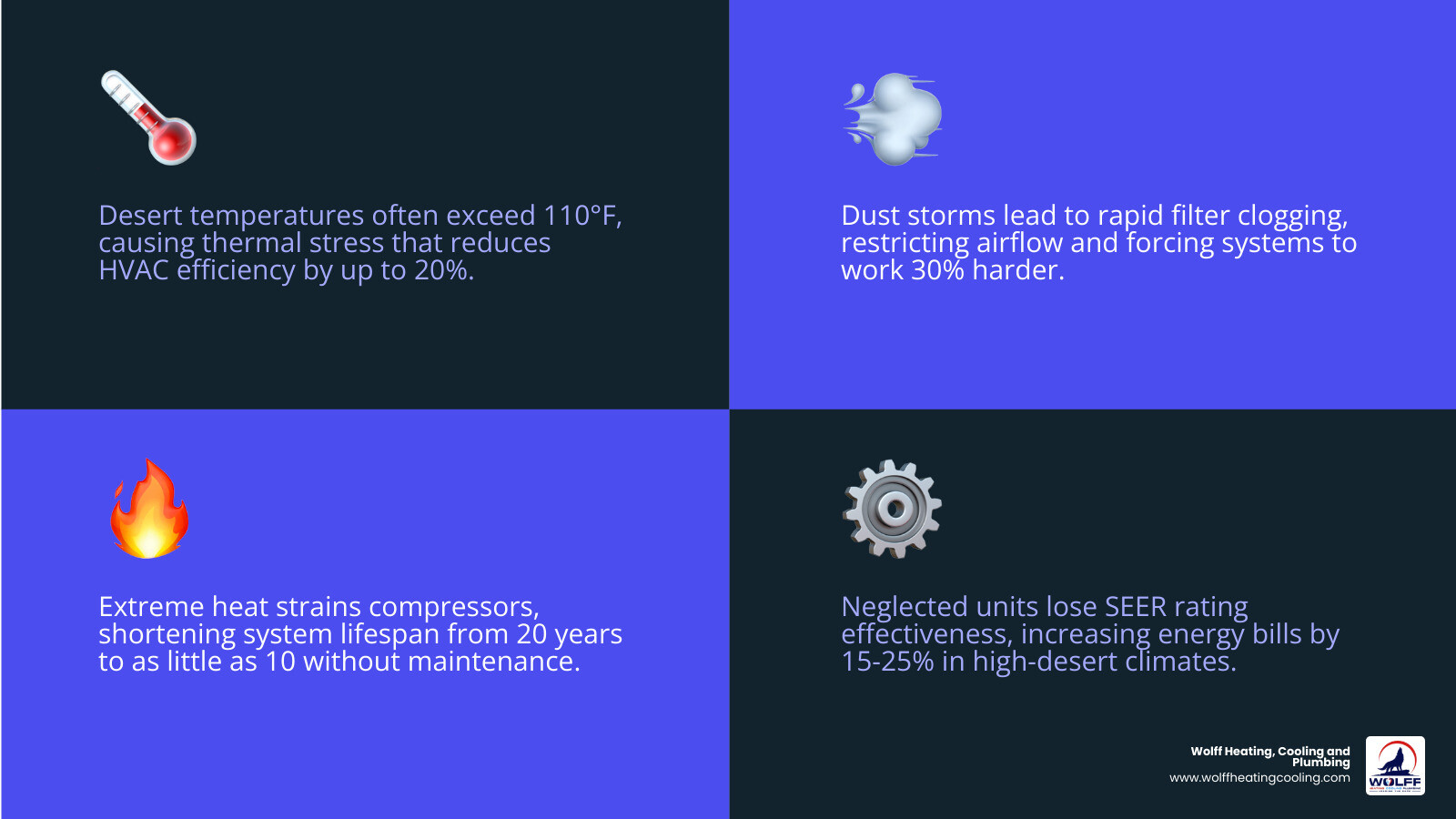
Our climate doesn’t just “warm up”; it subjects mechanical systems to a relentless thermal stress test. When outdoor temperatures soar toward 110°F, your air conditioner isn’t just running; it’s sprinting a marathon.
- Thermal Strain: For every degree the temperature rises above 95°F, your system’s efficiency (its SEER rating) drops noticeably. The hotter it gets, the harder the compressor has to work to move heat out of your home.
- Dust Accumulation: Our famous New Mexico winds carry fine silt and sand. This dust acts like a blanket on your outdoor condenser coils, insulating the heat you’re trying to get rid of and forcing the system to run longer cycles.
- Lifespan Reduction: In milder climates, an AC might last 20 years. In the desert, a neglected system might only make it 8 to 10 years. However, with proper AC Maintenance Albuquerque Homes can realistically see their systems last 15 years or more.
By Preparing ACs for Albuquerque Summers in the early spring, you ensure that the system is ready for the “heavy lift” months. Proactive care is always more affordable than an emergency repair in the middle of a July heatwave.
Monthly DIY HVAC Maintenance Tips for Desert Homeowners
While professional service is vital, there are several hvac maintenance tips for desert homeowners that you can handle yourself to keep things running smoothly between visits.
1. The Air Filter Rule In the desert, the “change every three months” rule is a myth. During the peak cooling season, you should inspect your filters every 30 days. If you have pets, live near a dirt road, or have recently experienced a dust storm, you may need to replace them monthly.
- MERV Ratings: Aim for a filter with a MERV rating between 8 and 11. This provides a balance of catching fine desert dust without “starving” your system of airflow. Filters that are too restrictive (MERV 13+) can actually cause your evaporator coil to freeze up.
2. Condensate Drain Maintenance Your AC removes humidity from the air (even in our dry climate!). This moisture collects in a drain pan and exits through a line. Over time, algae and dust can create a sludge that clogs this line.
- The Vinegar Flush: Every three months, pour a cup of distilled vinegar mixed with water down the condensate drain access point. This kills algae and prevents backups that could lead to water damage in your home.
3. Outdoor Unit Clearance Your outdoor condenser needs to breathe. Check the area around the unit and ensure there is at least two feet of clear space in all directions. Trim back any desert willow, sagebrush, or weeds. Also, gently hose down the exterior fins (when the power is off) to remove loose dirt and tumbleweed debris. For more detailed steps, check out these Tips for Maintaining Your AC System.
Maximizing Efficiency with HVAC Maintenance Tips for Desert Homeowners
Efficiency isn’t just about the machine; it’s about how the machine interacts with your home.
- Thermostat Calibration: If your thermostat is off by just a few degrees, your system may be running much longer than necessary. Consider upgrading to a smart thermostat. These devices learn your schedule and can be programmed to raise the temperature when you’re away at work in Bernalillo or Corrales, significantly reducing the “run time” on your compressor.
- Airflow Balance: Ensure all supply and return vents are open and unobstructed by furniture or rugs. Blocking vents doesn’t save energy; it actually increases pressure in the ductwork and can lead to system failure.
- Duct Sealing: In older Albuquerque homes, leaky ducts can waste up to 30% of your cooled air before it ever reaches your living room. Sealing these leaks is one of the most effective ways to lower your utility bills. Consistent AC Maintenance includes checking for these distribution issues.
Professional Seasonal Tune-Ups and System Optimization
While DIY tasks are great for day-to-day health, a professional AC Tune-Up is a deep dive into the “guts” of your system. Our technicians at Wolff Heating, Cooling, and Plumbing perform a comprehensive multi-point inspection that covers things a homeowner simply can’t see.
What We Check During a Tune-Up
- Refrigerant Levels: Low refrigerant is the #1 cause of poor cooling. Because AC systems are closed loops, low refrigerant always means there is a leak. We find and fix the leak rather than just “topping it off.”
- Electrical Connections: Heat causes wires to expand and contract, which can loosen connections over time. Loose wires generate even more heat, leading to melted components or fire risks. We tighten all connections and measure voltage and amperage.
- Lubrication: Friction is the enemy of any mechanical system. We lubricate moving parts like blower motors and fans to ensure they spin freely and quietly.
- Safety Controls: We test the system’s start cycle, operation, and shutdown sequence to ensure all safety limits are functioning correctly.
Don’t forget the other half of the year! A Furnace Tune-Up in October is essential for checking the heat exchanger for cracks and ensuring your family stays safe from carbon monoxide during the chilly high-desert winters.
Specialized Care for Desert Cooling Systems
In the Albuquerque area, we see a wide variety of cooling technologies. Each requires a different approach to maintenance.
| Maintenance Task | Refrigerated Air (Central AC) | Evaporative Cooling (Swamp Cooler) |
|---|---|---|
| Primary Filter | Disposable/Media Filter (Change monthly) | Cooling Pads (Replace annually) |
| Water Usage | Minimal (Condensate only) | Constant (Requires water line) |
| Coil Cleaning | Annual professional cleaning | N/A (Pan cleaning required) |
| Winterization | Cover outdoor unit (optional) | Drain water and install winter cover |
| Hard Water Issues | Low | High (Scale buildup on pads/pump) |
The Swamp Cooler Challenge
Many homes in Placitas and Tijeras still rely on evaporative coolers. These are highly effective in our dry air but require “swamp cooler startup” every spring. This involves deep cleaning the reservoir, checking the float valve, and ensuring the water distribution lines aren’t clogged with mineral deposits.
Heat Pump Care
Heat pumps are becoming increasingly popular in New Mexico because they provide both heating and cooling. Because they run year-round, Heat Pump Maintenance is even more critical. Since there is no “off-season” for a heat pump, the Importance of Heat Pump Maintenance cannot be overstated; these systems should be serviced every six months without fail.
When to Repair vs. Replace Your Desert HVAC System
Eventually, every homeowner faces the big question: “Do I fix it again, or is it time for a new one?” In the desert, the math changes slightly because of the extreme conditions.
The 10-Year and 50% Rules
- The 10-Year Rule: If your system is over 10 years old and requires a major repair, it’s time to start looking at replacement. In Albuquerque’s heat, a 10-year-old unit is often reaching the end of its efficient life.
- The 50% Rule: If the cost of a repair is more than 50% of the value of a new system, replacement is almost always the smarter financial move.
The R-22 and SEER2 Factor
If your unit was manufactured before 2010, it likely uses R-22 refrigerant (Freon), which has been phased out. Repairs involving R-22 are now prohibitively expensive. Furthermore, new SEER2 standards introduced in 2023 mean that modern units are significantly more efficient than those from even five years ago.
If you notice your utility bills rising every summer despite regular maintenance, or if you have inconsistent temperatures across your home, your AC Needs Professional Maintenance to determine if a replacement is due. For a deeper look at your options, see our Guide to AC Maintenance and Repair.
Frequently Asked Questions about Desert HVAC Care
How often should I change my air filter in a dusty climate?
In Albuquerque, we recommend checking your filter every single month. During “monsoon season” or after a particularly windy spring week, dust can clog a filter in as little as 20 days. A clogged filter restricts airflow, which makes your blower motor work harder and can eventually cause the entire system to overheat. For the best results, use MERV 11 filters to capture fine desert silt.
What is the best thermostat setting for desert summers?
The Department of Energy recommends setting your thermostat to 78 degrees Fahrenheit when you are at home. For every degree you set it below 78, your energy consumption increases by about 6% to 8%. Use a smart thermostat to schedule a “recovery time”—cooling the house down just before you arrive home from work, rather than keeping it at 72 degrees all day while the house is empty.
Why is my AC freezing up in the middle of a heatwave?
It sounds counterintuitive, but an AC can turn into a block of ice even when it’s 100°F outside. This is usually caused by airflow restriction. If the air can’t move across the evaporator coil, the refrigerant inside stays too cold, causing the moisture in the air to freeze on the coil. The most common culprits are dirty air filters, blocked return vents, or low refrigerant levels. If you see ice on your indoor or outdoor lines, turn the system off immediately and call for a professional diagnosis to prevent compressor damage.
Conclusion
Desert living offers beautiful sunsets and wide-open spaces, but it demands respect for the environment — and that includes your home’s mechanical systems. By following these hvac maintenance tips for desert homeowners, you aren’t just saving money on your monthly bills; you’re ensuring that your home remains a sanctuary when the New Mexico sun is at its peak.
At Wolff Heating, Cooling, and Plumbing, we bring over 25 years of experience to every home in Albuquerque, Rio Rancho, and the surrounding mountain communities. We know the unique challenges of the high desert, from hard water buildup in swamp coolers to the impact of high-altitude air on furnace combustion. Our honest estimates and superior service are designed to give you peace of mind all year long.
Don’t wait for the first 100-degree day to find out your system isn’t up to the task. Schedule your comprehensive maintenance today and keep your cool all summer long.
Talk to a real Albuquerque technician.
Tell us what's going on and our Wolff team will reach out — usually within the hour during business hours. For emergencies, call us directly anytime.
Call us(505) 269-1429- Emergency Service Available
- Licensed & Insured
- 4.9★ from 130+ Google reviews
- Albuquerque, NM & 13 nearby towns
2420 Comanche Rd NE C3, Albuquerque, NM 87107
Request your service
No obligation. We never sell your info.