
 Menu
Menu
How Old Is Too Old for an HVAC System? Here Are the Key Thresholds
Knowing how old is too old for an HVAC system can save you from a surprise breakdown on the hottest day of an Albuquerque summer — or the coldest night of a New Mexico winter. As a general rule, most systems reach the end of their reliable service life somewhere between 10 and 20 years, depending on the type of equipment and how well it has been maintained.
Here is a quick reference by system type:
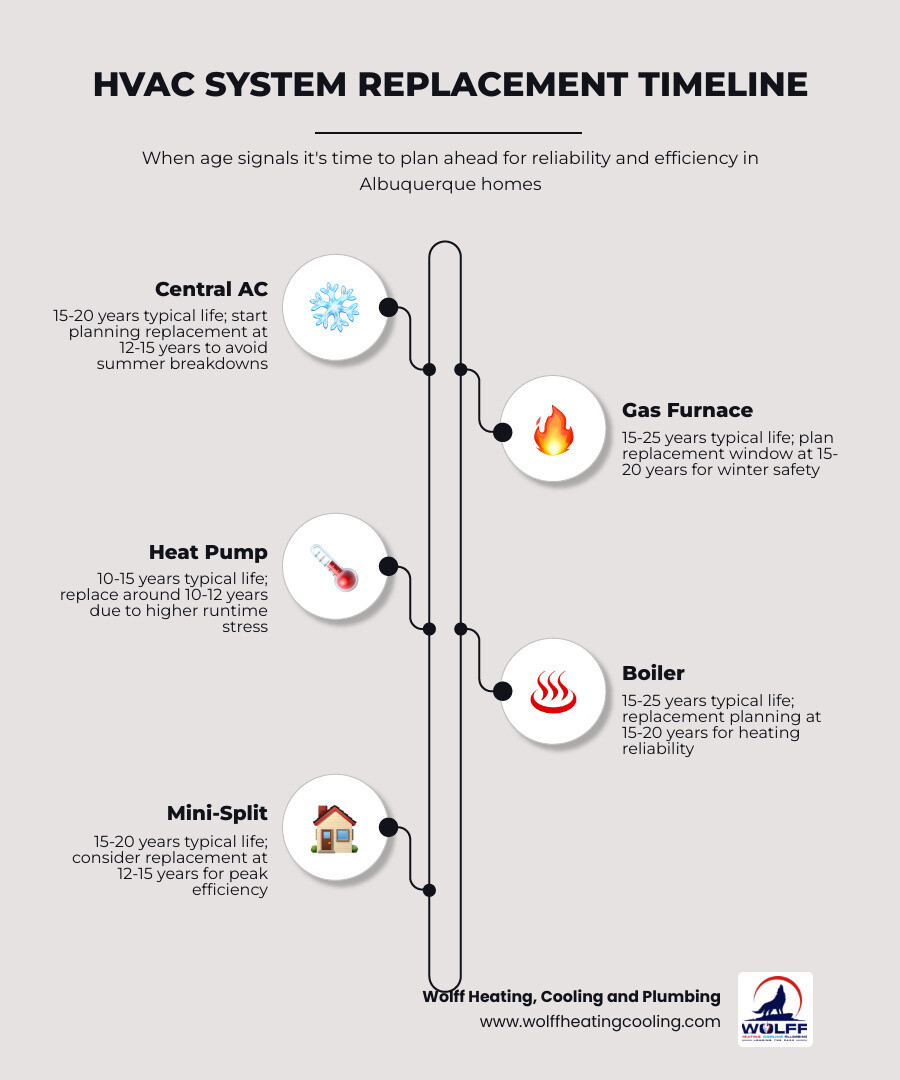
| HVAC System Type | Typical Lifespan | Start Planning Replacement |
|---|---|---|
| Central Air Conditioner | 15-20 years | Around 12-15 years |
| Gas Furnace | 15-25 years | Around 15-20 years |
| Heat Pump | 10-15 years | Around 10-12 years |
| Boiler | 15-25 years | Around 15-20 years |
| Ductless Mini-Split | 15-20 years | Around 12-15 years |
If your system is approaching or past these windows — especially if you are also seeing rising energy bills, more frequent repairs, or uneven temperatures — it is worth taking a closer look before it fails at the worst possible moment.
Age is only one piece of the picture, though. A 12-year-old system that has been well-maintained in a moderate climate may have years of reliable life left. A poorly maintained unit in a harsh environment can wear out much sooner. The sections below walk you through exactly how to check your system’s age, spot the warning signs that matter, and decide whether repair or replacement makes more sense for your home.
How old is too old for an HVAC system? Start with the age ranges
When we talk about whether an HVAC system is “too old,” we are usually looking at the “wear-out phase.” This is the period in a machine’s life where the cost of keeping it running begins to outweigh the benefits of its service. In our experience serving the Albuquerque area for over 25 years, we have seen that every piece of equipment has its own unique “retirement age.”
Average lifespan of central AC, furnaces, heat pumps, boilers, and mini-splits
Different components of your home comfort system face different levels of stress. Here is the breakdown of what you can expect from each:
- Central Air Conditioners (15–20 years): Modern AC units are built to be efficient, but they live outdoors and face the elements. While some can stretch to 20 years with professional care, many begin to lose significant efficiency after the 12-year mark.
- Gas Furnaces (15–25 years): Furnaces tend to be the marathon runners of the HVAC world. Because they only run during the heating season and stay tucked away indoors, they often last longer than ACs. However, safety becomes a major concern once they cross 20 years.
- Heat Pumps (10–15 years): Heat pumps work twice as hard because they provide both heating and cooling. Since they run year-round, they typically have a shorter lifespan than a dedicated furnace or AC.
- Boilers (15–25 years): Modern steel boilers are reliable for about two decades, while older cast-iron models have been known to chug along for 30 years or more if the water chemistry is kept in check.
- Ductless Mini-Splits (15–20 years): These are highly efficient, but because they rely on sophisticated electronics and sensitive inverter technology, their lifespan mirrors that of a standard central AC.
Why age alone does not answer how old is too old for an HVAC system
We often tell our neighbors in Rio Rancho and Bernalillo that a manufacture date is just a number. The “real” age of your system is determined by how hard it has worked and how well it has been treated.
A system that was incorrectly sized—meaning it is too big or too small for the home—will “short cycle” or run constantly, adding years of wear and tear in a very short time. Furthermore, a unit that has missed its annual check-ups is essentially aging in “dog years.” Dirt and neglect are the leading causes of premature failure. To keep your system from hitting that “too old” wall early, we recommend following a regular schedule. You can learn more about this in our guide on Don’t Wait for a Breakdown: How Often to Schedule Tune-Ups.
How Albuquerque weather can shorten or extend equipment life
Our local climate is unique, and it definitely plays a role in answering how old is too old for an HVAC system. Albuquerque’s high heat and dry air are tough on outdoor condensers. Even more significant is the dust. Fine New Mexico dust can coat coils and clog motors, forcing the system to work much harder to move air.
If your system sits through our dusty springs without a cleaning, it’s like trying to run a race while breathing through a thick cloth. This extra strain leads to overheating and electrical surges. This is why we emphasize that Is Annual HVAC Maintenance Worth It or Just Hot Air?—in our desert environment, it is absolutely essential for reaching that 20-year milestone.
How to find the exact age of your HVAC system
Before you can decide if your system is too old, you need to know exactly how old it is. If you didn’t live in the house when the system was installed, you’ll need to do a little detective work.
Check the nameplate first for a manufacture date
The easiest way to find the age is to look for the manufacturer’s nameplate (also called a data plate) on the side of the unit. For your air conditioner or heat pump, this is on the outdoor cabinet. For your furnace, you may need to pop off the front door panel to see the label inside.
Look for a field labeled “MFR DATE,” “Manufacture Date,” or “Date of Mfr.” If it’s there, your job is done! You’ll see a month and year that tells you exactly when the unit left the factory.
Decode model and serial numbers when the date is missing
If the manufacture date isn’t clearly listed, don’t worry. The age is hidden inside the serial number. Most manufacturers use a code where the first few digits represent the week and year. For example, a serial number starting with “1208” might mean the unit was built in the 12th week of 2008.
However, every brand (like Trane, Carrier, or Rheem) has a different coding system. You can usually find a brand-specific “serial number decoder” online, or you can check the refrigerant label. If your unit uses R-22 refrigerant (often called Freon), it was almost certainly manufactured before 2010.
Other ways to verify age if labels are faded or missing
Sometimes the New Mexico sun fades those labels until they are unreadable. If that’s the case, try these alternatives:
- Service Stickers: Look for stickers left by previous HVAC technicians. They often write the installation date or the dates of past repairs.
- Home Inspection Report: If you bought your home recently, the inspector likely noted the age of the HVAC system in their report.
- Permit Records: In areas like Albuquerque and Bernalillo, HVAC installations require a permit. You can often check local building department records to see when the last permit was pulled for your address.
- Installer Records: If you see a company name on the unit, give them a call. They may have the installation date in their digital files.
Warning signs your system is too old even if it still runs
A system doesn’t have to stop working entirely to be “too old.” In fact, many systems continue to “run” while costing the homeowner a fortune in inefficiency and stress.
How old is too old for an HVAC system when performance starts slipping?
By the time a central AC reaches 12 years old, it is often running at only 80-85% of its original efficiency. You might notice that the system has to run for much longer cycles to reach the temperature set on the thermostat.
Are there “hot spots” in your living room or “cold spots” in the bedrooms? As components age, the blower motor and compressor lose their “oomph,” leading to poor airflow and uneven cooling. If you’re noticing these issues, it’s a sign that the system is struggling to keep up with Albuquerque demands. We have a detailed list of these Signs You Need AC Repair that can help you identify if the issue is a simple fix or a sign of old age. Similarly, for winter issues, check our guide on When to Call for Furnace Repair.
Repair frequency, breakdown patterns, and major component failures
If you feel like you have your HVAC technician on speed dial, your system is likely too old. We generally see a “repair spiral” start around year 12 to 15. One year it’s a capacitor, the next it’s a fan motor, and suddenly you’re facing a failed compressor.
Major component failures—like a dead compressor or a leaked evaporator coil—are often the “final straw” for an aging system. Replacing these parts can be very expensive, and putting a brand-new compressor into a 15-year-old system is like putting a new engine in a car with 300,000 miles. You can find more about these AC Problems and Professional Solutions on our blog, or specifically read about Signs Your AC Compressor Is Failing.
Safety and refrigerant red flags that push replacement higher on the list
Some signs aren’t just about comfort—they are about safety. For a furnace, a cracked heat exchanger is a critical failure because it can leak carbon monoxide into your home. If you smell a faint “burning” odor or gas, or if your furnace is making strange noises, it’s time for an immediate check. Our article on Furnace Not Working Albuquerque covers these red flags in detail.
For air conditioners, the type of refrigerant matters immensely. If your system uses R-22, it is effectively obsolete. Production of R-22 was banned years ago, and the cost to “top off” a system with a leak is now astronomical. If an old R-22 system develops a leak, it is almost always “too old” to justify the repair. If you’re wondering Why AC Isn’t Cooling in Albuquerque, a refrigerant leak in an old unit is a very common culprit.
Repair or replace? Use simple homeowner rules of thumb
When your system hits that 12-to-15-year mark and breaks down, you face a tough choice. To make it easier, we use a few simple rules of thumb to help our customers in Placitas and Corrales decide.
The 50% rule and the $5,000 rule explained simply
These two rules are common ways homeowners think through the decision:
- The 50% Rule: If a single repair is a significant share of what a full replacement would involve, replacement is often the better long-term move because the rest of the system is still aging.
- The $5,000 Rule: Some homeowners use a simple formula that multiplies the age of the system by the repair amount to help guide the decision. If the result is high, replacement may make more sense than continuing to invest in older equipment.
You can dive deeper into these frameworks in our article, The 5000 Rule and Other Ways to Decide If Your HVAC Is Toast.
When repair still makes sense on an older system
Age isn’t an automatic disqualifier. Repairing an older system makes sense if:
- The fix is minor (like a clogged drain line or a simple capacitor).
- The system has been meticulously maintained and still cools/heats evenly.
- The unit is still under a parts warranty.
- You are not planning a full system upgrade yet and the equipment is otherwise performing well.
When replacement is usually the smarter move
Replacement is the clear winner when:
- You have had more than two repairs in the last two years.
- The system uses R-22 refrigerant and has a leak.
- There is a major safety risk, like a cracked heat exchanger.
- Your energy bills have spiked noticeably without a change in usage.
- You are dealing with Heat Pump Issues in Albuquerque where the unit runs constantly but never reaches the set temp. For more on that, see Heat Pump Keeps Running Fix It Fast.
What you gain by replacing an older HVAC system in 2026
If you decide your system is “too old,” the good news is that the HVAC technology available in 2026 is lightyears ahead of what was installed in 2010.
Efficiency, comfort, and reliability upgrades homeowners notice right away
Modern systems use SEER2 (Seasonal Energy Efficiency Ratio) ratings that are significantly higher than older units. Replacing a 15-year-old unit with a new high-efficiency model can reduce your cooling electricity use significantly.
Beyond the bills, you’ll notice:
- Variable-Speed Technology: Instead of being “all on” or “all off,” these systems adjust their speed to match your home’s needs exactly, leading to much steadier temperatures.
- Quieter Operation: New units are designed with sound-dampening materials that make them whisper-quiet compared to the “clunk and rattle” of old systems.
- Better Humidity Control: In our dry climate, this might seem less vital, but proper humidity control actually makes the air feel more comfortable at higher temperatures.
Why refrigerant changes matter in 2026
The HVAC industry is currently in the middle of a major transition. R-22 is gone, and R-410A (the “standard” for the last 15 years) is currently being phased down by the EPA. By replacing your system in 2026, you are moving to the newest generation of refrigerants. This helps ensure your system will be easier to service over the long term rather than relying on older refrigerants.
Tax credits, rebates, and incentives that may help in 2026
2026 is a good year to upgrade because of the incentives available. Thanks to the Inflation Reduction Act and local utility programs, qualifying homeowners may be able to offset part of the project. Here are some common incentive types:
- Federal Tax Credits: Qualifying heat pumps, central ACs, and furnaces may be eligible for federal tax incentives.
- Utility Rebates: Local providers in the Albuquerque area often offer rebates for switching to ENERGY STAR certified equipment.
- Manufacturer Rebates: Many brands offer seasonal incentives on qualifying systems.
Replace both indoor and outdoor components for best results
One mistake we see is homeowners trying to “save money” by only replacing the outdoor unit. In 2026, HVAC systems are designed as “matched pairs.” If you put a new, high-efficiency outdoor condenser on an old, dirty indoor evaporator coil, the system will never reach its rated efficiency. It can even cause the new compressor to fail prematurely and will almost certainly void your manufacturer warranty. Always replace the full system to get the performance you’re paying for.
Frequently Asked Questions about how old is too old for an HVAC system
Can an HVAC system last 20 years or more?
Yes, but it’s rare. We usually only see this with high-quality gas furnaces or cast-iron boilers that have been pampered with annual professional maintenance. For an air conditioner in the Albuquerque heat, 20 years is the absolute upper limit, and by that point, the system is usually a liability that could fail at any moment.
Should you replace an HVAC system just because it is 10 to 12 years old?
Not necessarily. If your 10-year-old system is running perfectly, your bills are stable, and our technicians give it a clean bill of health during a tune-up, keep it! However, 10 to 12 years is the perfect time to start a “replacement fund” so you aren’t caught off guard when the time eventually comes.
Is a system with unusual sounds or weak airflow automatically too old?
Not always. A squealing sound could just be a slipped belt, and weak airflow might be a simple clogged filter. However, if the system is over 15 years old and starts making “ghost in the attic” noises, it’s often a sign of mechanical failure. For help diagnosing those sounds, check out Unusual AC Sounds in Albuquerque.
Conclusion
Determining how old is too old for an HVAC system is about balancing age, performance, and reliability. While most systems in our Albuquerque climate start showing their age around the 12-to-15-year mark, the best way to know for sure is through a professional evaluation.
At Wolff Heating, Cooling, and Plumbing, we’ve spent over 25 years helping homeowners and business owners in Rio Rancho, Placitas, and throughout the valley make these decisions with confidence. We pride ourselves on honest guidance—if your system has good life left, we’ll tell you. If it’s a safety hazard, we’ll show you why.
Don’t wait for a total breakdown to start thinking about your home’s comfort. Whether you need a simple tune-up to extend your system’s life or help planning a modern, high-efficiency upgrade, we are here to help. Contact us today for more info about HVAC services and let’s keep your home comfortable for years to come.