
 Menu
Menu
Is It Time to Fix It or Finally Replace It? Here’s How to Tell
Knowing when to repair vs replace your HVAC system can save you from throwing money at a unit that’s already on its last legs — or from replacing something that had years of good service left. It’s one of the most common and costly decisions homeowners face, and there’s no single right answer. But there are some clear rules of thumb that make the choice a lot easier.
Here’s a quick breakdown to guide your decision:
| Situation | Likely Best Move |
|---|---|
| System is under 10 years old, minor issue | Repair |
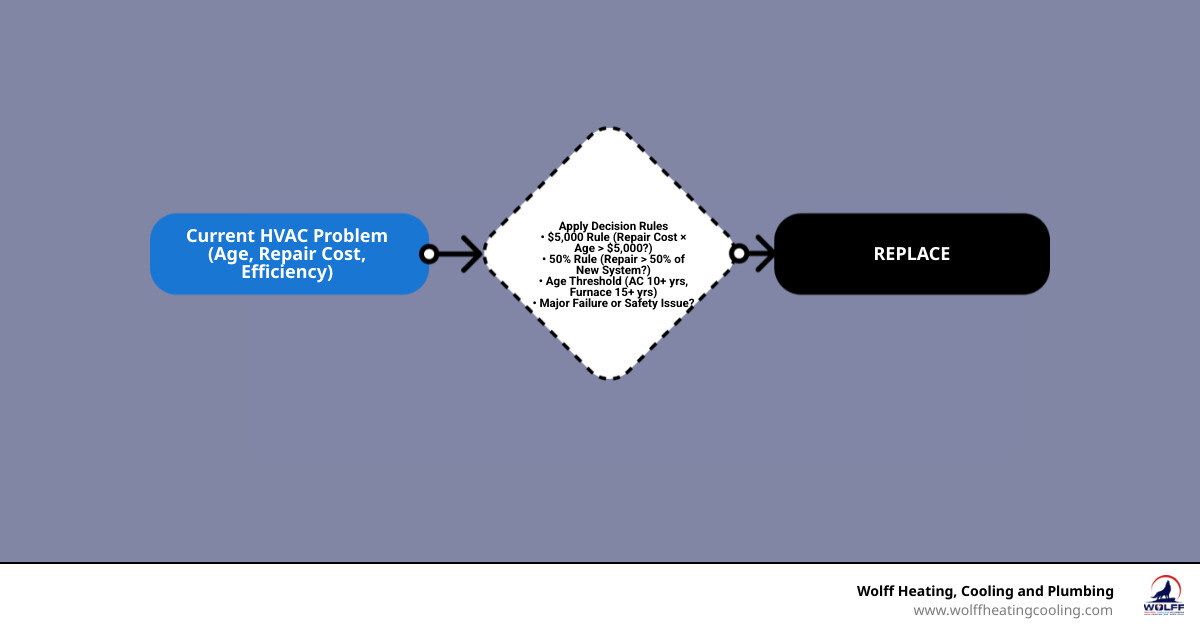
| Repair cost × system age exceeds $5,000 | Replace |
| Repair cost is more than 50% of a new system | Replace |
| System is 10+ years (AC) or 15+ years (furnace) | Strongly consider replacing |
| Major component failure (compressor, heat exchanger) | Replace |
| Safety issue (carbon monoxide, gas leak) | Replace immediately |
| System under warranty, first major issue | Repair |
Most HVAC systems last somewhere between 10 and 20 years depending on the type and how well they’ve been maintained. Air conditioners and heat pumps typically hit their limit around the 10-to-12-year mark. Furnaces can go 15 to 20 years before they’re truly done. Once a system starts creeping toward those thresholds — especially if repairs are becoming more frequent — the math often starts favoring replacement over another fix.
The tricky part is that a $300 repair bill can look like the obvious choice until you realize it’s the third repair this year on a 14-year-old system. That’s where structured decision rules like the $5,000 rule and the 50% rule come in. They take the guesswork out of what can feel like a high-stakes judgment call.
Understanding the Lifespan of Your Heating and Cooling Equipment
When we talk about the lifespan of an HVAC system, we aren’t just talking about when it stops turning on. We’re talking about its “economic life”—the point where it costs more to keep it running than it’s worth. In a climate like Albuquerque’s, where our summers are scorching and our winter nights in the High Desert get surprisingly frosty, your equipment works hard.
Air Conditioner and Heat Pump Longevity
Typically, air conditioners and heat pumps have a lifespan of about 10 to 12 years. Because these units sit outside, they are exposed to the elements—sun, dust, and wind—which can wear down the coils and electrical components. If you’ve noticed signs you need AC repair, such as strange smells or weak airflow, it’s worth checking the manufacturing date on the unit’s nameplate. If it’s pushing 12 years, that “minor” fix might just be the start of a long line of breakdowns.
Furnace Durability
Furnaces are the heavy lifters of the HVAC world. Because they live indoors (usually in a closet, basement, or attic) and have fewer moving parts than an AC compressor, they tend to last longer—usually 15 to 20 years. However, an aging furnace can develop cracks in the heat exchanger, which is a major safety risk. Recognizing signs you need furnace repair early can help you decide if a simple part replacement will do or if the unit is truly “toast.”
The Impact of Maintenance and Environment
A system that has been professionally maintained every year can easily outlast one that’s been ignored. Regular cleanings prevent the motor from overworking and keep those utility bills from spiking. Conversely, environmental factors like the heavy dust we experience in Rio Rancho or Bernalillo can clog filters and coils, shortening equipment life if not addressed.
Typical Equipment Lifespans:
- Air Conditioners: 10–12 years
- Heat Pumps: 10–12 years
- Furnaces: 15–20 years
- Ductwork: 20–25 years (though leaks often start much sooner!)
When to Repair vs Replace Your HVAC System: The Golden Rules
Deciding when to repair vs replace your HVAC system doesn’t have to be a shot in the dark. In the industry, we use a few “Golden Rules” to help homeowners make an objective choice. These rules help protect your investment and ensure you aren’t “throwing good money after bad.”
The 50% Rule
This is the simplest rule to remember: If the cost of the repair is 50% or more of the cost of a brand-new system, you should almost always replace it. Why? Because even after you spend that money on a repair, you still have an old, inefficient system that is likely to break down again soon. Choosing to repair or replace your heat pump based on this percentage ensures you’re looking at long-term value rather than just the immediate bill.
Investment Protection
Think of your HVAC system like a car. You wouldn’t put a brand-new transmission into a 20-year-old sedan with 300,000 miles on it, right? The same logic applies here. Replacing an old unit provides you with a fresh warranty, better reliability, and significantly lower monthly energy costs.
Applying the $5,000 Rule to Your System
The “$5,000 Rule” is a favorite among technicians because it factors in the age of the unit, which is often the biggest predictor of future failure.
How to calculate it:
- Take the age of your system in years.
- Multiply that age by the repair estimate you received.
- If the total is more than $5,000, it’s time to replace.
- If the total is less than $5,000, a repair is likely the more economical choice.
Example: You have a 12-year-old AC unit that needs a $500 repair. 12 x 500 = $6,000. Since $6,000 is greater than $5,000, the rule suggests you should replace the unit.
Major Component Failure
There are some parts that are so vital that their failure almost always triggers a replacement. For instance, knowing the signs your AC compressor is failing is crucial. The compressor is the “heart” of your AC. If it dies out of warranty, the labor and part costs are so high that a full replacement is usually the only move that makes sense economically.
When to Repair vs Replace Your HVAC System Based on Age
As we move through 2026, technology is advancing faster than ever. If your AC was installed before 2014, it’s likely using outdated technology and inefficient refrigerants.
- The 10-Year AC Threshold: Once an air conditioner hits a decade, its efficiency starts to drop significantly. Modern units are designed to much higher standards (SEER2), meaning a new unit could pay for itself in energy savings over just a few years.
- The 15-Year Furnace Limit: If your furnace is over 15 years old, ENERGY STAR recommends considering a replacement. There are many furnace installation or replacement signs that appear around this age, such as a pilot light that won’t stay lit or a blower motor that hums constantly.
Efficiency and Performance Indicators for Replacement
Sometimes the decision isn’t forced by a total breakdown. Sometimes, your system is “working,” but it’s doing a terrible job. If you’re constantly adjusting the thermostat or your utility bills are skyrocketing, your system is sending you a message.
SEER2 and AFUE Ratings
- SEER2 (Seasonal Energy Efficiency Ratio): This measures how much cooling you get for every watt of electricity used. Older units might have a SEER rating of 8 or 9. Today, standard units are 14 or 15, and high-efficiency models can go well above 20. Switching from a SEER 9 to a SEER 14 can reduce your energy consumption by more than 35%!
- AFUE (Annual Fuel Utilization Efficiency): This applies to furnaces. An old furnace might have an AFUE of 80%, meaning 20% of the energy you pay for is literally going up the chimney. Modern high-efficiency furnaces can reach 95% or higher.
Rising Utility Bills and Airflow Issues
Have you noticed your energy bills creeping up every year, even though you haven’t changed your habits? HVAC equipment accounts for about 50% of a home’s energy use. As parts wear out, they have to work longer and harder to reach the same temperature. If you combine an aging unit with the fact that the average home ductwork leaks 30% of its air before it even reaches your rooms, you’re looking at a lot of wasted money. If you’re in Albuquerque and considering an AC replacement, the efficiency gains alone can be a massive motivator.
When to Repair vs Replace Your HVAC System for Energy Savings
Upgrading to a new system isn’t just about avoiding repairs; it’s about a lifestyle upgrade.
- ENERGY STAR Benefits: Replacing a 10+ year old system with an ENERGY STAR certified model can save you 20% to 40% on your monthly heating and cooling costs.
- The R-22 Phase-Out: If your old AC uses R-22 refrigerant (Freon), you’ve probably noticed that repairs involving refrigerant are now incredibly expensive. R-22 was phased out because it’s harmful to the ozone layer. Modern systems use R-410A or newer, more eco-friendly alternatives that are cheaper to service and much better for our New Mexico environment.
- Variable-Speed Technology: Older systems are either “on” or “off.” Modern variable-speed systems can run at lower speeds to maintain a perfectly steady temperature, which also helps with humidity control—a huge plus during our “monsoon” humidity spikes. If you replace your heat pump in Albuquerque, you’ll likely notice a much quieter, more comfortable home immediately.
Critical Factors: Safety, Comfort, and Homeownership Plans
While math and efficiency are important, safety and comfort are the true deal-breakers.
Safety First: Red-Flag Symptoms
There are some situations where we will always recommend replacement over repair for the safety of your family:
- Carbon Monoxide Risks: A cracked heat exchanger in a furnace can leak odorless, colorless, and lethal carbon monoxide into your home. If your furnace is old and showing signs of heavy corrosion, it’s a ticking time bomb.
- Fire Hazards: Frayed wiring or overheating motors in an old AC unit can pose a fire risk, especially in the dry heat of Placitas or Cedar Crest.
- Gas Leaks: Any compromise in the gas valves or delivery system of an older furnace is a major red flag.
If you suspect any of these, you need to look into a furnace replacement immediately.
Comfort and Uneven Temperatures
Does your bedroom feel like a sauna while your living room is an icebox? This is often a sign that your system is no longer sized correctly for your home or that the blower motor is failing. While duct sealing can help, an underperforming unit will always struggle to provide even comfort. We often see this in older homes in the North Valley or Corrales where additions have been made, but the original HVAC system was never upgraded to handle the extra space. Checking out furnace options in Albuquerque can show you how modern zoning can fix these “hot spots” for good.
Your Moving Timeline
Are you planning to sell your home in the next year or two? If so, a minor repair might be the way to go, provided the system is safe. However, keep in mind that savvy buyers in 2026 will ask for the age of the HVAC system. A brand-new, energy-efficient system can be a major selling point and may even allow you to ask for a higher sale price. If you plan to stay in your home for 5+ years, replacement is almost always the better financial move due to the cumulative energy savings.
Frequently Asked Questions about HVAC Decisions
Should I replace the entire HVAC system or just individual components?
We almost always recommend replacing the entire system (both the indoor and outdoor units) at the same time. HVAC systems are designed to work as “matched pairs.” If you hook up a brand-new, high-efficiency outdoor AC unit to an old, dirty indoor coil, the system won’t reach its rated efficiency, and you’ll likely void the manufacturer’s warranty. Plus, you’ll just be waiting for the old part to break down next. Doing a full AC installation ensures everything is under warranty and running at peak performance.
Are there financial incentives or tax credits for upgrading in 2026?
Yes! Thanks to the Inflation Reduction Act, there are significant federal tax credits available for homeowners who upgrade to high-efficiency equipment.
- Heat Pumps: You can often claim a tax credit of up to 30% (capped at $2,000) for qualifying heat pump installations.
- Furnaces and ACs: There are smaller but still significant credits for high-efficiency gas furnaces and central AC units.
- Utility Rebates: Local utility companies in New Mexico often provide instant rebates for switching to ENERGY STAR certified equipment. These incentives can make the “replace” option much more attractive than a costly repair.
How important is a professional inspection in this decision?
It is absolutely vital. A YouTube video or a blog post can give you the “rules,” but a professional technician can see things you can’t. We use specialized tools to check for microscopic cracks in heat exchangers, measure refrigerant pressure, and assess the health of your ductwork. An expert diagnostic is the only way to get an accurate sizing for a new system. If your current system was oversized (a common mistake), it will “short-cycle,” turning on and off too frequently, which kills efficiency and wears out the motor. Getting a professional heat pump installation starts with a proper load calculation for your specific home.
Conclusion
Deciding when to repair vs replace your HVAC system is a big choice, but you don’t have to make it alone. By using the $5,000 rule, keeping an eye on the age of your equipment, and staying alert for safety red flags, you can make a decision that keeps your home comfortable and your bank account healthy.
At Wolff Heating, Cooling, and Plumbing, we’ve spent over 25 years helping our neighbors in Albuquerque, Rio Rancho, and the surrounding areas navigate these exact dilemmas. We pride ourselves on providing honest estimates and superior work—we aren’t here to sell you something you don’t need, but we are here to make sure your family stays safe and cool.
If your system is making scary noises or your energy bills are making you wince, it’s time for an expert opinion. Whether you need a simple fix or a complete furnace install, we’re ready to help.
Don’t wait for a total system failure in the middle of a heatwave.
Schedule your expert HVAC evaluation in Albuquerque today