
 Menu
Menu
Refrigeration vs. Evaporation: Which Cooling System Is Right for Your Albuquerque Home?
A swamp cooler vs central ac comparison comes down to one core question: does your home need moisture added to the air, or removed from it? In Albuquerque’s high-desert climate, that distinction matters more than almost anywhere else in the country. Spring and early summer air is bone dry — perfect conditions for an evaporative cooler to shine. But once monsoon season rolls in, the calculus shifts fast. Homeowners across the Albuquerque area find themselves stuck between a system that’s cheap to run and a system that actually keeps up with the weather.
Here’s a quick breakdown to help you decide:
| Factor | Swamp Cooler | Central AC |
|---|---|---|
| Best climate | Dry (humidity below 50%) | Any climate, including humid |
| How it cools | Evaporates water to add cool, moist air | Removes heat and humidity using refrigerant |
| Energy use | Low (200–400 watts) | Higher (3,000–5,000 watts) |
| Windows required | Yes — needs open windows for airflow | No — closed system, windows stay shut |
| Humidity impact | Adds moisture (great for dry air) | Removes moisture (ideal in humid conditions) |
| Monsoon performance | Drops significantly above 50% humidity | Consistent regardless of outdoor humidity |
| Air filtration | Brings in fresh outdoor air | Recirculates and filters indoor air |
| Maintenance | More frequent (pads, water tank, pump) | Less hands-on (filter changes, annual tune-up) |
| Typical lifespan | 10–15 years | 15–20 years |
| Installation complexity | Lower | Higher (requires ductwork) |
The short answer: swamp coolers are a smart, low-cost option during Albuquerque’s dry months, but central AC delivers reliable, consistent comfort year-round — especially when the monsoons hit. The right choice depends on your home’s layout, your tolerance for maintenance, and how you want to feel on the most uncomfortable days of summer.
Read on for a full breakdown of how each system works, how they compare on cost and air quality, and what makes sense for high-desert living in 2026.
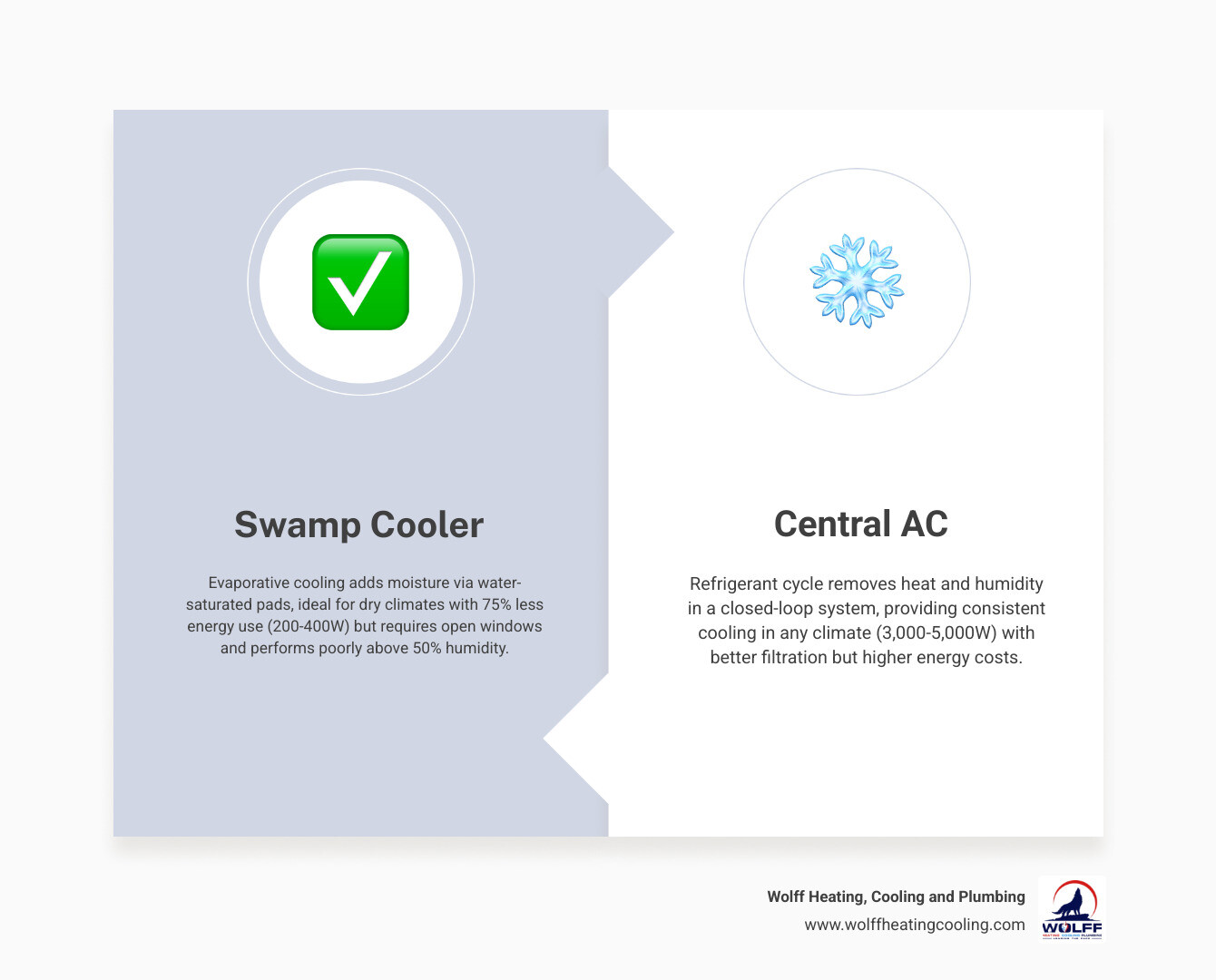
The Mechanics of Cooling: How Each System Works
To truly understand the swamp cooler vs central ac comparison, we have to look under the hood. While both systems aim to keep you from melting during a July afternoon in Rio Rancho, they use completely different laws of physics to get there.
The Evaporation Process (Swamp Coolers)
Think about how you feel when you step out of a swimming pool on a breezy day. Even if it’s 90 degrees out, you feel a sudden chill. That’s evaporative cooling in action. A swamp cooler—technically called an evaporative cooler—mimics this process.
It uses a pump to saturate thick cooling pads with water. A large fan pulls hot, dry outdoor air through these wet pads. As the water evaporates, it absorbs heat from the air, dropping the temperature significantly. This cooled, moistened air is then blown into your home. It’s an “open” system, meaning it constantly pulls in fresh air and pushes old air out. Because of this, our team often performs Ac Service Albuquerque Nm/ to ensure the pumps and pads are in top shape before the heat peaks.
The Refrigerant Cycle (Central AC)
Central air conditioning, or refrigerated air, works more like your kitchen refrigerator. It is a “closed-loop” system that recirculates the air already inside your home. Instead of adding moisture to cool things down, it uses a chemical refrigerant to “grab” heat from your indoor air and dump it outside.
The process involves four main components: a compressor, a condenser, an expansion valve, and an evaporator coil. As warm air from your house passes over the cold evaporator coil, the refrigerant absorbs the heat. The now-cooled air is sent back through your ducts, while the heat is carried outside to the condenser unit. This process inherently removes humidity, which is why you’ll see a little drain line dripping water outside your house. If your system isn’t blowing cold, you might need a professional Ac Repair Albuquerque Nm/ to check for refrigerant leaks or electrical issues.
Swamp Cooler vs Central AC Comparison: Pros and Cons
Choosing between these two isn’t just about the technology; it’s about how you live. Each system requires a different level of interaction from the homeowner.
For a swamp cooler to work, you must have windows or vents open. If you don’t provide a way for the air to escape, the house will become pressurized, the airflow will stop, and your living room will start feeling like a literal swamp. This “open-window” policy is great for fresh air, but it can be a security concern or a nuisance if it’s a dusty, windy day in Bernalillo.
Central AC, on the other hand, requires your home to be sealed tight. This allows for precise temperature control. You can set your thermostat to 72 degrees and expect it to stay there, regardless of whether it’s 100 degrees or 85 degrees outside. However, this convenience comes with the need for regular Ac Maintenance Albuquerque Homes/ to keep those sensitive internal components running efficiently.
Swamp Cooler vs Central AC Comparison for Indoor Air Quality
Indoor air quality (IAQ) is a major factor for families in the high desert.
- Swamp Coolers: These systems provide a constant stream of fresh, filtered outdoor air. This can be great for clearing out indoor odors or CO2. However, because you have to leave windows open, you are also inviting in whatever is floating around outside—pollen, dust, and smoke from regional wildfires. The pads do some filtering, but they aren’t nearly as effective as high-efficiency HVAC filters.
- Central AC: Since the system is closed and recirculates air, it can utilize advanced filtration. We can install MERV-rated filters or even UV light purifiers within our Hvac/Albuquerque Nm/Air Conditioning Services/ to trap allergens, pet dander, and fine dust. For allergy sufferers in Cedar Crest or Tijeras, central AC is usually the clear winner.
Swamp Cooler vs Central AC Comparison for Humidity Control
In Albuquerque, we deal with extreme dryness for most of the year.
A swamp cooler acts as a giant humidifier. This is a massive “pro” during the dry spring months when your skin is cracking and your sinuses feel like sandpaper. It adds much-needed moisture to the air.
However, this strength becomes a weakness during the monsoon season. When outdoor humidity levels rise above 50%, the water on the pads can’t evaporate effectively. If the water doesn’t evaporate, the air doesn’t cool. This is why many people with a Swamp Cooler Albuquerque Nm/ find themselves feeling “sticky” and warm during late July and August. Central AC, conversely, removes moisture, making it the more reliable choice for total comfort during those humid spells.
Climate Suitability: Performance in Arid vs. Humid Environments
The swamp cooler vs central ac comparison is heavily dictated by the local weather. In a perfectly dry environment, a high-quality swamp cooler can drop the incoming air temperature by 15–20°F. If it’s 95°F outside and 10% humidity, your swamp cooler could potentially pump 75°F air into your home. That’s pretty comfortable!
But Albuquerque isn’t always 10% humidity. Our “monsoon” pattern brings sudden shifts. Once the humidity hits that 50% threshold, the cooling power of evaporation stalls.
Central Air Conditioning In Albuquerque Nm/ doesn’t care about the humidity. It will pull the heat out of your home whether it’s a dry heat or a humid heat. For homeowners who want “set it and forget it” comfort that works every single day of the summer, refrigerated air is the gold standard.
Energy Efficiency and Environmental Footprint
If your primary goal is to keep your utility bills as low as possible, the swamp cooler is hard to beat. Because the only mechanical parts are a small water pump and a fan motor, a swamp cooler uses up to 75% less electricity than a central AC system.
- Swamp Cooler Power: Typically uses 200–400 watts. That’s roughly the same as running a few old-fashioned light bulbs.
- Central AC Power: Typically uses 3,000–5,000 watts. The compressor requires a significant amount of energy to squeeze that refrigerant and move heat.
However, “efficiency” isn’t just about electricity. Swamp coolers use water—anywhere from 3 to 15 gallons per hour. In a desert region where water conservation is vital, this is a significant environmental footprint to consider.
Central AC systems don’t use water, but they do use chemical refrigerants. Modern systems use more eco-friendly refrigerants with high SEER (Seasonal Energy Efficiency Ratio) ratings, which help offset their higher electricity consumption. When we handle an Ac Installation Albuquerque Nm/, we focus on high-efficiency units that provide the best balance of comfort and energy savings for the 2026 standards.
Maintenance, Home Value, and Modern Alternatives
Maintenance is where the two systems truly diverge. Swamp coolers are “high-touch.” You need to winterize them in the fall to prevent frozen pipes and “start them up” in the spring. This involves cleaning the pan, replacing the pads, and checking the belt. If you neglect this, you risk mold, mineral buildup (from our hard Albuquerque water), and unpleasant odors.
Central AC requires less frequent hands-on work from the homeowner—mostly just changing the air filters every 1–3 months. However, when things go wrong, they are more complex to fix. This is why our Residential Hvac Services Albuquerque Nm/ are so popular; we take the guesswork out of keeping these sophisticated machines running.
Impact on Home Value
In today’s market, central air conditioning is generally viewed as a premium feature. Most homebuyers in Albuquerque, Rio Rancho, and Corrales prefer refrigerated air because of the consistent comfort it provides during the monsoons. Converting from a swamp cooler to central AC can significantly increase your home’s resale value and appeal.
Modern Alternatives: Ductless Mini-Splits
If you have an older home in Placitas or Bernalillo that doesn’t have ductwork, you aren’t stuck with a swamp cooler. Ductless mini-splits are an incredible alternative. They provide refrigerated air (cooling and heating!) to specific zones of your home without the need for bulky ducts. They are whisper-quiet and incredibly efficient.
Frequently Asked Questions about Home Cooling
What are the noise levels of each system?
Swamp coolers generally produce a constant, low-frequency “whoosh” or white noise from the large blower fan. Some people find this relaxing for sleep, while others find it intrusive. Central AC systems have an indoor component (the air handler) that is usually very quiet, but the outdoor condenser makes a buzzing or humming sound. Modern central units with variable-speed fans are significantly quieter than the models from a decade ago.
Should I switch from a swamp cooler to central AC?
You should consider switching if:
- Monsoon season makes you miserable: If you find yourself using floor fans and still feeling “sticky” in August, it’s time for an upgrade.
- You have severe allergies: The ability to keep windows closed and use high-grade filters is a game-changer for respiratory health.
- You are remodeling: If you’re already opening up walls or upgrading your electrical panel, it’s the perfect time to install refrigerated air.
- You want consistent temperatures: If you’re tired of the “hot spots” in your house that the swamp cooler can’t reach, central AC provides much more even distribution.
Are there hybrid options available for New Mexico homes?
Yes! Some homeowners choose to keep both. They use the swamp cooler during the bone-dry months of May and June to save on electricity, then switch over to a refrigerated system (like a mini-split or a smaller AC unit) when the humidity rises. This gives you the ultimate flexibility, though it does mean maintaining two separate systems.
Conclusion: Making the Right Choice for Your Home
So, in the swamp cooler vs central ac comparison, who wins? There is no one-size-fits-all answer.
If you are on a strict budget, enjoy the fresh air of open windows, and don’t mind a little extra humidity during the monsoons, a swamp cooler is a time-tested New Mexico tradition.
However, if you value precision, reliability, and superior air quality—especially when the Albuquerque weather gets unpredictable—central air conditioning is the superior investment. It provides a level of comfort that a swamp cooler simply cannot match once the humidity starts to climb.
At Wolff Heating, Cooling, and Plumbing, we’ve spent over 25 years helping our neighbors in Albuquerque, Rio Rancho, and the surrounding areas stay comfortable. Whether you need a seasonal tune-up for your evaporative cooler or you’re ready to make the leap to refrigerated air, we’re here to provide honest estimates and superior work.
Ready to upgrade your home comfort? Expert Air Conditioning in Albuquerque is just a phone call away. Let us help you find the system that wins for your unique home and lifestyle.