
 Menu
Menu
Why Desert Homeowners Often Overlook Their Biggest Indoor Air Problem
Do I need a humidifier in the desert? For most desert homeowners — yes, and more urgently than you might expect. Here’s a quick answer:
Quick Answer: Do You Need a Humidifier in the Desert?
| Situation | Do You Need a Humidifier? |
|---|---|
| Indoor humidity below 30% | Yes — very likely |
| Dry skin, nosebleeds, or static shocks at home | Yes |
| Wood furniture or floors cracking | Yes |
| Running heat or AC most of the year | Yes |
| During monsoon season (July–September) | Possibly not — may need a dehumidifier instead |
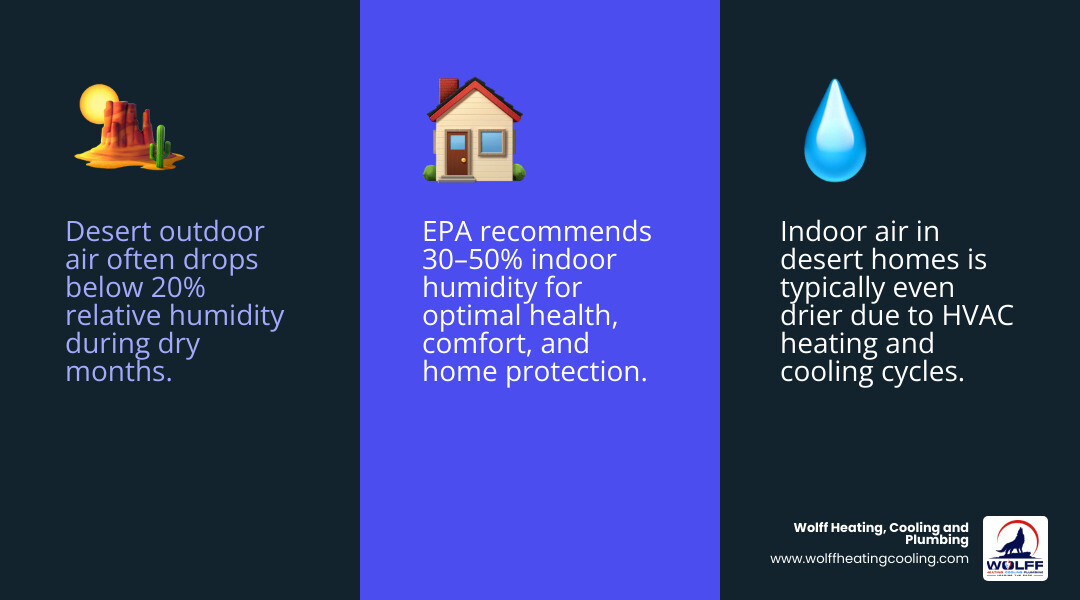
Desert climates like Albuquerque, NM are famous for low humidity — and outdoor air can drop well below 20% during the driest months. But here’s what catches most homeowners off guard: the air inside your home is often even drier than what’s outside. Your HVAC system, whether it’s heating in winter or cooling in summer, actively strips moisture from the air as it runs. Since most of us spend around 90% of our time indoors, that dryness adds up fast — affecting your health, your sleep, your home, and even your energy bills.
The EPA recommends keeping indoor humidity between 30% and 50%. In Albuquerque and across the high desert Southwest, hitting that target without help is nearly impossible for much of the year.
The Science of Dry Air: Do I Need a Humidifier in the Desert?
When we talk about the desert, we usually focus on the heat. But for those of us living in Albuquerque, Rio Rancho, or Bernalillo, the real silent culprit is “relative humidity.” This is a measure of how much water vapor is in the air compared to the maximum amount the air could hold at that specific temperature.
In the high desert of New Mexico, our outdoor humidity levels regularly dip below 30%, and during the hottest months of 2026, we’ve seen single-digit percentages. When this dry outdoor air enters your home, it doesn’t just stay at that level; it often gets worse. This leads many to ask, “do i need a humidifier in the desert?” To understand why the answer is almost always “yes,” we have to look at how our homes interact with the environment.
Maintaining Indoor Air Quality isn’t just about filtering out dust or pollen; it’s about managing the molecular makeup of the air you breathe. Without enough moisture, the air becomes “thirsty.” It begins to pull moisture from wherever it can find it: your skin, your wooden furniture, your pets, and even the structural beams of your house.
Why Desert Air is Drier Indoors
It seems counterintuitive that indoor air could be drier than the desert itself, but the physics of evaporation and HVAC cycles make it a reality. As we move through April 2026, we are seeing typical spring patterns where temperatures fluctuate wildly between day and night.
- The Heating Cycle: When your furnace runs during a chilly Albuquerque night, it warms the air. While the absolute amount of moisture stays the same, the relative humidity plummets because warm air has a much higher capacity to hold water than cold air.
- The Cooling Process: Air conditioning is essentially a dehumidification process. As your AC cools the air, moisture condenses on the evaporator coil and is drained away. In a humid climate like Florida, this is a blessing. In New Mexico, it’s stripping away the tiny bit of moisture you had left.
- Mechanical Ventilation: Most modern homes are built to be airtight. While this is great for energy bills, it traps “stale” dry air inside and allows the HVAC system to keep processing and drying the same air over and over again.
Signs You Need a Humidifier in the Desert
If you aren’t sure whether your home is suffering from “Arid House Syndrome,” your body and your surroundings will usually tell you. We often recommend that our customers Improve Your Home’s Indoor Air Quality if they notice these red flags:
- The “Science Experiment” Static: If walking across your carpet results in a painful spark every time you touch a doorknob, your humidity is likely below 30%. Beyond 55% humidity, static energy production is virtually impossible, but in a dry desert home, your house becomes a giant conductor.
- Physical Discomfort: Waking up with a “sandpaper” throat, parched lips that crack when you smile, or frequent nosebleeds are classic signs.
- Respiratory Irritation: Dry air leeches moisture from your mucous membranes. This doesn’t just feel bad; it actually makes you more susceptible to colds and the flu because your natural defenses are dried out.
- Brittle Houseplants: If your ferns are turning brown at the tips or your tropical plants are “staging a protest” despite regular watering, the air is likely sucking the moisture right out of their leaves through transpiration.
Health and Home: The Impact of Low Humidity
Living in a state of constant dryness isn’t just a minor inconvenience; it has measurable effects on your well-being and your wallet. Most people spend 90% of their time indoors, making the quality of that indoor air a primary factor in overall health.
From a medical perspective, low humidity is a silent agitator. When your nasal passages dry out, your body’s ability to filter out viruses and bacteria is compromised. Furthermore, research shows that certain airborne pathogens actually stay suspended in the air longer in low-humidity environments. In a more humid room, these particles bind with water droplets and fall to the ground. In a dry desert home, they stay afloat, waiting to be inhaled.
Your skin also pays the price. Low humidity can trigger oil-producing glands to overcompensate, which can paradoxically lead to acne, or it can exacerbate conditions like eczema and dermatitis. The skin’s hyaluronic acid needs external moisture to keep your skin elastic; without it, you may notice premature aging or persistent itchiness.
Protecting Your Property from Arid Conditions
Your home is likely your biggest investment, and the desert air is trying to shrink it. Many of the materials used in home construction and furnishing are hygroscopic, meaning they absorb and release moisture based on the surrounding environment.
- Woodwork and Flooring: Hardwood floors, cabinets, and wooden structural beams will shrink when the air is too dry. This leads to unsightly gaps in floorboards, “popping” noises at night, and even structural cracks in crown molding.
- Musical Instruments: If you own a piano or a guitar in Albuquerque, you know the struggle. Wood that gets too dry will warp or crack, causing instruments to go out of tune or, in extreme cases, become unplayable.
- Electronics: As mentioned before, dry air promotes static electricity. A significant static discharge can actually fry sensitive circuit boards in computers and televisions. Moisture in the air acts as a natural conductor to ground this static safely.
Investing in Humidifiers is often the most cost-effective way to preserve these valuables over the long term.
The Role of Humidity in Energy Efficiency
One of the most surprising benefits of maintaining proper humidity is the impact on your utility bills. There is a reason “dry heat” feels more tolerable than “humid heat”—moisture holds heat.
In the winter, air that is kept at 40% humidity feels significantly warmer than air at 15% humidity, even if the thermostat is set to the same temperature. This is because the moisture in the air prevents the sweat on your skin from evaporating too quickly (which is a cooling process). By adding a humidifier, you can often turn your thermostat down by two or three degrees without losing an ounce of comfort.
According to ASHRAE standards, keeping indoor humidity below 60% is vital for mold prevention, but staying above 30% is key for thermal retention. This “sweet spot” is where your HVAC system operates at peak efficiency.
Choosing the Right System for New Mexico Climates
When you decide to tackle the dryness, you have two main paths: portable units or whole-house systems. In a climate as consistently dry as ours in New Mexico, the choice often comes down to how much maintenance you are willing to perform.
| Feature | Portable Humidifiers | Whole-House Systems |
|---|---|---|
| Coverage | Single room (bedroom/office) | Entire home via ductwork |
| Maintenance | Daily refilling; weekly cleaning | Annual service; occasional filter change |
| Lifespan | 2–5 years | 10–15 years (with HVAC) |
| Initial Cost | Lower | Higher |
| Noise Level | Noticeable fan/gurgling | Silent (integrated into HVAC) |
| Water Source | Manual (must carry water) | Automatic (plumbed into water line) |
For those in Albuquerque and Rio Rancho, the “white dust” issue is a major consideration. Our water is notoriously hard. Ultrasonic portable humidifiers can vibrate mineral deposits into a fine white dust that settles on every surface of your home. Whole-house systems, particularly steam or evaporative models, handle mineral buildup much more gracefully.
Portable vs. Whole-House Humidifiers in the Desert
Portable units are great for targeted relief. If you only feel the dryness in your bedroom at night, a small ultrasonic or evaporative unit might suffice. However, they come with a “chore” list. You must refill them daily, and because the water sits in a reservoir, you have to scrub them every few days to prevent mold and bacteria from being pumped into your air.
A whole-house system is a “set it and forget it” solution. These units are installed directly into your HVAC ductwork. When your furnace or AC turns on, the humidifier adds a controlled amount of water vapor to the air stream. We often recommend these for Humidifiers Albuquerque NM because they provide even distribution. You won’t have a “wet spot” near a portable unit while the rest of the house remains a desert; instead, every room stays at a perfect 35–45%.
The Monsoon Exception: When Dehumidification Matters
Wait—a dehumidifier in the desert? It sounds like a joke, but from July to September, New Mexico experiences the Monsoon season. During these months, outdoor humidity can spike to 60% or 70%.
While our dry air is the primary concern, localized moisture can become an issue during the monsoons. If your home is tightly sealed, activities like long showers, boiling water for pasta, or even just breathing can trap moisture inside. If your indoor humidity tops 60%, you run the risk of mold growth in dark corners or closets. In these specific cases, or in homes with poorly ventilated basements, a dehumidifier might be necessary to bring the levels back down to that healthy 30–50% range.
Maintenance and Best Practices for Desert Humidification
Whether you choose a portable unit or a whole-home system, maintenance is the key to healthy air. In the desert, our biggest enemy is mineral buildup.
- Water Quality: If you use a portable unit, distilled water is a must. It prevents the “white dust” and keeps the internal components from scaling over. For whole-home systems, we often recommend a steam humidifier if you have hard water, as they are more efficient at managing mineral deposits.
- Filter/Pad Replacement: Evaporative humidifiers use a “wick” or “pad” to soak up water. Over time, the minerals in our New Mexico water will calcify these pads, making them hard as a rock and completely ineffective. These should be replaced at least once per season.
- Hygrometer Monitoring: You can’t manage what you don’t measure. A simple $15 hygrometer from a hardware store will tell you exactly where your home stands. Aim for 30–50%. If you see condensation on your windows, your humidity is too high—turn the system down!
Integrating Humidity Control with Smart HVAC
The modern way to handle desert air is through integration. Many smart thermostats now come with built-in humidistats. This allows your home to automatically adjust moisture levels based on the outdoor temperature.
For example, on a very cold night, the system might slightly lower the humidity to prevent frost from forming on your windows. As the day warms up, it will increase the moisture to keep your skin feeling hydrated. This level of automation ensures your system lasts longer and your comfort remains consistent without you ever having to touch a dial.
Natural Methods to Supplement Moisture
If you aren’t ready for a full system yet, there are low-cost ways to help your home “breathe” easier:
- Indoor Plants: Plants like the Boston Fern or Spider Plant are excellent at transpiration. They pull water from the soil and release it through their leaves. Grouping plants together creates a “micro-humid” zone in your living room.
- The “Old School” Methods: Leaving the bathroom door open after a shower or air-drying your laundry on a rack inside can add a surprising amount of moisture to a room.
- Water Features: A small indoor fountain or even a fish tank can provide a slow, steady source of evaporation.
- Sealing Leaks: Most of our indoor dryness comes from outdoor air leaking in. Sealing drafts around windows and doors helps keep the moisture you do have inside where it belongs.
Frequently Asked Questions
Do I need a humidifier if I have air conditioning?
Yes! As we mentioned, air conditioning is a natural dehumidifier. In a place like Albuquerque, the AC takes the already-dry air and strips even more moisture out of it to cool you down. Using a humidifier alongside your AC ensures you stay cool without feeling like a piece of beef jerky.
Can a humidifier damage my HVAC system?
Not if it is professionally installed. Whole-home humidifiers are designed to work with your furnace and AC. The main risk is over-humidification, which can lead to mold in the ducts. However, modern systems use sensors to ensure the humidity never reaches a dangerous level. Proper drainage is also key, which is why we always ensure a dedicated drain line is installed.
What is the ideal indoor humidity for a desert home?
The EPA suggests 30–50%. In the New Mexico desert, many people find that 35–40% is the “sweet spot” where they stop getting static shocks and their skin feels hydrated, but they don’t have to worry about condensation on the windows.
Conclusion
At Wolff Heating, Cooling, and Plumbing, we’ve spent over 25 years helping our neighbors in Albuquerque, Rio Rancho, Corrales, and the surrounding areas stay comfortable in one of the harshest climates in the country. We know that a home is more than just a shelter—it’s an environment that should support your health and protect your belongings.
If you’re tired of the static shocks, the dry skin, and the constant thirst of your desert home, it might be time to look into a professional humidity solution. Whether you need a simple repair to an existing system or a brand-new whole-home installation, our team is here to provide honest estimates and superior service.
Don’t let the desert air dictate your comfort. Schedule your humidifier consultation today and give your home the “drink of water” it’s been waiting for.