
 Menu
Menu
Is It Time to Fix or Replace Your Heating System in Albuquerque, NM?
Wondering should I repair or replace my furnace or boiler? Here’s a quick answer before we dive deeper:
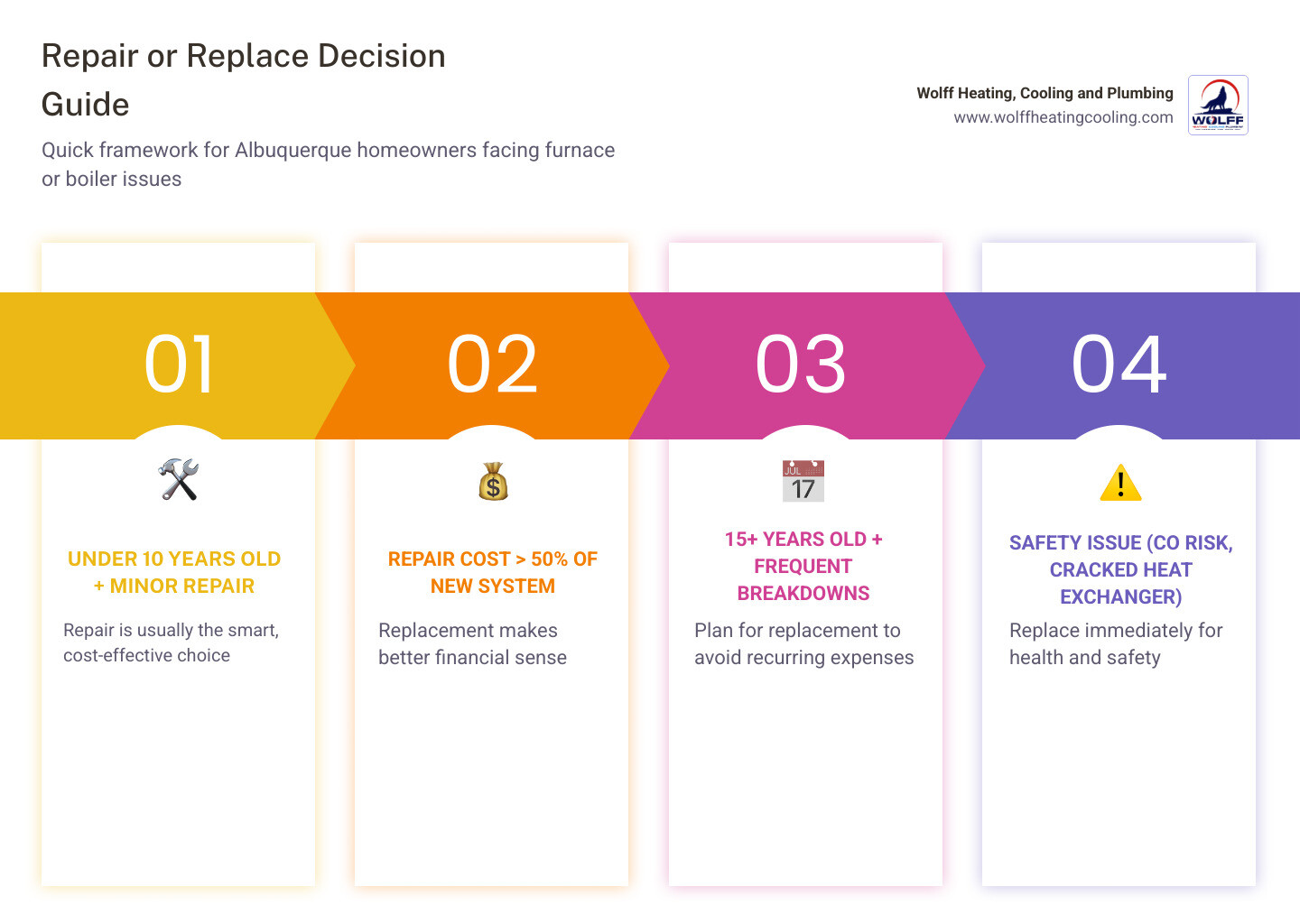
Quick Decision Guide:
| Situation | Likely Answer |
|---|---|
| System is under 10 years old, minor repair needed | Repair |
| Repair cost exceeds 50% of a new system’s price | Replace |
| System is 15+ years old with recurring breakdowns | Replace |
| Age × repair cost exceeds $5,000 | Replace |
| Safety issue (cracked heat exchanger, CO leak) | Replace immediately |
| Young system, small repair, no pattern of failure | Repair |
Your furnace or boiler is one of the most important systems in your home — especially during New Mexico’s cold winters. When it starts acting up, the pressure to make a quick decision can feel overwhelming. Do you spend money on a repair and hope for the best? Or bite the bullet and invest in a new system?
The honest answer is: it depends on a handful of key factors — and getting them wrong in either direction costs you money. Repair too eagerly on an aging system and you may find yourself paying again in six months. Replace too soon and you leave value on the table.
This guide walks you through everything Albuquerque homeowners need to know to make a confident, informed decision.
Key Factors: Should I Repair or Replace My Furnace or Boiler?
Deciding whether to keep patching up your current heater or to invest in a brand-new installation comes down to looking at the big picture. It is rarely just about a single broken part. Instead, we encourage homeowners to evaluate how the system is performing overall.
First, consider your home’s comfort levels and heating consistency. Are some rooms in your house freezing while others feel like a sauna? If your system can no longer distribute heat evenly, it is a sign of systemic decline.
Second, look at your utility bills. If your heating bills have been creeping up winter after winter, even though you schedule regular maintenance, your system is losing its efficiency. Older units have to work much harder to produce the same amount of heat, which directly inflates your monthly energy expenses.
Finally, pay attention to the frequency of breakdowns. A single minor repair is nothing to worry about. However, if you find yourself calling a technician every single winter, those service fees quickly accumulate. When you reach the point of “nickel-and-diming” your budget just to keep an old unit running, replacement becomes the more financially sound choice. Recognizing the Signs You Need Furnace Repair early can save you from a complete mid-winter breakdown, but you must also know when those issues cross over into Furnace Installation or Replacement Signs.
Evaluating System Age and Expected Lifespan
Age is one of the most reliable indicators of whether a heating system is nearing the end of its useful life. As equipment ages, the metal components undergo constant thermal expansion and contraction. Over time, this physical stress leads to structural fatigue, rust, and eventually, mechanical failure.
While regular maintenance can certainly stretch the lifespan of your equipment, no heating system lasts forever. Operating an exceptionally old system is often a gamble, as older units can fail completely during a severe New Mexico cold snap, leaving your home vulnerable to freezing pipes. Whether you rely on a forced-air Furnace Albuquerque NM or a radiant Boilers Albuquerque NM, understanding where your system sits on its natural lifespan timeline is crucial.
How Age Affects the Decision: Should I Repair or Replace My Furnace or Boiler?
Different types of heating systems have different life expectancies:
- Gas Furnaces: Typically last 15 to 20 years. While some well-maintained models can stretch to 25 years, they generally operate at a fraction of their original efficiency by that point.
- Boilers: Cast iron boilers are incredibly durable and can last 15 to 30 years with proper water treatment and maintenance. Modern condensing boilers, while highly efficient, have a slightly shorter lifespan of about 15 to 20 years due to their complex electronic and condensing components.
- Heat Pumps: Generally last 10 to 15 years because they operate year-round for both heating and cooling. If you are weighing options for a hybrid system, you can learn more about when to Repair or Replace Your Heat Pump.
If your heating system is well within the first half of its expected lifespan, repairing it is almost always the right move. However, if your furnace is pushing 17 years or your boiler is past its 20th birthday, even a minor repair should make you pause and consider replacement.
The Math Behind the Decision: 50% Rule vs. 5,000 Rule
When emotional bias or the stress of a cold house clouds your judgment, turning to mathematics can bring immediate clarity. There are two widely accepted formulas in the HVAC industry that help homeowners decide if a system is truly “toast”: the 50% Rule and the 5,000 Rule.
By analyzing your system’s repair history and comparing cumulative repair costs against the actual replacement value, you can make an objective financial decision. To explore these mathematical guidelines in deeper detail, check out our guide on The 5000 Rule and Other Ways to Decide if Your HVAC is Toast.
Calculating Costs: Should I Repair or Replace My Furnace or Boiler?
Let’s break down how these two rules work in practice:
- The 50% Rule: This rule is incredibly straightforward. If the cost of your pending repair is 50% or more of the cost of a brand-new heating system, you should replace it. Spending a significant portion of a new system’s value just to keep an old, out-of-warranty unit running is rarely a wise investment.
- The 5,000 Rule: This formula takes the age of your system and multiplies it by the repair estimate. If the resulting number is greater than 5,000, you should replace the system. If it is less than 5,000, repairing it is generally the smarter financial path.
$$\text{Age of System (Years)} \times \text{Repair Cost (Dollars)} = \text{Score}$$
Here is a quick reference table to show how this math plays out across different scenarios:
| System Age | Repair Estimate | Calculation (Age × Repair) | Decision |
|---|---|---|---|
| 6 Years (Furnace) | Moderate Repair | $6 \times \text{Moderate} = \text{Low Score}$ | Repair (System is young; investment is safe) |
| 12 Years (Furnace) | Heavy Repair | $12 \times \text{Heavy} = \text{Score over 5,000}$ | Replace (System is older; high risk of future failure) |
| 10 Years (Boiler) | Minor Repair | $10 \times \text{Minor} = \text{Low Score}$ | Repair (Boilers have long lifespans; minor fixes are worth it) |
| 22 Years (Boiler) | Moderate Repair | $22 \times \text{Moderate} = \text{Score over 5,000}$ | Replace (Boiler has served its time; efficiency gains await) |
If you are facing a sudden breakdown and aren’t sure where your current issue fits on this spectrum, knowing When to Call for Furnace Repair for an expert diagnostic assessment is your best first step.
Energy Efficiency, Safety, and the 2026 EPA Regulations
As we navigate June 2026, the landscape of home heating and cooling has shifted significantly due to new environmental regulations. The Environmental Protection Agency (EPA) regulations under the AIM Act have initiated a major transition away from older, high-GWP (Global Warming Potential) refrigerants.
While gas furnaces and boilers do not use refrigerant directly, these regulations heavily impact homeowners with split systems (where a furnace and an air conditioner or heat pump share the same indoor cabinet and evaporator coil). If your older air conditioner fails and utilizes a phased-out refrigerant, replacing it to comply with 2026 standards may require a fully compatible indoor coil and furnace setup. This makes a combined system upgrade highly practical and cost-effective.
Beyond regulations, safety must always remain your top priority. Older gas-fired systems carry inherent risks as their structural integrity degrades. Cracked heat exchangers are particularly dangerous because they can leak carbon monoxide—an odorless, colorless, and potentially lethal gas—directly into your home’s breathing air. If a certified technician discovers a cracked heat exchanger or a severe structural compromise, the system is legally “red-tagged” and must be shut down immediately. In these cases, replacement is not just a financial choice; it is a safety necessity.
If you are looking to step away from traditional forced air, exploring High Efficiency Boilers Albuquerque NM can provide an incredibly safe, clean, and comfortable alternative. To understand why these modern hydronic systems are so highly regarded, read about the High Efficiency Boiler System Benefits.
Upgrading for Long-Term Comfort and Savings
Upgrading to a modern, high-efficiency system offers substantial benefits that go far beyond simply restoring heat:
- Massive Efficiency Gains: Older heating systems often operate at AFUE (Annual Fuel Utilization Efficiency) ratings of 60% to 80%, meaning up to 40% of the fuel you pay for is wasted up the chimney. Modern condensing furnaces and boilers boast AFUE ratings of 90% to 98.5%.
- Lower Utility Bills: Upgrading a decade-old system to an ENERGY STAR-qualified model can reduce your annual heating bills by 15% to 30% or more.
- Enhanced Indoor Air Quality: New systems feature superior filtration options, and because they do not have to run constantly at maximum capacity to heat your home, they maintain more consistent humidity levels.
- Peace of Mind: A new installation comes with robust manufacturer warranties, shielding you from unexpected repair bills for years to come.
For those considering hydronic heating, the Boiler Heating System Advantages include incredibly quiet operation, draft-free warmth, and zone-control capabilities that let you heat only the rooms you are active in.
Frequently Asked Questions about Heating System Replacement
How long do furnaces and boilers typically last in New Mexico?
In the Albuquerque metro area—including Rio Rancho, Corrales, and Bernalillo—our high-desert climate features cold, dry winters and hot summers. Because our winter temperatures regularly drop below freezing, heating systems get a serious workout for several months of the year.
On average, a well-maintained gas furnace in New Mexico will last 15 to 20 years, while a cast-iron boiler can easily reach 20 to 30 years. However, our extremely dry air can accelerate dust accumulation inside the cabinet, which places extra stress on motors and burners. Regular professional maintenance is crucial to achieving these maximum lifespans. For a comprehensive look at keeping your system running smoothly in our local climate, refer to our Furnace Repair Albuquerque Complete Guide or our Boiler Repair Albuquerque NM Guide.
What are the warning signs of a cracked heat exchanger?
A cracked heat exchanger is one of the most critical safety hazards in residential heating. Because it separates the combustion process from the air circulating through your home, any breach can allow carbon monoxide to enter your living spaces.
Key warning signs include:
- A change in the burner flame color from a crisp, steady blue to a flickering, lazy yellow.
- Soot buildup inside the furnace cabinet.
- An unusual, chemical-like odor resembling formaldehyde when the heat turns on.
- Frequent, unexplained headaches, dizziness, or flu-like symptoms among family members (which should prompt you to evacuate and call emergency services immediately).
If you notice any of these signs, or if your system is short-cycling and blowing cool air, consult our troubleshooting guide on what to do when you find your Furnace Not Working Albuquerque.
How do the 2026 EPA regulations impact my current heating system?
The 2026 EPA regulations do not mean you are forced to replace a perfectly functional furnace or boiler. However, they do change the landscape for repairs and future compatibility.
As older refrigerants are phased out, servicing older combined heating and cooling systems will become increasingly expensive. If your older system experiences a major component failure, finding compatible replacement parts may become difficult or cost-prohibitive. Upgrading to a modern system now ensures you are fully compliant with current standards and avoids the headache of future parts shortages.
To plan your transition smoothly, check out our Furnace Installation Albuquerque NM Complete Guide or our Boiler Installation Albuquerque Complete Guide.
Conclusion
Deciding should I repair or replace my furnace or boiler doesn’t have to be a stressful guessing game. By weighing your system’s age, calculating the math with the 50% or 5,000 rules, and considering the safety and efficiency advantages of modern technology, the right path forward becomes clear.
At Wolff Heating, Cooling, and Plumbing, we have spent over 25 years helping our neighbors in Albuquerque, Rio Rancho, Placitas, Corrales, Cedar Crest, Tijeras, and Bernalillo stay warm and comfortable. We believe in providing honest estimates, superior workmanship, and clear, pressure-free guidance so you can make the absolute best decision for your home and your budget.
Ready to find out exactly what your heating system needs? Schedule your professional heating assessment with the local experts at Wolff Heating, Cooling, and Plumbing today!