
 Menu
Menu
When Your AC Acts Up in Albuquerque and Rio Rancho: Start Here
Before you call a technician, knowing what to check before calling for AC repair in the Albuquerque and Rio Rancho area can save you time, money, and a lot of frustration on a scorching New Mexico afternoon.
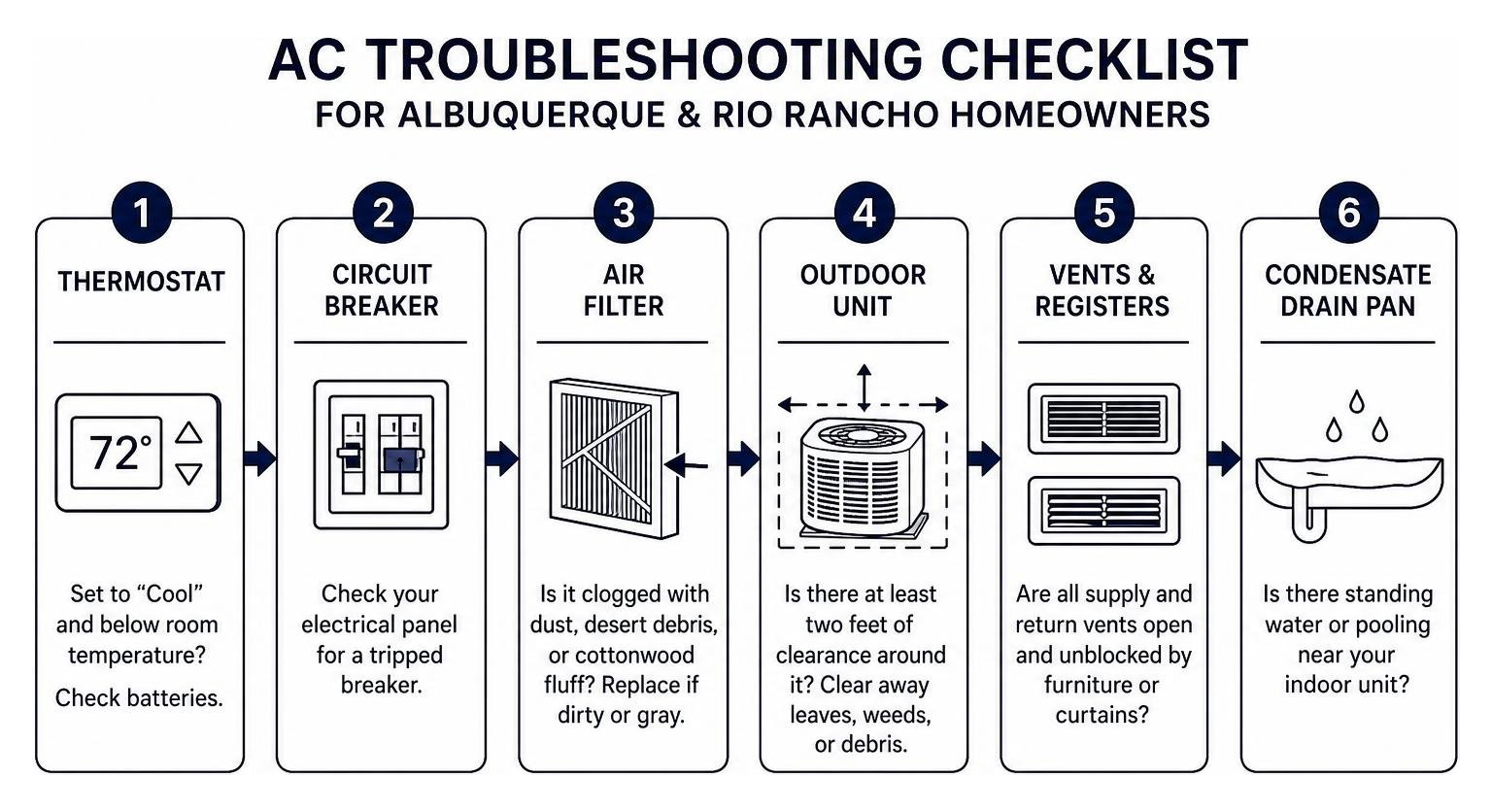
Here is a quick checklist to run through first:
- Thermostat – Is it set to “Cool” and the temperature set below the current room temperature? Are the batteries fresh?
- Circuit breaker – Check your electrical panel for a tripped breaker connected to the AC.
- Air filter – Is it clogged with dust, desert debris, or cottonwood fluff? Replace it if it looks dirty or gray.
- Outdoor unit – Is there at least two feet of clearance around it? Clear away any leaves, weeds, or debris.
- Vents and registers – Are all supply and return vents open and unblocked by furniture or curtains?
- Condensate drain pan – Is there standing water or pooling near your indoor unit?
If you have checked all of the above and your system is still struggling, it is time to call a professional.
Albuquerque and Rio Rancho summers are no joke. Temperatures regularly climb past 95°F, and your AC runs nearly nonstop to keep up. Add in the high desert’s notorious dust storms, cottonwood fluff season along the Rio Grande, and the dry air that accelerates wear on mechanical components, and you have a recipe for a system that gets pushed hard every single year.
The good news is that many common AC complaints — warm air blowing from vents, the system not turning on, or weak airflow — often have simple explanations that you can check yourself in just a few minutes. According to the U.S. Department of Energy, nearly 75% of AC breakdowns are caused by issues that regular maintenance and basic checks could have prevented.
This guide walks you through exactly what to look at before picking up the phone, so you can rule out the easy fixes first and know with confidence when it is time to bring in an expert.
What to Check Before Calling for AC Repair in the Albuquerque and Rio Rancho Area
When the summer heat rolls off the Sandia Mountains and settles over the Middle Rio Grande Valley, your cooling system becomes the most important equipment in your home. But before you pick up the phone to schedule an emergency service call, it is wise to perform a few basic inspections.
Living in a high-desert environment like ours means our HVAC systems face unique challenges. Windborne dust, dry heat, and seasonal cottonwood fluff can mimic serious mechanical failures when they are actually just causing simple, treatable blockages. Understanding What to Check When Your AC Loses Its Cool in Dry Heat is your first line of defense against unnecessary service charges.
By running through a structured, step-by-step diagnostic process, you can determine whether your cooling issues require a quick DIY adjustment or the skilled hands of a licensed technician. Let’s break down the primary areas you should inspect.
Quick Power and Thermostat Checks: What to Check Before Calling for AC Repair in the Albuquerque and Rio Rancho Area
It might sound overly simplistic, but a surprising number of AC service calls are resolved by simply flipping a switch or changing a battery. Your air conditioning system relies on a delicate balance of electrical pathways and communication signals to function. If any part of this chain is broken, the entire system will sit idle.
First, take a close look at your thermostat. Is the display screen active, or is it completely blank? If it is blank, your thermostat batteries may have died. Most modern digital thermostats rely on AA or AAA batteries to retain their programming and send signals to your cooling unit. Swap them out for fresh ones and see if the system fires back up.
Next, verify that the system is actually set to “Cool” and that the fan is set to “Auto” rather than “On.” If the fan is set to “On,” the blower motor will run continuously, circulating room-temperature air even when the outdoor compressor is resting. Also, check the temperature setting. It must be set at least a few degrees below the current indoor temperature to trigger a cooling cycle. That thermostat placement matters; if yours is located in direct afternoon sunlight or near a heat-producing appliance, it can misread the actual temperature of your home, leading to erratic cycles. For a deeper dive into these control issues, read our guide on AC Thermostat Issues in Albuquerque.
If the thermostat is set correctly but nothing is happening, check your home’s electrical panel. Air conditioners draw a significant amount of electricity, particularly during triple-digit July heatwaves when the local power grid is under heavy load. A sudden power surge can easily trip your AC’s dedicated circuit breaker.
Locate your electrical panel and look for the breaker labeled “AC” or “HVAC.” If it has tripped, it will be sitting in the middle position between “On” and “Off.” Flip it completely to the “Off” position first, then flip it firmly back to “On.”
Note: If the breaker trips again immediately after you reset it, do not try to reset it a second time. This indicates a serious electrical short or a failing compressor motor, and attempting to force it can cause an electrical fire. Leave it off and call for professional help.
Finally, do not forget to check the physical power switches. Your indoor air handler (usually located in a utility closet, attic, or garage) has a switch that looks exactly like a standard light switch. It is incredibly easy to bump this switch when grabbing household items, cutting off all power to the blower fan. Additionally, your outdoor condenser unit has a dedicated outdoor disconnect box mounted on the exterior wall nearby. Ensure the pull-out fuse block or switch inside this box is fully engaged.
Air Filter and Vent Inspections: What to Check Before Calling for AC Repair in the Albuquerque and Rio Rancho Area
Once you have verified that your system has power, the next major culprit to investigate is airflow. Your air conditioner does not just “create” cold air; it cools your home by extracting heat and moisture from the indoor air. To do this effectively, it must be able to pull a massive volume of air across your indoor evaporator coils.
This is where Albuquerque’s high-desert climate comes into play. The dust storms that sweep through Rio Rancho, Corrales, and Bernalillo carry fine silty soil that settles deep into your home’s return vents. If you live near the Bosque or in areas like Los Ranchos, seasonal cottonwood fluff acts like a thick blanket, wrapping around outdoor condenser coils and sealing off indoor return registers.
Pull out your indoor air filter and hold it up to a light source. If you cannot see light passing through the fibers, or if it is covered in a thick, gray layer of dust and pet dander, it is choked. A clogged air filter restricts airflow to a crawl. This forces your blower motor to work twice as hard to move air, spiking your monthly energy bills and causing the entire system to overheat and shut down. In extreme cases, restricted airflow causes the temperature of your evaporator coils to drop below freezing, turning condensation into a solid block of ice.
We recommend changing your air filters every 30 to 60 days, especially during the peak summer cooling season. If you have pets or suffer from seasonal allergies, monthly replacement is even better. For more information on maintaining proper airflow in our unique climate, consult our AC Repair Albuquerque Complete Guide.
While you are checking the filter, take a walk through your home and inspect your air registers and return vents. Ensure that at least 80% of your supply registers are fully open, even in rooms that you do not use. Closing too many vents does not save energy; instead, it increases static pressure within your ductwork, unbalancing your system and leading to premature equipment failure. Make sure that large pieces of furniture, heavy drapes, or area rugs are not blocking your return registers, as these are the lungs of your HVAC system.
Troubleshooting Airflow and Thermostat Issues
When airflow is restricted, your air conditioner will begin to exhibit a variety of frustrating symptoms. You might notice that while the outdoor unit is humming away, the air coming out of your registers feels weak or barely cool. Over time, these minor airflow restrictions can escalate into serious mechanical issues that trigger automatic safety shutdowns.
If you are experiencing inconsistent cooling, it is helpful to understand the direct connection between restricted airflow, frozen components, and water leaks. Recognizing these Signs You Need AC Repair early can prevent a minor airflow blockage from turning into a costly compressor replacement.
Dealing with Frozen Coils and Water Leaks
One of the most surprising sights for a homeowner in the middle of summer is finding a thick layer of ice coating their indoor AC unit or the copper refrigerant lines running outside. How can a system freeze when it is 100°F outside?
It all comes down to thermodynamics. Your air conditioner uses a chemical refrigerant to absorb heat from your indoor air. As the refrigerant flows through the indoor evaporator coils, it becomes incredibly cold. Under normal circumstances, the warm return air blowing over the coils transfers its heat, keeping the coils just warm enough to prevent freezing while condensing moisture out of the air.
However, if your air filter is clogged or your return vents are blocked, there isn’t enough warm air passing over the coils to transfer heat. The temperature of the coils drops below 32°F, causing the natural condensation on the coils to instantly freeze. This ice acts as an insulator, further blocking heat transfer and causing the ice buildup to grow until your system is completely encased in a block of ice. Low refrigerant levels due to a physical leak can also cause the system pressure to drop, leading to the same freezing effect.
If you discover ice on your coils, follow these steps immediately:
- Shut the system off at the thermostat. Running an iced-over AC can destroy the compressor, which is the heart of your system.
- Switch the thermostat fan setting to “On.” This will run the blower fan without running the outdoor compressor, helping to circulate warm air and melt the ice safely.
- Check your air filter. If it is dirty, replace it immediately.
- Wait for the ice to melt completely before attempting to restart the system. This can take several hours depending on the severity of the freeze.
As all that ice melts, or as your system naturally extracts humidity during our late-summer monsoon season, a massive amount of water is produced. This water collects in a drain pan beneath your indoor coil and is routed out of your home through a condensate drain line.
Over time, dust, algae, and mold can build up inside this narrow PVC drain line, creating a stubborn clog. When the line clogs, the water has nowhere to go but to overflow the drain pan, leading to water pooling around your indoor furnace closet, garage floor, or worse, leaking through your ceiling.
To prevent this, you can perform a simple DIY flush. Locate the access T-joint on your condensate line (usually a small, uncapped PVC pipe near your indoor unit) and pour a cup of household white vinegar down the line once every few months. The vinegar will kill any emerging algae or slime, keeping the pathway clear. If the line is already fully clogged, you can often use a wet/dry shop-vac attached to the outdoor exit point of the drain line to suck out the blockage.
Understanding AC Short-Cycling
Have you noticed your air conditioner turning on, running for two or three minutes, shutting off, and then turning back on again just a few minutes later? This rapid, repetitive cycling is known as “short-cycling,” and it is one of the most damaging behaviors an HVAC system can exhibit.
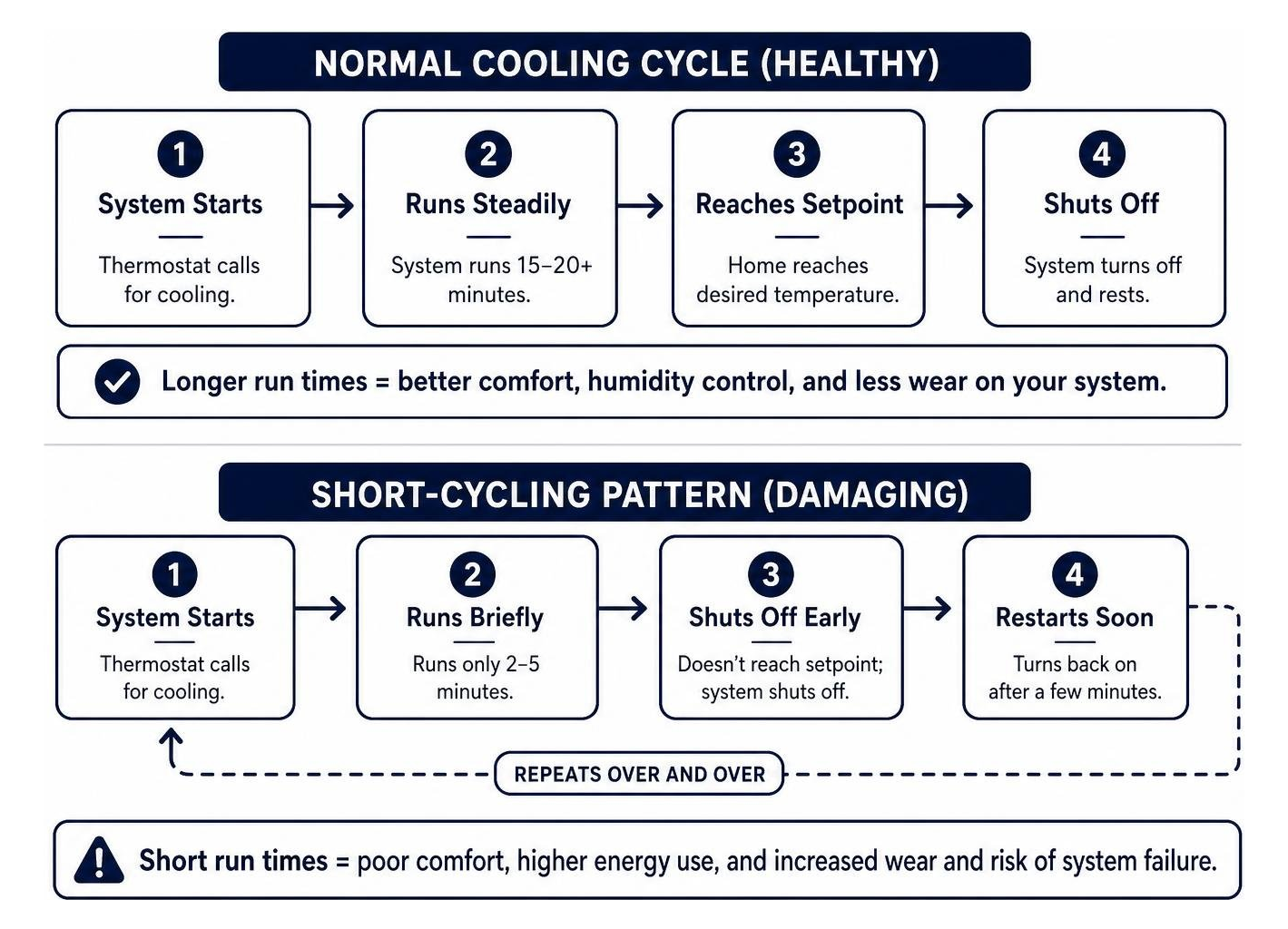
Every time your air conditioner starts up, its electrical components — particularly the compressor and the capacitors — experience a high surge of electrical current. This startup phase is when the system experiences the most wear and tear. A healthy AC should run for at least 15 to 20 minutes per cycle to cool your home evenly and remove humidity.
Short-cycling can be caused by several issues:
- Overheating: If your air filter is heavily clogged, the system may be overheating and shutting down as a safety precaution before completing a full cycle.
- Thermostat Miscalibration: If your thermostat is located near a drafty window, an exterior door, or directly under a supply register, it may think the home has cooled down instantly, shutting the system off prematurely.
- Oversized System: If your AC is too large for your home’s square footage, it will dump a massive amount of cold air into the space very quickly, satisfying the thermostat before it has a chance to run a proper cycle. This leaves your home feeling humid and drafty.
- Low Refrigerant: If your system is leaking refrigerant, low pressure switches can trigger rapid safety shutdowns to protect the compressor from running dry.
If changing your air filter and checking your thermostat settings does not resolve the short-cycling, you should shut the system down and contact a professional to prevent permanent damage to your compressor.
Recognizing When Your AC Needs Professional Intervention
While basic troubleshooting can resolve a surprising number of minor cooling issues, there comes a point where DIY fixes are no longer safe or effective. Modern air conditioning systems are complex machines that combine high-voltage electricity, pressurized chemical refrigerants, and sensitive electronic control boards.
Attempting to handle specialized repairs without the proper training and diagnostic tools can lead to personal injury, voided equipment warranties, or permanent damage to your system. Knowing How to Know When to Call a Professional for Cooling Problems is key to keeping your home comfortable and your family safe.
Unusual Noises and Sensory Warning Signs
Your air conditioner should operate with a predictable, gentle hum. While you might hear a slight click when a cycle begins or the sound of rushing air through your vents, any sudden change in your system’s acoustic profile is a clear warning sign that something is wrong.
Never ignore these unusual noises:
- Screeching or Squealing: This typically indicates a failing blower motor bearing or a worn-out fan belt in older systems.
- Grinding or Scraping: This often sounds like a “blender full of gravel” and usually means the metal fan blades have come loose and are scraping against their protective housing, or the compressor’s internal bearings are failing.
- Rattling or Clanking: This can be as simple as loose cabinet panels or debris inside the outdoor unit, but it can also point to loose motor mounts or failing internal compressor valves.
- Buzzing or Clicking: Constant clicking usually indicates an electrical issue, such as a failing contactor or relay that is struggling to send power to the compressor. Buzzing can point to an electrical short or a failing capacitor.
Beyond noises, your nose can also tell you when it is time to call in the pros. If you smell a distinct burning or electrical odor when your AC turns on, shut the system off at the breaker immediately. This is a sign of overheating wires or a burning motor winding.
A musty or damp smell coming from your vents usually points to biological growth within your ductwork or on your evaporator coils, which can severely impact your indoor air quality and requires professional duct cleaning or coil sanitization.
Deciding to Repair vs. Replace Your Aging AC
If your air conditioner is struggling to keep up with the summer heat, you may find yourself facing a difficult decision: should you continue to pay for repairs, or is it time to invest in a complete system replacement?
To help make this decision, we recommend looking at three primary factors:
- The Age of the System: The average lifespan of a residential central air conditioner is about 13 years. If your system is approaching or has surpassed this mark, its internal components are likely reaching the end of their mechanical life.
- The “50% Rule”: If the cost of a single repair exceeds 50% of the overall value of the system, or if your cumulative repair bills over the last two years are approaching that threshold, replacement is almost always the more economical long-term choice.
- Refrigerant Type: If your older system uses R-22 refrigerant (commonly known as Freon), you should know that R-22 was completely phased out in January 2020 and is no longer manufactured. Because the remaining supply is extremely scarce, repairing a refrigerant leak on an R-22 system is incredibly expensive. Upgrading to a modern, eco-friendly R-410A system will save you money on future repairs and drastically lower your monthly energy bills.
Frequently Asked Questions About Desert AC Troubleshooting
Why is my AC running but not cooling my home effectively?
If your system is running constantly but your indoor temperature continues to climb, you are likely dealing with restricted airflow or declining system efficiency. Start by checking your air filter and ensuring all return vents are open and unblocked.
Next, inspect your outdoor condenser unit. In our high-desert climate, windborne dust and cottonwood fluff can build up on the delicate aluminum fins of the outdoor coils, creating an insulating barrier that prevents the system from releasing heat. If the coils look dirty, shut off the power to the unit and gently hose down the coils from the top down using a standard garden hose (do not use a pressure washer, as this will bend the fragile fins).
What does it mean if my AC is leaking water or has ice on the coils?
Ice on your evaporator coils or water pooling around your indoor unit is almost always a sign of restricted airflow or a refrigerant leak. When airflow is blocked by a dirty filter or closed vents, the temperature of the refrigerant inside the coils drops below freezing, turning natural condensation into ice.
Once the ice builds up, it will eventually melt when the system shuts off, overflowing your drain pan and causing a water leak. Always turn the system off immediately if you spot ice, replace your filter, and allow the system to defrost completely before restarting.
How often should I clean my AC coils in the Albuquerque area?
Because of the high volume of airborne dust, pollen, and seasonal cottonwood debris in the Middle Rio Grande Valley, outdoor condenser coils should be cleaned at least once a year, ideally in the spring before the peak summer cooling season begins.
Regular cleaning prevents your compressor from running at elevated temperatures and pressures, which extends the lifespan of your equipment and protects against expensive mid-summer breakdowns.
Conclusion
Taking a few minutes to run through this basic troubleshooting checklist can save you from a stressful afternoon and help you identify simple, cost-free fixes before you call for service. But when your system requires professional care, you want to work with a team you can trust.
At Wolff Heating, Cooling, and Plumbing, we have spent over 25 years keeping our neighbors comfortable in Albuquerque, Rio Rancho, Corrales, Placitas, Cedar Crest, Tijeras, and Bernalillo. As a fully licensed, bonded, and insured team, we are committed to providing superior work, excellent service, and honest, upfront estimates. We understand the unique challenges of high-desert cooling, and we are here to ensure your home remains a cool, refreshing sanctuary all summer long.
If you have completed your checklist and your system is still struggling to beat the heat, don’t worry. Use our interactive HVAC Troubleshooter to pinpoint your system’s symptoms, or contact our friendly team today to schedule your professional diagnostic visit!