
 Menu
Menu
Trying to Choose Between a Swamp Cooler and AC in Albuquerque? Here’s What Homeowners Should Know
When weighing a swamp cooler vs AC decision, here’s the quick answer many Albuquerque homeowners are looking for:
| Factor | Swamp Cooler | Central AC |
|---|---|---|
| Electricity demand | Lower | Higher, depending on system efficiency and runtime |
| Energy use | Fan and pump operation | Compressor and blower operation |
| Best climate | Dry, low humidity | Any climate, including humid |
| Water use | Yes | No |
| Works during monsoon season | Performance drops significantly | Yes, consistently |
| Indoor humidity effect | Adds moisture | Removes moisture |
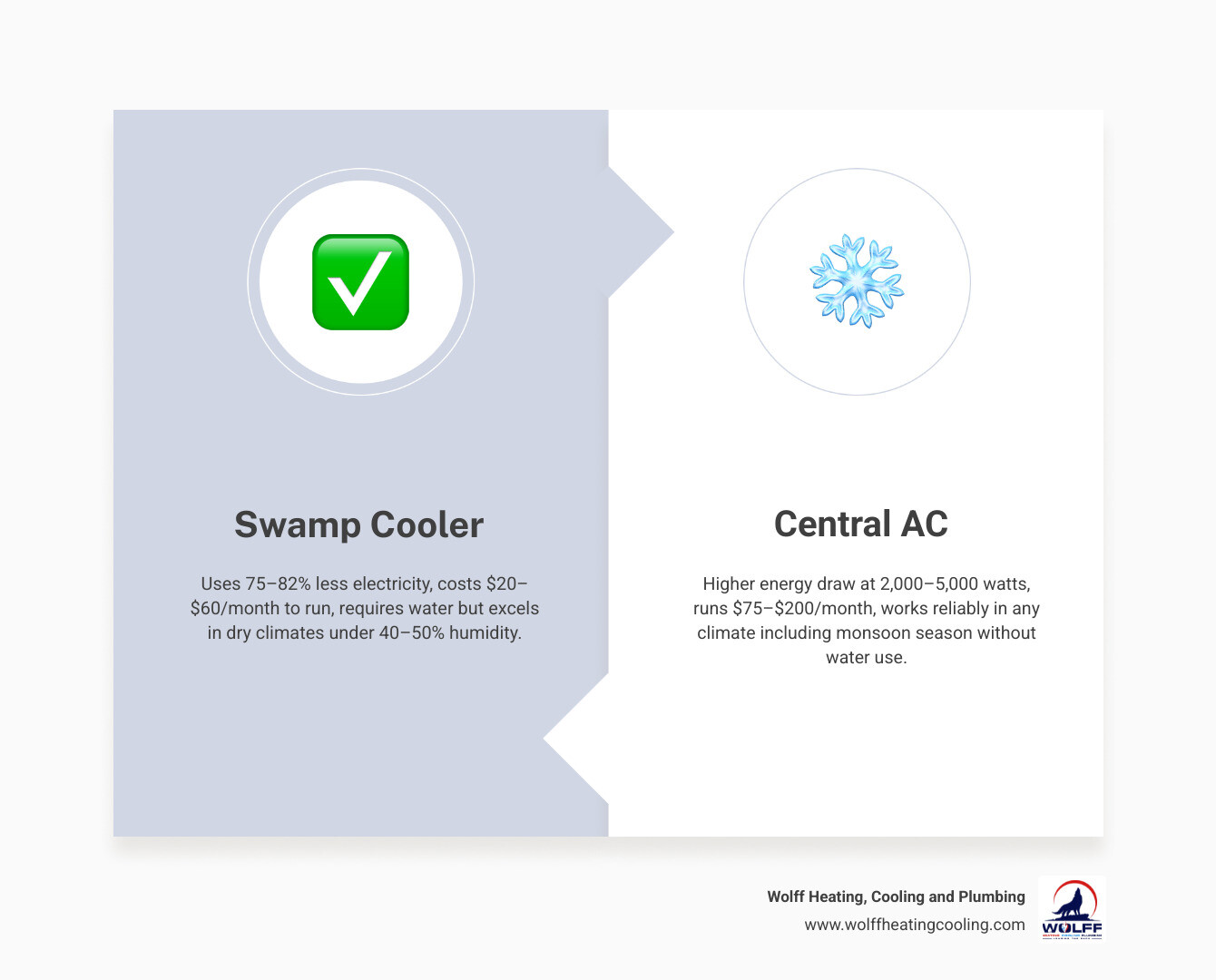
Swamp coolers use much less electricity than refrigerated air conditioning — a real advantage in Albuquerque’s dry, high-desert climate. For many homes, that lower electrical demand is one reason evaporative cooling remains popular through dry stretches of the summer.
But the full picture is more nuanced than electricity use alone. Installation requirements, water use, maintenance, monsoon season performance, indoor air quality, and long-term comfort all factor into which system actually fits your home.
This guide breaks down the major homeowner considerations so you can make a confident, informed decision for your Albuquerque home.
For a deeper look at how each system performs in New Mexico’s unique conditions, visit our guide on Dry Heat Dilemmas and Whether AC or Swamp Coolers Win.
Related homeowner questions:
Installation Considerations When Choosing a Swamp Cooler or AC

Installation planning is where the difference between a swamp cooler and refrigerated air conditioning becomes obvious. A swamp cooler is a simpler system. It mainly depends on a blower, pump, water distribution system, cooling pads, and proper ventilation. Refrigerated AC has more major components, including an outdoor condenser, indoor coil, refrigerant lines, electrical controls, and often more involved ductwork requirements.
That does not automatically mean one system is “better.” It means the right choice depends on your home, your comfort goals, and how you use cooling during Albuquerque’s long warm season.
In general:
| Installation Factor | Swamp Cooler | Refrigerated AC |
|---|---|---|
| Equipment design | Simpler mechanical design | More components and controls |
| Installation scope | Often less involved, depending on location | Usually more involved |
| Ductwork needs | Needs airflow path and ventilation | Needs sealed, properly sized ducts |
| Electrical needs | Usually lower power demand | Higher electrical demand |
| Comfort control | Less precise | More precise |
| Humidity control | Adds moisture | Removes moisture |
If you are comparing both systems for a home in Albuquerque, Rio Rancho, Placitas, Corrales, Cedar Crest, Tijeras, or Bernalillo, start with the home itself. Is there existing ductwork? Is the current ductwork sealed and sized correctly? Is the electrical panel ready for refrigerated air? Does your home already have a rooftop evaporative cooler? These questions shape the real installation scope.
For more help thinking through the desert-climate decision, see our guide to Choosing Between Refrigerated Air and Swamp Coolers in the Desert.
System Components and Home Fit
Swamp coolers typically have fewer major components than refrigerated AC systems. That is one reason they remain popular across the Albuquerque area. The basic design is refreshingly straightforward: air passes through wet pads, heat is absorbed through evaporation, and a blower moves cooler air into the home. It is almost elegant in its simplicity. Like a desert breeze with a motor.
Central refrigerated AC equipment is more complex. It uses a compressor, refrigerant, coils, pressure controls, and a closed-loop refrigeration cycle to remove heat from indoor air. This added complexity gives AC one major advantage: consistent cooling even when outdoor humidity rises.
Equipment lifespan matters, too. A well-maintained swamp cooler can serve a home for many seasons, but hard water, pad condition, corrosion, and winterization all affect longevity. A properly installed and maintained AC system can also last many years, especially when filters, coils, refrigerant charge, and airflow are kept in good shape.
The practical takeaway: swamp coolers usually win on simplicity and energy efficiency, while AC usually wins on comfort precision and humidity control. For a deeper homeowner-focused breakdown, visit Is a Swamp Cooler Better Than AC for Your Home?.
Retrofitting and Ductwork Requirements
Retrofitting is where a simple comparison can get complicated.
A swamp cooler needs airflow. That means it must pull in dry outdoor air, cool it through evaporation, and push it through the home. Because it brings in outside air, the home needs relief air through open windows, up-ducts, vents, or other airflow paths. If the air cannot leave, the cooler cannot work properly.
Refrigerated AC is the opposite. It works best in a sealed home. Doors and windows should stay closed so the system can recirculate indoor air, remove heat, and manage humidity. Leaky ducts, poor insulation, or oversized/undersized equipment can reduce efficiency and comfort.
When converting from a swamp cooler to refrigerated air, common considerations include:
- Existing duct condition and sizing
- Whether ducts are sealed well enough for AC
- Furnace or air handler compatibility
- Electrical capacity
- Thermostat wiring
- Refrigerant line routing
- Condensate drainage
- Home insulation and air leakage
- Room-by-room comfort issues
This is why we recommend a professional load calculation instead of guessing based on square footage alone. Two Albuquerque homes with the same size can have very different cooling needs depending on sun exposure, windows, insulation, ceiling height, and layout.
Energy Use, Water Use, and Ongoing Maintenance Needs
Once the system is installed, electricity demand and maintenance needs become major parts of the swamp cooler vs AC decision.
Swamp coolers use much less electricity because they do not rely on a compressor. They mainly power a blower fan and a small water pump. Refrigerated AC uses more electricity because the compressor does the heavy lifting of moving heat out of the home.
However, swamp coolers also use water, and they require seasonal maintenance. AC does not use water for cooling, but it needs filter changes, coil cleaning, airflow checks, and periodic professional service.
| Ongoing Factor | Swamp Cooler | Refrigerated AC |
|---|---|---|
| Electricity use | Low | Moderate to high, depending on efficiency |
| Water use | Yes | No |
| Main energy draw | Fan and pump | Compressor and blower |
| Routine maintenance | Pads, pump, belt, float, water lines | Filters, coils, refrigerant, drain, electrical |
| Seasonal service | Spring startup and fall winterization | Annual cooling tune-up |
| Climate sensitivity | High | Low |
| Indoor humidity | Increases | Decreases |
| Air filtration | Limited compared to AC | Stronger filtration options |
To understand the mechanics behind evaporative cooling, read A Simple Guide to How Your Swamp Cooler Actually Works. If your cooler is running but not cooling well, our Ultimate Guide to Evaporative Cooler Troubleshooting can help you spot common issues.
Electrical Efficiency and Wattage Differences
The basic energy-use formula is simple:
- Watts x hours used = watt-hours
- Divide by 1,000 = kilowatt-hours
Swamp coolers often operate in the low hundreds of watts. Central AC systems commonly use several times more electricity because the compressor requires much more power than an evaporative cooler pump and fan.
For refrigerated AC, efficiency is measured with SEER2 ratings. As of June 2026, SEER2 is the standard efficiency language homeowners will often see when comparing new air conditioning equipment. A higher SEER2 rating generally means the system can provide more cooling for less electricity, assuming it is installed correctly and matched to the home.
But efficiency ratings are only part of the story. Real-world energy use also depends on:
- Equipment size
- Duct condition
- Thermostat settings
- Outdoor temperature
- Indoor heat gain
- Insulation
- Filter condition
- How many hours the system runs
- Whether the system is properly maintained
A high-efficiency AC system with poor airflow can still waste energy. A swamp cooler with clogged pads or poor water distribution can also run longer while delivering less comfort. The equipment matters, but installation and maintenance matter just as much.
Water Usage Impact for Swamp Coolers
Swamp coolers reduce electrical demand by using water evaporation to cool air. That is the trade-off: lower electric use, but added water use.
In dry Albuquerque weather, evaporation works well because the air can absorb moisture. A whole-home evaporative cooler may use several gallons of water per hour depending on size, outdoor temperature, humidity, pad condition, and runtime. During long hot days, that water use becomes part of the overall system picture.
Water usage does not usually outweigh the electrical-efficiency advantage of a swamp cooler in dry conditions, but it should not be ignored. This is especially true if:
- The cooler runs for long hours every day
- The float valve leaks
- The bleed-off line wastes excess water
- Pads are scaled and inefficient
- The unit is oversized or poorly adjusted
- The water supply line has a hidden leak
If your cooler seems to be using more water than expected or is not cooling like it used to, read Is Your New Mexico Swamp Cooler Actually Working?.
Swamp Cooler Maintenance and Hard Water Challenges
New Mexico’s hard water can be tough on swamp coolers. Mineral buildup collects on pads, water lines, pumps, and distribution tubes. Once pads become crusted with scale, air cannot pass through them as easily, water does not spread evenly, and cooling performance drops.
That means the cooler may run longer while doing less. Nobody wants a machine that works hard and delivers “lukewarm optimism.”
Common swamp cooler maintenance tasks include:
- Replace or clean evaporative pads as needed
- Inspect water distribution lines
- Check pump operation
- Clean the pan
- Inspect the float valve
- Look for leaks
- Check belt condition and tension where applicable
- Verify blower operation
- Remove mineral buildup
- Confirm proper airflow through the home
- Start up the system in spring
- Winterize the system before freezing weather
Poor maintenance can also create odor and indoor air quality concerns. Stagnant water, dirty pads, and mineral buildup can make the air smell musty. For help avoiding that issue, see Evaporative Cooling Without the Moldy Aftertaste.
Air Conditioning Maintenance and Lifespan
Refrigerated AC has different maintenance needs. Instead of pads and water lines, AC depends on clean airflow, correct refrigerant charge, clean coils, and reliable electrical components.
Important AC maintenance tasks include:
- Change or clean air filters regularly
- Keep supply and return vents open and unobstructed
- Clean indoor and outdoor coils as needed
- Check refrigerant levels
- Inspect electrical connections
- Test thermostat operation
- Clear the condensate drain
- Inspect blower components
- Check duct airflow
- Schedule professional tune-ups
- Keep outdoor equipment clear of debris
A well-maintained AC system can provide consistent comfort for many years. Neglected AC systems often lose efficiency, run longer, cool unevenly, or experience avoidable repairs. Regular maintenance is not just about preventing breakdowns; it is about protecting comfort, efficiency, and equipment life.
Climate Suitability and Comfort Value in New Mexico
Climate is the deciding factor in any swamp cooler vs AC decision for Albuquerque-area homes.
Swamp coolers thrive in dry air. Albuquerque, Rio Rancho, Placitas, Corrales, Cedar Crest, Tijeras, and Bernalillo often have the low humidity that evaporative cooling needs. During dry parts of the cooling season, a properly maintained swamp cooler can feel comfortable while using far less electricity than refrigerated AC.
But New Mexico weather has a plot twist: monsoon season.
When humidity rises, evaporation slows down. The swamp cooler may still move plenty of air, but the air does not cool as much. Indoor humidity can climb, rooms can feel sticky, and comfort can drop quickly. This is when refrigerated AC has the advantage because it removes both heat and moisture.
For more desert-specific guidance, read Is a Swamp Cooler Better Than AC for High Desert Living?.
How Humidity Affects Cooling Performance
Evaporative cooling depends on the gap between dry-bulb temperature and wet-bulb temperature. In plain English: the drier the air, the more water can evaporate, and the more cooling you get.
When relative humidity is low, swamp coolers can perform very well. As humidity rises, the air is already holding more moisture, so evaporation becomes less effective. Once humidity gets high enough, a swamp cooler can start to feel like it is adding dampness without providing enough cooling.
General comfort patterns look like this:
| Outdoor Humidity | Swamp Cooler Performance |
|---|---|
| Low humidity | Strong performance |
| Moderate humidity | Reduced cooling |
| High humidity | Poor comfort and muggy air |
| Monsoon conditions | Often inconsistent |
Refrigerated AC is less affected by outdoor humidity because it uses refrigerant to move heat and also removes moisture from indoor air. That makes AC more consistent during humid stretches, stormy days, and high dew point conditions.
If you want a deeper comparison of cooling methods, visit Refrigeration vs Evaporation Which System Wins.
Home Comfort and Long-Term System Fit
Long-term value is not just about energy use. It is also about how comfortable the home feels and how well the system supports daily living.
Swamp coolers can be attractive because they are energy-efficient in dry weather, add moisture to very dry indoor air, and provide lots of fresh-air ventilation. Many Albuquerque-area homeowners like the feel of evaporative cooling during dry heat.
Refrigerated AC can be attractive because it provides:
- More consistent room temperatures
- Better humidity control
- Closed-window operation
- Stronger filtration options
- Better comfort during monsoon season
- Easier integration with modern thermostats
- Improved comfort for some allergy-sensitive households
Indoor air quality is a big consideration. Swamp coolers bring in outdoor air, which can also bring in dust, pollen, smoke, or other outdoor irritants depending on conditions. AC recirculates indoor air through filters, which can help reduce airborne particles when paired with the right filtration and duct maintenance.
The best long-term fit depends on your house, your comfort expectations, and how often humidity affects your cooling season.
Frequently Asked Questions About Cooling Choices
Is running a swamp cooler easier on electricity than running an AC?
Usually, yes, during dry Albuquerque weather. Swamp coolers use much less electricity because they rely on a fan, pump, and evaporation rather than a compressor. In a dry climate, that can make a noticeable difference in household energy use.
However, low electrical demand is not always the only priority if the system does not keep the home comfortable. If monsoon humidity makes the cooler ineffective, homeowners may turn to fans, portable comfort solutions, or other workarounds. At that point, comfort can become the deciding factor.
A swamp cooler is most effective when:
- Outdoor air is dry
- Pads are clean
- Water distribution is even
- The blower is working properly
- The home has good ventilation
- The system is correctly sized
- The homeowner is comfortable with open-window operation
Refrigerated AC may use more electricity, but it provides more predictable comfort during humidity, smoke, pollen, and extreme heat events.
Can you run a swamp cooler and central AC at the same time?
Not in the same space at the same time. They need opposite operating conditions.
A swamp cooler needs open windows or vents so fresh, cooled air can move through and leave the home. Refrigerated AC needs a sealed home so it can recirculate indoor air efficiently.
Running both together can waste energy and create comfort problems. The swamp cooler adds moisture and outdoor air, while the AC tries to remove moisture and cool sealed indoor air. That is like asking one person to open every window while another follows behind closing them. Entertaining? Maybe. Efficient? No.
A better strategy is hybrid seasonal use:
- Use the swamp cooler during dry parts of the cooling season
- Switch to refrigerated AC during monsoon humidity
- Use ceiling fans to improve comfort without overworking either system
- Keep up with maintenance so both systems are ready when needed
Some homes are set up for both systems, but they should be operated intentionally, not simultaneously.
What should Albuquerque homeowners ask before choosing an energy-efficient cooling system?
Before choosing equipment, homeowners should look at the whole home, not just the cooling unit. The right answer depends on comfort goals, ductwork, insulation, electrical readiness, indoor air quality needs, and how the home performs during hot or humid weather.
Helpful questions include:
- Does the home already have ductwork, and is it sealed properly?
- Is the existing system keeping every room comfortable?
- Does the home feel muggy during monsoon season?
- Are dust, pollen, smoke, or allergies a concern?
- Is the electrical system ready for refrigerated cooling equipment?
- Would a ductless system help with a room addition, garage conversion, or problem area?
- Is a maintenance plan needed to keep the system reliable?
A local HVAC professional can inspect the home, explain system options, and recommend a practical path forward. You can also learn more about local evaporative cooling considerations on our Swamp Cooler Albuquerque NM page.
Conclusion
The best cooling system is the one that fits your home, your comfort expectations, and Albuquerque’s high-desert climate.
Swamp coolers often have the advantage when it comes to electricity use, simplicity, and dry-weather efficiency. Refrigerated AC has the advantage when it comes to consistent temperature control, humidity removal, filtration options, and monsoon-season comfort.
Here is the simple way to think about it:
- Choose a swamp cooler if you value low electricity use, fresh airflow, and strong performance in dry heat.
- Choose refrigerated AC if you want consistent cooling, better humidity control, and closed-window comfort.
- Consider a hybrid approach if your home allows for seasonal flexibility.
- Always factor in maintenance, water use, ductwork, indoor air quality, and long-term comfort before deciding.
At Wolff Heating, Cooling, and Plumbing, we help homeowners and business owners across Albuquerque, Rio Rancho, Placitas, Corrales, Cedar Crest, Tijeras, and Bernalillo make smart cooling decisions based on real local conditions. With over 25 years of experience, licensed, bonded, and insured service, and a commitment to clear communication and superior service quality, we are here to help you choose the system that makes sense for your home or business.
Our team supports HVAC installation, repair, and maintenance, plumbing services, water heater services, ductless systems, indoor air quality solutions, emergency service needs, maintenance plans, and energy-efficient system options.
Ready to compare your options with a local HVAC team? Schedule professional cooling services in Albuquerque today.