
 Menu
Menu
Does a Water Softener Extend the Life of a Tankless Water Heater in New Mexico?
Does a water softener extend the life of a tankless water heater in New Mexico? Yes — and in a state with some of the hardest water in the country, it can make the difference between a system that lasts 20 years and one that fails in 10.
Quick Answer:
- New Mexico water — especially in Albuquerque and Rio Rancho — is classified as hard to very hard, with mineral concentrations that can exceed 1,000 mg/L
- Hard water deposits calcium and magnesium scale inside a tankless water heater’s heat exchanger, reducing efficiency and causing premature failure
- A water softener removes those minerals before they enter your plumbing system, significantly slowing scale buildup
- With a water softener, descaling frequency drops from every 6–12 months to every 2–4 years
- Most major manufacturers, including Rheem and Navien, require water hardness treatment above 11 GPG to keep warranty coverage valid
- A properly maintained tankless water heater can last 15–20 years — hard water without treatment can cut that to 10 years or less
Many homeowners moving into new construction in Albuquerque, Rio Rancho, or Placitas assume that because their plumbing is brand new, it will run without issues for years. But mineral buildup can start forming inside a tankless heat exchanger within the first year of operation in hard water areas. By the time problems become obvious — fluctuating water temperatures, error codes, reduced pressure — damage is already underway.
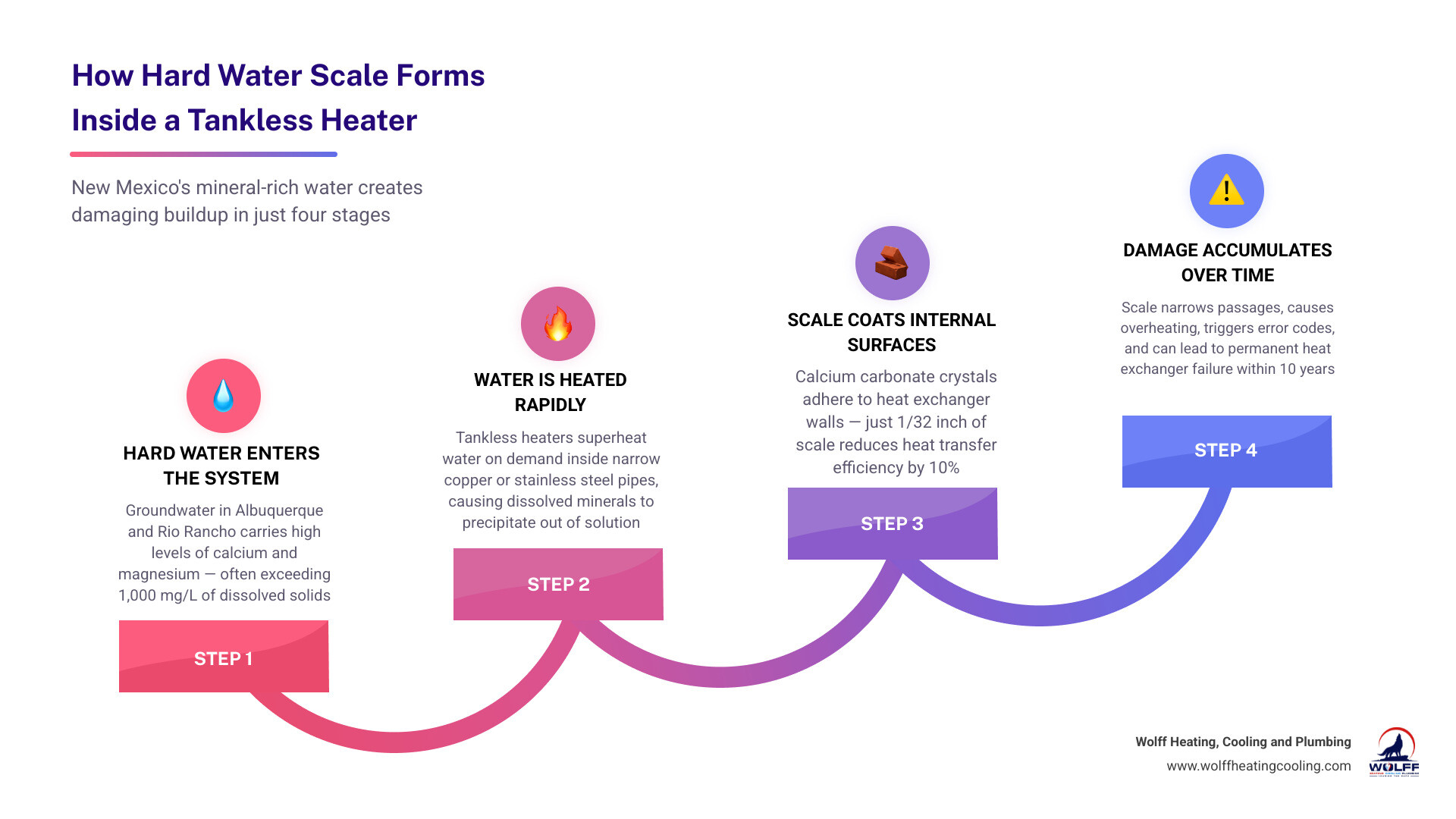
New Mexico’s geology is part of the problem. Groundwater here travels through mineral-rich rock formations, picking up calcium and magnesium along the way. When that water gets heated inside a tankless unit, those dissolved minerals solidify and coat the narrow internal passageways that make the system work. Scale as thin as 1/32 of an inch can reduce heat transfer efficiency by 10%. Over time, the unit works harder, runs hotter, and wears out faster.
A water softener addresses the problem at the source — before hard water ever reaches your heater.
Why New Mexico’s Hard Water is a Silent Killer for Tankless Systems
To understand why hard water is so destructive to tankless systems, we have to look at how these appliances operate. Unlike traditional tank heaters that store and slowly heat 40 to 80 gallons of water, tankless systems heat water on demand. When you turn on a hot water tap, high-powered gas burners or electric elements instantly fire up, transferring intense heat to the water flowing through a series of tightly coiled, narrow copper or stainless steel pipes.
This rapid heat transfer is incredibly energy-efficient, but it creates a major vulnerability. The chemical properties of water dictate that calcium and magnesium are inversely soluble. This means that as water temperature rises, these minerals precipitate out of the liquid state and solidify much faster.
Inside the narrow passageways of a tankless heat exchanger, this precipitation happens instantly. The minerals bond to the hot metal surfaces, creating a chalky, rock-hard layer of calcium carbonate scale. This leads directly to the most common Tankless Water Heater Scale Issues, which act as a physical barrier to heat and restrict water flow.
The Geological Reality of New Mexico’s Water Supply
New Mexico’s beautiful desert landscapes are rich in limestone, gypsum, and ancient volcanic soils. While these geological formations define our regional beauty, they also heavily impact our water quality.
About 30% of Albuquerque’s water supply comes from underground aquifers, with the remainder sourced from surface water through the Colorado River basin via the Rio Grande. In communities like Rio Rancho, Placitas, Corrales, and Bernalillo, groundwater is the primary source.
As rain and snowmelt filter down through New Mexico’s soil, the water naturally dissolves and absorbs high concentrations of calcium, magnesium, and total dissolved solids (TDS). According to data from the U.S. Geological Survey (USGS), water in the Albuquerque metro area and surrounding communities is classified as “hard,” while localized areas relying heavily on groundwater aquifers are rated as “very hard.” In many of these groundwater systems, water hardness easily exceeds 15 grains per gallon (GPG) or roughly 250 parts per million (ppm). In extreme cases across the state, dissolved mineral levels can spike much higher, presenting an immediate threat to modern plumbing appliances.
How Scale Buildup Destroys Heat Exchangers
When scale begins to coat the interior of a tankless heat exchanger, it acts as an extremely effective insulator. This is bad news for your utility bills and the physical integrity of your system.
Because the scale layer blocks the transfer of heat from the burner to the water, the system has to burn more fuel and run much hotter to achieve your desired water temperature. A scale layer as thin as 1/32 of an inch can drop heat transfer efficiency by 10%, forcing the system to work harder and consume more energy.
This insulating barrier also creates localized “hot spots” on the heat exchanger walls. The metal underneath the scale becomes trapped in an intense thermal cycle, heating up far beyond its engineered limits. Over time, this extreme heat causes metal fatigue, warping, and microscopic cracking.
In gas-fired tankless units, this localized overheating can cause the heat exchanger to rupture, leading to internal water leaks that ruin the burner assembly and electronic control boards. Once the heat exchanger cracks, the unit is typically beyond repair, requiring a complete and expensive system replacement.
Does a Water Softener Extend the Life of a Tankless Water Heater in New Mexico?
Installing a whole-home water softener is the single most effective way to protect your investment. But how exactly does it work, and can it really help you decide Will Your Tankless Water Heater Outlive Your Car? in our demanding New Mexico climate?
How Softened Water Protects the Heating Elements
Traditional water softeners utilize a process called ion exchange to eliminate hardness minerals before they can enter your home’s plumbing. Inside the softener’s resin tank are millions of microscopic, negatively charged plastic beads. These beads are pre-loaded with sodium ions.
As hard water from your main line passes through the resin bed, the positively charged calcium and magnesium ions naturally cling to the beads, displacing the sodium ions. The water that exits the system and enters your tankless water heater is “softened,” meaning the minerals responsible for scale buildup have been physically removed and replaced with a harmless trace amount of sodium.
Without calcium and magnesium in the water, scale simply cannot form. The heat exchanger surfaces remain perfectly clean, allowing the heating elements or burners to transfer heat directly to the water with zero thermal resistance.
| Performance Factor | Untreated Hard Water (Albuquerque/Rio Rancho) | Treated Softened Water |
|---|---|---|
| Heat Transfer Efficiency | Drops by 10% to 30% as scale thickens | Remains at peak factory efficiency (up to 99%) |
| Scale Accumulation Rate | Rapid (visible buildup within 6–12 months) | Virtually non-existent |
| Average Lifespan | 8 to 10 years (or fewer without regular flushing) | 15 to 20+ years |
| Required Flushing Frequency | Every 6 to 9 months | Every 2 to 4 years |
| Utility Bill Impact | Gradually increases over time | Remains low and stable |
Quantifying the Lifespan Extension in Albuquerque Homes
In ideal conditions with soft water, a high-quality tankless water heater is designed to last between 15 and 20 years. However, in the harsh water conditions of central New Mexico, an untreated tankless unit can suffer catastrophic heat exchanger failure in as little as 5 to 10 years.
By installing a water softener, you are actively preventing the leading cause of premature appliance death. By removing the mineral threat, a water softener can easily double the operational lifespan of your tankless water heater, allowing you to get the full 20-year return on your home improvement investment.
To learn more about maximizing the longevity of your system, check out our guide on How to Extend Your Tankless Water Heater’s Lifespan.
Water Softeners vs. Alternative Scale Prevention Methods
While ion-exchange water softeners are the most popular choice, they are not the only water treatment systems on the market. Homeowners in Albuquerque, Rio Rancho, and Corrales often ask us about alternative methods like scale inhibitors, Template Assisted Crystallization (TAC), and whole-house sediment filtration.
- Scale Inhibitors (Polyphosphate Filters): These inline filters feed small amounts of polyphosphate into the water stream. The chemicals coat the hardness minerals, preventing them from binding to metal surfaces. While effective for minor water issues, they struggle to keep up with the extremely high mineral concentrations found in New Mexico’s groundwater.
- Template Assisted Crystallization (TAC) / Salt-Free Conditioners: These systems do not remove minerals. Instead, they use a specialized media to transform dissolved calcium and magnesium into microscopic crystals that remain suspended in the water. While they prevent scale from sticking to pipes, they do not soften the water or provide the additional household benefits of traditional softeners.
- Whole-House Sediment Filtration: These systems are excellent for removing dirt, sand, and rust, which is especially important for homes in Placitas or Cedar Crest on private well systems. However, sediment filters cannot remove dissolved minerals like calcium and magnesium, meaning they offer no protection against chemical scale buildup inside a heat exchanger.
Why a Water Softener is the Gold Standard for New Mexico Homes
For homes dealing with the high-mineral aquifers of New Mexico, a traditional ion-exchange water softener remains the gold standard. Unlike physical conditioners or chemical inhibitors, a water softener physically removes the hard minerals from your water supply.
This comprehensive removal doesn’t just protect your tankless water heater; it protects your entire home. Softened water prevents scale from clogging your showerheads, protects your dishwasher and washing machine, reduces soap and detergent consumption by up to 50%, and prevents the dry skin and dull hair commonly caused by washing in hard water.
Does a water softener extend the life of a tankless water heater in New Mexico without annual flushing?
One common misconception is that installing a water softener completely eliminates the need for any water heater maintenance. While a water softener will drastically reduce scale formation and extend the time between required services, it does not replace the need for periodic maintenance.
Even with a water softener, trace minerals, system sediment, and airborne dust can still find their way into your unit. The inlet water filter must be cleaned regularly to maintain proper flow rates, and the burner assembly, venting, and sensors should be inspected by a professional to ensure safe operation.
However, instead of requiring a professional descaling flush every 6 to 12 months, a softened home can safely extend that maintenance interval to every 2 to 4 years. For a complete breakdown of what goes into keeping your system running smoothly, read our guide on Tankless Water Heater Care for Homes.
Manufacturer Warranties and Hard Water Requirements
If you purchase a high-end tankless water heater from top manufacturers like Rheem, Navien, Rinnai, or A.O. Smith, you are making a major investment in your home. These units come with excellent warranties — often covering the heat exchanger for up to 15 years.
However, there is a major catch hidden in the fine print of almost every manufacturer’s warranty: scale damage is not covered.
Most major manufacturers explicitly state that if your home’s water hardness exceeds a certain threshold — typically 11 GPG (or roughly 188 mg/L) — and you do not have an active water treatment system installed, any failure caused by scale buildup will completely void your warranty.
In Albuquerque and Rio Rancho, where municipal water frequently tests well above this 11 GPG limit, operating a tankless water heater without a water softener means you are essentially running the unit without a warranty from day one.
How does a water softener extend the life of a tankless water heater in New Mexico warranty coverage?
By installing a water softener, you establish a reliable line of defense that keeps your water quality well within the manufacturer’s specified operating parameters.
If your heat exchanger ever experiences a non-scale-related mechanical issue during the warranty period, having a professionally installed water softener serves as verifiable proof that you have maintained the system according to the manufacturer’s guidelines. This ensures that you won’t be left paying out-of-pocket for a replacement unit due to a voided warranty.
Frequently Asked Questions About Tankless Heaters and Hard Water
We receive many questions from homeowners in central New Mexico regarding water softeners, water quality, and tankless water heater performance. Here are some of the most common inquiries we address in the field.
What are the signs that hard water has already damaged my tankless water heater?
If scale has already begun to accumulate inside your heat exchanger, your system will start giving you warning signs. Watch out for these common indicators:
- Fluctuating Water Temperatures: Also known as the “cold water sandwich” effect, this happens when scale buildup interferes with the unit’s internal water flow sensors, causing the burner to turn off and on unexpectedly during use.
- Reduced Water Pressure: Thick scale deposits physically narrow the internal diameter of the copper pipes, leading to a noticeable drop in hot water pressure at your showers and faucets.
- Rumbling or Squealing Noises: As water is forced through scale-restricted passages, it can boil instantly and create pocket steam, resulting in popping, rumbling, or whistling noises during operation.
- Error Codes: Modern tankless units are equipped with advanced diagnostics. If the heat exchanger overheats due to scale insulation, the system will shut down and display error codes indicating high internal temperatures or sensor faults.
Can I use a salt-free water conditioner instead of a traditional softener?
Yes, salt-free physical water conditioners (such as TAC systems) are a viable option if you are on a sodium-restricted diet or prefer not to deal with buying and loading bags of salt.
These systems are highly effective at preventing scale from adhering to hot metal surfaces like your tankless heat exchanger. However, keep in mind that they do not actually remove the hard minerals from the water, so you will still experience some spotty dishes and soap scum on your shower doors.
How often should I descale my tankless water heater if I have a water softener?
If you have a properly functioning water softener, your descaling frequency can be safely reduced from the standard 6–12 months to once every 2 to 4 years.
However, we still recommend having a professional plumber inspect your system annually. During this quick visit, we can check the water softener’s performance, clean the water heater’s inlet filter, inspect the venting system, and ensure all safety controls are working flawlessly.
Conclusion
A tankless water heater is a fantastic upgrade for any New Mexico home, offering endless hot water and excellent energy savings. However, our local geology means that hard water is an unavoidable reality.
Investing in a high-quality water softener is the single most effective step you can take to protect your tankless system, maintain its peak energy efficiency, keep your manufacturer’s warranty intact, and extend its operational life to its full 20-year potential.
At Wolff Heating, Cooling, and Plumbing, we have over 25 years of experience helping homeowners in Albuquerque, Rio Rancho, Placitas, Corrales, Cedar Crest, Tijeras, and Bernalillo protect their homes from the damaging effects of hard water. Our team of licensed, bonded, and insured professionals is dedicated to providing superior workmanship, honest estimates, and local expertise you can trust.
Whether you need to install a whole-home water softener, schedule an annual tankless maintenance flush, or explore your options for a brand-new, high-efficiency water heating system, we are here to help.
Schedule your tankless water heater service with the local experts at Wolff Heating, Cooling, and Plumbing today to keep your home’s hot water flowing reliably for years to come!