
 Menu
Menu
When Your AC Dies on the Hottest Day: AC Contactor Burned Out Symptoms and Causes in High Desert Heat
ac contactor burned out symptoms and causes in high desert heat are something Albuquerque homeowners run into more often than they should — and usually at the worst possible moment. Here’s a quick overview of what to watch for:
Most Common Symptoms of a Burned-Out AC Contactor:
- Loud buzzing, humming, or rapid chattering from the outdoor unit
- AC fails to start even when the thermostat is calling for cooling
- System runs continuously and won’t shut off
- Warm air blowing despite the unit appearing to run
- Visible burn marks, pitting, or melted plastic on the contactor
- Burning smell coming from the outdoor condenser cabinet
Most Common Causes in High Desert Heat:
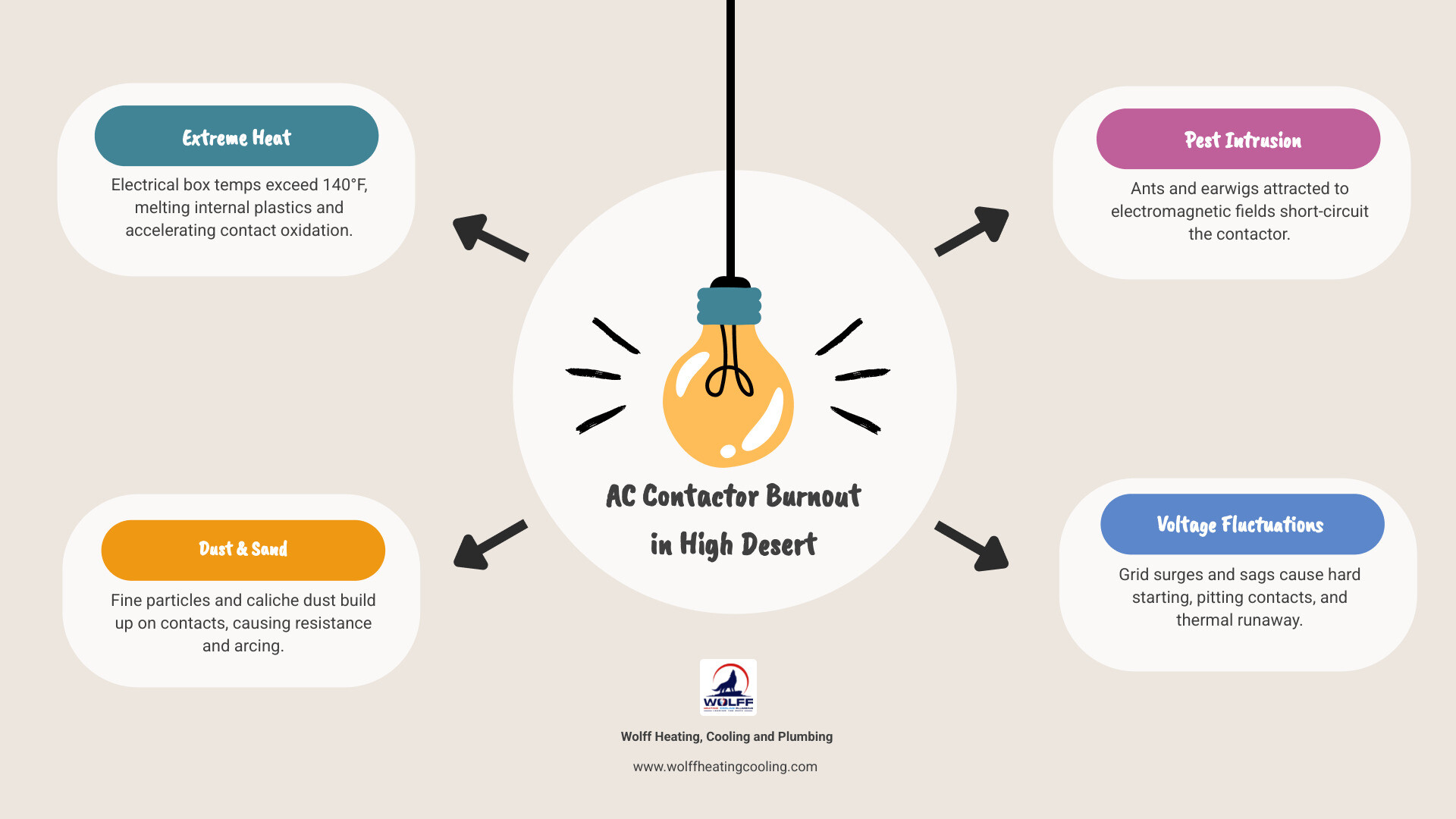
- Extreme ambient temperatures pushing electrical box temps above 140°F
- Fine dust, blowing sand, and caliche buildup on contact surfaces
- Pest intrusion from ants and earwigs attracted to electromagnetic fields
- Voltage fluctuations and power surges from the local grid
- Short cycling caused by relentless summer heat demand
- Normal wear accelerated by 8+ months of annual heavy use
Your AC contactor is a small component — roughly the size of a deck of cards — but it controls the flow of electricity to the most expensive parts of your cooling system. When it burns out in Albuquerque’s punishing high desert heat, the consequences can go far beyond a warm afternoon. A failed contactor can take your compressor with it, turning a straightforward repair into a major system replacement. The high desert environment here is especially brutal on this part: extreme temperatures, blowing dust, and persistent pests all work together to shorten its life well below what manufacturers expect. Knowing the warning signs early is the difference between a quick fix and a catastrophic breakdown.
I’m Joe Wolff, and with over 25 years serving Albuquerque homeowners through some of the toughest cooling seasons the high desert can throw at us, I want to walk you through exactly what to look for and why it matters.
What is an AC Contactor and Why Does It Fail in Albuquerque?
To understand why your air conditioner suddenly stops blowing cold air, you have to look at the gatekeeper of your outdoor unit: the AC contactor. Think of the contactor as a heavy-duty electromechanical switch. Its primary job is to control the flow of high-voltage electricity to the two most power-hungry components in your outdoor condenser: the compressor and the condenser fan motor.
In Albuquerque and surrounding areas like Rio Rancho and Corrales, our unique high desert geography places unique stress on these electrical components. Sitting at an elevation of over 5,000 feet, our air is thinner, which means it is less effective at dissipating heat from electrical control boxes. Additionally, our dramatic diurnal temperature swings — where a scorching 100°F afternoon rapidly drops to a cool 60°F night — cause constant thermal expansion and contraction in electrical connections. Over time, this mechanical movement loosens terminal screws, creating electrical resistance and setting the stage for premature failure.
For a broader look at how the dry climate impacts your system, check out our guide on What to Check When Your AC Loses Its Cool in Dry Heat.
The Role of the Contactor in High Desert Climates
Your air conditioner operates on two distinct electrical circuits: a low-voltage control circuit (24 volts) and a high-voltage power circuit (240 volts). Sending a full 240 volts directly through your delicate indoor thermostat would result in a very literal, very dangerous fireworks show in your living room.
Instead, when your thermostat senses the indoor temperature rising, it sends a safe, low-voltage 24V signal to the outdoor unit. This signal energizes an electromagnetic coil inside the contactor. The magnetic field pulls down a metal bar called an armature, closing the heavy brass or copper contacts. This action completes the high-voltage 240V bridge, allowing electricity to rush to the compressor and fan.
Because of our long, hot summers, your contactor performs this physical “switching” action thousands of times a season. While standard contactors are rated for roughly 100,000 cycles under laboratory conditions, the real-world thermal loads of New Mexico drastically accelerate wear. If you are struggling with a system that refuses to engage, read more about Why Your AC Isn’t Cooling in Albuquerque.
How High Desert Heat Shrinks Contactor Lifespan
When outdoor temperatures in the Rio Rancho or Bernalillo area hit 100°F or higher, the temperature inside your AC unit’s sealed metal electrical control box can easily soar past 140°F. This localized heat dome degrades the protective insulation wrapping the contactor’s electromagnetic coil.
Under normal, mild climate conditions, a high-quality AC contactor can easily last 10 to 15 years (and sometimes up to 20 years in regions where the AC only runs three months out of the year). However, in the high desert, where systems run hard for eight or more months annually, that lifespan is cut in half.
| Climate Type | Average Annual Usage | Expected Contactor Lifespan | Primary Failure Accelerators |
|---|---|---|---|
| Mild Climates | 2 to 3 Months | 10 to 15+ Years | Normal mechanical wear, moisture |
| High Desert (Albuquerque/Rio Rancho) | 8+ Months | 8 to 12 Years | Extreme ambient heat, diurnal temperature swings |
| Extreme Heat / Low-Quality Parts | Continuous / Heavy | 3 to 5 Years | Short cycling, dust storms, voltage drops |
AC Contactor Burned Out Symptoms and Causes in High Desert Heat
When an electromechanical switch is forced to operate in extreme temperatures, it undergoes severe physical changes. Every single time those metal contacts touch, a tiny electrical arc jumps between them. This electrical arcing can momentarily reach temperatures exceeding 3,000°F.
To handle this extreme heat, manufacturers coat the contact points with a highly conductive silver-alloy plating. However, as high desert heat elevates the baseline temperature of the metal, this silver plating begins to wear away, exposing the raw copper underneath. Raw copper oxidizes incredibly fast when exposed to air and heat. This oxidation creates high electrical resistance, which in turn generates even more heat. This self-destructive cycle is known as “thermal runaway,” and it is the primary reason behind a ac contactor burned out symptoms and causes in high desert heat.
If you suspect your system is suffering from thermal damage, learn more about identifying these issues in our article on AC Problems and Professional Solutions.
Auditory and Visual AC Contactor Burned Out Symptoms and Causes in High Desert Heat
Fortunately, a failing contactor rarely goes quietly. It will usually give you several auditory and visual warning signs before it fails completely:
- Loud Buzzing or Humming: A healthy contactor makes a single, clean “click” when it engages. If you hear a loud, continuous buzzing or humming sound resembling a swarm of angry bees coming from your outdoor unit, the electromagnetic coil is weakening or dirt has settled on the pole faces, preventing a tight seal.
- Chattering or Rapid Clicking: Often sounding like a playing card stuck in bicycle spokes, “chattering” occurs when the contacts rapidly bounce open and shut. This is usually caused by low control voltage or a failing coil that cannot maintain the magnetic pull.
- Pitted, Charred, or Welded Contacts: If you look at the physical contact points, they should be smooth and silver. Failing contacts will look pitted, blackened with carbon deposits, or may even be completely melted and welded together.
- Melted Plastic and Burning Smells: The extreme heat generated by arcing can melt the contactor’s plastic housing. This often releases a distinct, acrid odor. If you notice this, read our guide on what to do when your AC Smells Like Burning Plastic in Albuquerque.
Environmental AC Contactor Burned Out Symptoms and Causes in High Desert Heat
Albuquerque’s climate presents several environmental hazards that directly attack your electrical components:
- Blowing Sand and Caliche Dust: Our spring windstorms carry incredibly fine, abrasive dust. This dust penetrates the outdoor electrical cabinet and settles directly onto the contact points. When the contacts close, this dust acts as an insulating barrier, preventing a clean connection and forcing the electricity to arc across the gap, which rapidly burns away the protective silver plating.
- Pest Intrusion (Ants and Earwigs): Desert pests are naturally drawn to the electromagnetic fields and warmth generated by energized contactor coils. Ants, in particular, will crawl between the open contacts. When the contactor closes, the insects are crushed, which instantly interrupts the electrical connection. Even worse, dying ants release alarm pheromones that attract hundreds more, quickly filling the contactor with dead bugs and causing a complete short circuit.
If environmental factors have already taken a toll on your system, you can learn about the next stage of damage in our breakdown of Signs Your AC Compressor is Failing.
The Hidden Dangers of Ignoring a Failing Contactor
Ignoring a noisy or struggling AC contactor is a massive gamble. Because this small part acts as the electrical gateway to your entire outdoor unit, its failure can trigger a chain reaction of expensive damage.
Industry data shows that 68% of all compressor failures trace back to a single overlooked component — the AC contactor. When contacts become pitted or charred, they block the clean flow of electrical current, causing voltage drops. If a compressor is forced to run on this dirty power, it will overheat, breaking down its internal motor insulation. In fact, 72% of compressors will fail within 30 days if charred contacts are left unaddressed.
Beyond equipment damage, a failing contactor poses a serious safety hazard. The National Fire Protection Association (NFPA) notes that faulty contacts contribute to roughly 15% to 20% of all HVAC-related electrical fires. When terminals loosen due to high desert thermal expansion, the resulting electrical arcing can easily ignite the plastic housing of the contactor or nearby wiring.
Welded Contacts and Continuous Running
When electrical arcing becomes severe enough, the extreme heat can literally weld the metal contact plates together. When this happens, the contactor is stuck in the “closed” position.
Even if your indoor thermostat reaches its target temperature and signals the system to shut down, the high-voltage circuit remains closed. Your outdoor condenser fan and compressor will continue to run nonstop. This continuous operation causes the indoor evaporator coil to freeze over.
Once the coil is encased in ice, it can no longer evaporate the liquid refrigerant. This liquid refrigerant then travels back down the copper lines to the outdoor unit, flooding the compressor. Because liquid cannot be compressed, this “liquid floodback” causes instant, catastrophic mechanical destruction of the compressor.
The Capacitor Connection and Electrical Strain
Your AC contactor does not work alone; it operates in tandem with your dual run capacitor. The capacitor acts like a temporary battery, providing the massive electrical boost needed to start the compressor motor.
Statistically, 65% of AC startup failures involve a faulty capacitor. In our extreme New Mexico heat, capacitors degrade rapidly because their internal dielectric fluid boils when cabinet temperatures exceed 158°F.
When a capacitor weakens, it can no longer provide that necessary starting boost. This forces the compressor to struggle to spin up, drawing locked-rotor amperage (LRA) — which is three to five times its normal running current. This massive surge of electricity travels directly through the contactor, creating severe arcing that burns out the contacts in short order.
How to Safely Diagnose and Maintain Your AC Contactor
While a visual check can tell you a lot, a proper diagnosis requires precision tools. However, safety must be your absolute top priority. The outdoor electrical panel contains lethal 240-volt circuits, and the dual run capacitor stores a massive electrical charge even when the main breaker is turned off.
If you are comfortable working with electricity and have the proper safety gear, you can perform a diagnostic check using a digital multimeter:
- Disconnect All Power: Turn off the dedicated AC breaker in your home’s main electrical panel, and pull the physical disconnect plug located in the outdoor box next to your condenser.
- Verify Power is Off: Use a multimeter set to AC Voltage to test the incoming terminals. Ensure the reading is absolute zero before touching any components.
- Perform a Visual Inspection: Look for pitting, black carbon soot, melted plastic, or insect nests.
- Test the Coil Resistance: Set your multimeter to Ohms (resistance) and place the probes on the low-voltage side terminals of the coil. A healthy contactor coil should read between 10 and 20 Ohms. If your meter reads “OL” (Open Line), the coil is burnt out and the contactor must be replaced.
- Test the Contact Resistance: Push the contactor plunger down manually and measure resistance across the high-voltage contacts. A healthy connection should read between 0.1 and 0.3 Ohms. Any higher indicates severe pitting and carbon buildup.
- Check Voltage Drop: With the system running safely, a professional technician will measure the voltage drop across the closed contacts. This drop should never exceed 0.5 volts. A higher drop indicates excessive resistance and immediate replacement is needed.
During routine maintenance, we always ensure every electrical terminal lug is torqued exactly to specification. This prevents the vibration of the unit and high desert thermal expansion from loosening the wires, which is a primary cause of electrical fires. We also highly recommend installing a dedicated HVAC surge protector at your outdoor disconnect box to shield your sensitive contactor coil from NM grid voltage spikes.
Frequently Asked Questions About Desert AC Contactors
Can I run my AC with a bad contactor?
No, you should never run your air conditioner if you suspect the contactor is failing. Running a system with a compromised contactor introduces severe voltage fluctuations to your compressor. This dirty power degrades the motor windings, which can destroy your compressor in less than a month or trigger an electrical fire in your outdoor cabinet. If you hear loud chattering or buzzing, shut the system down at the thermostat immediately.
Can I clean or sand down pitted contacts instead of replacing them?
We strongly advise against this. While sanding or filing down pitted contacts might work as a temporary emergency fix to get your cooling back on for a night, it is not a permanent solution. Sanding strips away the protective silver-alloy plating, exposing the raw copper underneath. Raw copper oxidizes incredibly fast in our dry, hot outdoor air. Within a few weeks, the cleaned contacts will either burn out completely or weld shut, risking catastrophic compressor failure.
Will my AC fan still run if the contactor is bad?
Yes, this is highly common and incredibly dangerous. If your system uses a single-pole contactor (which only switches one side of the high-voltage line) or has a partial mechanical failure on a double-pole contactor, the outdoor fan motor may continue to spin while the compressor remains completely off. This allows the indoor blower to run without any cooling taking place, or worse, can cause liquid refrigerant to flood back and destroy the compressor motor windings.
Conclusion
A burned-out AC contactor might be a small part, but in our high desert climate, it is the thin line between a cool, comfortable home and a costly system replacement. Between Albuquerque’s intense summer heat, blowing caliche dust, and nesting desert pests, your outdoor electrical components are under constant attack.
At Wolff Heating, Cooling, and Plumbing, we have over 25 years of experience helping homeowners in Albuquerque, Rio Rancho, Placitas, Corrales, Cedar Crest, Tijeras, and Bernalillo keep their systems running efficiently through the hottest summers. Our licensed, bonded, and insured technicians provide honest estimates and superior workmanship to ensure your home stays safe and cool.
Don’t wait for a small buzzing noise to turn into a major system breakdown. Schedule professional AC repair in Albuquerque with our friendly team today, and let us make sure your cooling system is ready to handle the high desert heat!