
 Menu
Menu
How Often Should a Heat Pump Be Serviced in a High-Dust, High-Altitude Climate?
If you’re wondering how often should a heat pump be serviced in a high dust high altitude climate, here is the direct answer:
Recommended Heat Pump Service Frequency for High-Altitude, High-Dust Climates
| Condition | Minimum Service Frequency |
|---|---|
| Standard climate | Once per year |
| High altitude OR high dust | Twice per year |
| High altitude AND high dust (e.g., Albuquerque, NM) | Twice per year — spring and fall — plus filter checks every 30 days |
| Older systems (10+ years) or heavy-use systems | Consider quarterly inspections |
The U.S. Department of Energy recommends twice-annual heat pump maintenance for most homes — once before the heating season and once before the cooling season. In a place like Albuquerque or the broader New Mexico high desert, that twice-yearly baseline is not just a best practice. It is the minimum.
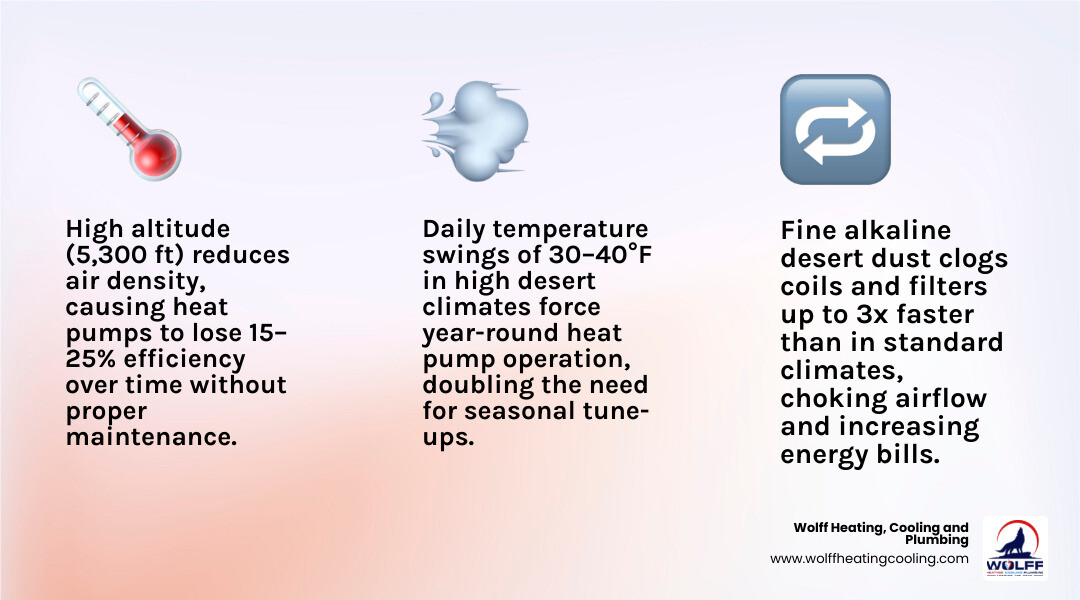
Here is why. Albuquerque sits at roughly 5,300 feet above sea level. The air is thinner, drier, and carries fine alkaline dust that settles into coils, clogs filters, and chokes airflow faster than most homeowners expect. Add daily temperature swings of 30 to 40 degrees, intense UV radiation, and a heat pump that runs year-round for both heating and cooling, and you have a system under compounding stress that a single annual tune-up simply cannot keep up with.
A neglected heat pump in these conditions can lose 15 to 25 percent of its efficiency over time — and dirty coils alone can trigger that kind of efficiency drop almost instantly. That translates directly to higher energy bills, more wear on critical components, and a shorter system lifespan.
The sections below break down exactly what is happening to your heat pump in this environment, what needs to be done and when, and how to tell if your system is already showing signs of stress.
Environmental Stressors: How High Altitude and Desert Dust Impact Heat Pumps
Operating a heat pump in Albuquerque, Rio Rancho, or the East Mountains (like Cedar Crest and Tijeras) is vastly different from operating one in a sea-level, humid climate. The physics of our high-altitude desert environment directly dictate how hard your heating and cooling system has to work.
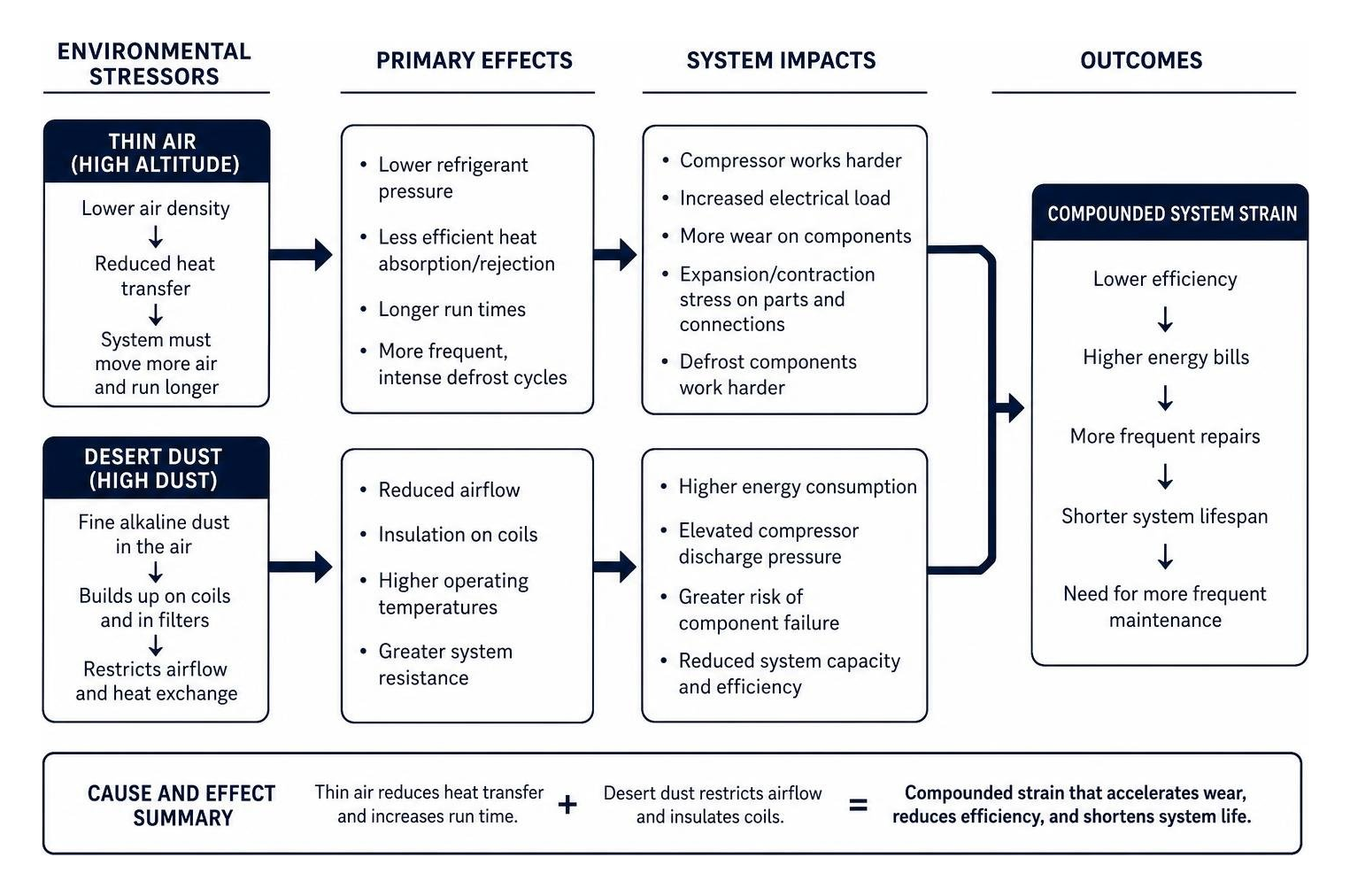
First, let’s look at air density. At elevations exceeding 5,000 feet, the air is significantly thinner. Thinner air has less mass, which means it cannot transfer heat as effectively as dense, sea-level air. To move the same amount of heat into or out of your home, your heat pump’s blower fan has to move a higher volume of air, and the compressor must run longer cycles. This inherent mechanical strain is constant.
Second, we must account for daily thermal cycling. In the New Mexico high desert, it is common to experience rapid temperature swings of 30 to 40 degrees Fahrenheit in a single 24-hour period. Your heat pump must frequently switch modes or rapidly ramp up its output. This constant expansion and contraction of metal components can slowly back electrical terminals and copper refrigerant connections out of their fittings, leading to micro-leaks and electrical faults.
For more details on managing your comfort in these unique conditions, check out our High Elevation HVAC Tips for Mountain Living.
How Altitude Impacts Refrigerant Pressure and Defrost Cycles
Because of the physical changes in air density at high elevations, refrigerant behaves differently inside the system. The pressure-temperature curves that technicians use at sea level do not apply here. Standard pressure gauges will give misleading readings unless they are calibrated for our specific altitude. If an inexperienced technician charges your system using sea-level defaults, your heat pump will run inefficiently, wasting energy and risking compressor failure.
Furthermore, high-altitude winters bring dry, freezing temperatures. While there is less moisture in our air than in coastal regions, the thin air causes the outdoor unit to run longer, more intense defrost cycles when frost does accumulate. This places extra wear on:
- Defrost control boards: These electronic brains must cycle the system back and forth between heating and cooling modes to melt outdoor ice.
- Defrost sensors: These components constantly monitor coil temperatures and are highly vulnerable to the extreme temperature fluctuations of high elevations.
- Reversing valves: The mechanical valve that physically changes the direction of the refrigerant flow must operate flawlessly under high pressure.
how often should a heat pump be serviced in a high dust high altitude climate to prevent coil damage
While altitude places physical stress on the system, desert dust introduces chemical and mechanical wear. The dust found along the West Mesa of Albuquerque and throughout Rio Rancho is highly alkaline. This alkaline silt is incredibly fine and highly hygroscopic, meaning it greedily absorbs moisture.
When your heat pump runs in cooling mode during our hot summers, the indoor evaporator coil naturally produces condensation. As fine desert dust is pulled into the system, it mixes with this condensation, forming a thick, clay-like sludge. This process is highly detrimental to your system for several reasons:
- Coil Fouling: This sludge acts as an insulating blanket over the copper coils. Instead of allowing heat to transfer freely, the dirt blocks the exchange, dropping your system’s operating efficiency by 15% to 25% almost instantly.
- Airflow Restriction: As the sludge hardens, it chokes the tiny spaces between the coil fins. This forces the blower motor to pull harder against high static pressure, leading to motor overheating.
- Capacitor Failure: When the system has to work harder due to restricted airflow and dirty coils, the electrical components run much hotter. On a 100°F summer day, the temperature inside your outdoor unit’s metal electrical cabinet can easily soar past 150°F. Since standard capacitors are only rated to handle up to 131°F safely, this heat causes electrical drift and rapid capacitor failure, which can quickly burn out your compressor.
To understand more about how desert debris compromises your HVAC system, read The Dirty Truth About HVAC Maintenance in Dusty Environments and explore our guide on Desert Survival 101 for Your High Desert HVAC.
how often should a heat pump be serviced in a high dust high altitude climate?
To combat the twin threats of thin mountain air and abrasive desert dust, bi-annual maintenance (twice per year) is the absolute gold standard.
- The Spring Tune-Up (Pre-Cooling): Scheduled between February and April, this visit focuses on deep-cleaning the outdoor condenser coils of winter dust, checking refrigerant charges against altitude-corrected specifications, and testing capacitors before the intense summer heat hits.
- The Fall Tune-Up (Pre-Heating): Scheduled between September and November, this service focuses on testing the reversing valve, calibrating the defrost cycle controls, inspecting the auxiliary electric heating elements, and ensuring the electrical connections remain tight after summer’s thermal expansion.
System age also plays a major role in determining service frequency. If your heat pump is under 7 years old, twice-yearly service keeps it running like new and satisfies manufacturer warranty requirements. However, if your system is over 10 years old, it has already logged thousands of highly demanding operating hours. For these older units, scheduling quarterly inspections or at least keeping a very close eye on the system between seasonal tune-ups is highly recommended to catch weak components before they cause a complete system breakdown.
Why Once-a-Year Service Falls Short in New Mexico
In milder parts of the country, a single annual HVAC visit is often sufficient. But in New Mexico, your heat pump is a “marathon runner.” Unlike a standard furnace or air conditioner that gets to rest for half the year, a heat pump performs double duty. It runs year-round, switching seamlessly from heating on chilly desert nights to cooling during scorching summer afternoons.
Skipping even one seasonal tune-up in our climate is the operational equivalent of driving your car 20,000 miles without an oil change. The combination of year-round operation, abrasive caliche dust, and high altitude means that minor issues—like a slightly weak capacitor or a tiny refrigerant leak—will rapidly compound into catastrophic component failures. To dive deeper into why year-round systems require specialized care, read about the Importance of Heat Pump Maintenance.
Critical Maintenance Tasks for High-Altitude, Dusty Systems
When we perform a professional tune-up in high-altitude, high-dust areas like Bernalillo, Placitas, or Corrales, we don’t just kick the dust off the outdoor unit and call it a day. A high-altitude tune-up requires highly technical, precise steps:
- Electrical Diagnostics: We measure the exact capacitance of your start and run capacitors. Even a minor drop in capacitance can cause the compressor to draw excess amperage, running hot and shortening its lifespan.
- Static Pressure Measurement: We test the pressure inside your ductwork to ensure the thin air is moving freely. High static pressure indicates restricted airflow, which destroys blower motors.
- Refrigerant Charge Verification: We use digital gauges calibrated for local altitude to verify that the refrigerant charge is correct down to the ounce.
- Coil Fin Alignment & Cleaning: We carefully straighten bent aluminum fins to maximize heat transfer and use specialized, self-rinsing coil cleaners to dissolve baked-on desert silt without damaging the delicate metal.
DIY Maintenance vs. Professional Tune-Ups
While professional calibration is essential, homeowners can take several simple, highly effective steps to protect their heat pumps between service visits:
- Diligent Filter Replacement: In dusty climates, forget the manufacturer’s advice of changing filters every 90 days. You should inspect your filter every 30 days. If you live in a high-wind area or have pets, replace it monthly.
- Choose the Right MERV Rating: We recommend using pleated filters rated between MERV 8 and MERV 11. These filters catch fine desert dust without restricting airflow. Avoid ultra-restrictive MERV 13+ filters unless your system has been specifically modified for them; in our thin air, highly restrictive filters will cause blower motors to overheat and fail.
- Maintain the Clearance Zone: Keep a 2-foot “dead zone” around your outdoor unit. Trim back desert scrub, weeds, and clear out any windblown tumbleweeds or plastic bags that may have been sucked against the outdoor coils.
- Gentle Rinsing: After a severe dust storm, turn off the power to your outdoor unit and gently rinse the condenser coils with a garden hose using a wide spray pattern. Never use a pressure washer, as the high pressure will instantly bend and ruin the delicate aluminum fins.
For a comprehensive checklist of what our team handles during a professional visit, view our Heat Pump Maintenance Albuquerque Guide.
how often should a heat pump be serviced in a high dust high altitude climate to protect the warranty
Many homeowners do not realize that skipping professional maintenance can void their manufacturer’s warranty. Major HVAC brands like Carrier, Lennox, and Trane explicitly state in their warranty terms that the system must be serviced annually or bi-annually by a licensed professional.
If your compressor fails five years into its life, the manufacturer will often require documented proof of regular professional maintenance before they will ship a replacement part. Keeping a folder of your service records is the best way to protect your financial investment. Regular care also dramatically extends the system’s operational life. While a neglected heat pump in New Mexico may fail in just 8 to 12 years, a well-maintained system can easily provide comfortable, efficient heating and cooling for 15 to 20+ years. Learn more about regional system lifespans in our guide on the Average Lifespan of an HVAC System in the Southwest.
Frequently Asked Questions About High-Altitude Heat Pump Care
What are the signs that my heat pump needs immediate service in a dusty climate?
Do not wait for your system to stop working entirely before calling for help. Watch out for these early warning signs:
- Short-Cycling: If your system turns on and off rapidly every few minutes, it is likely overheating due to restricted airflow or a failing sensor.
- Weak Airflow: If the air coming out of your registers feels weak or barely lukewarm, your filters or coils may be completely choked with dust.
- Strange Noises: Squealing, grinding, or loud rattling noises indicate worn bearings, loose fan blades, or a compressor under extreme mechanical strain.
- Ice Buildup: If you see a thick block of ice encasing your outdoor unit in the winter or your indoor coils freezing up in the summer, your system has a serious airflow block or a refrigerant leak.
Can regular maintenance extend my heat pump’s lifespan in New Mexico?
Absolutely. Regular maintenance reduces the overall runtime of your system by keeping the coils clean and the refrigerant balanced. This directly translates to less wear and tear on the compressor—the most expensive component in your heat pump. By keeping your system running at peak efficiency, you can also lower your monthly energy bills by up to 15% and prevent up to 80% of unexpected mid-season breakdowns.
For local maintenance solutions tailored to our neighboring communities, check out our guide on Heat Pump Maintenance Rio Rancho NM.
Why does my heat pump freeze up during high-altitude winters?
While a thin layer of frost is normal during freezing temperatures, solid ice buildup is a major warning sign. This is usually caused by:
- Defrost Board or Sensor Failure: The system fails to recognize that ice has accumulated, or the reversing valve fails to switch modes to melt the ice.
- Low Refrigerant: Micro-leaks caused by winter thermal expansion reduce refrigerant levels, causing the coils to run much colder than they should, which triggers rapid icing.
- Restricted Airflow: A severely clogged air filter prevents warm indoor air from transferring heat across the indoor coils, causing the entire system’s operating temperatures to plummet.
If you live in Bernalillo or the surrounding areas and are experiencing winter freeze-ups, read our dedicated resource on Heat Pump Maintenance Bernalillo NM.
Conclusion
Operating a heat pump in a high-dust, high-altitude climate requires a proactive approach to maintenance. By scheduling professional service twice a year—once in the spring and once in the fall—and checking your air filters every 30 days, you can protect your system from the harsh New Mexico environment, keep your utility bills low, and ensure your home stays comfortable year-round.
At Wolff Heating, Cooling, and Plumbing, we have over 25 years of experience servicing HVAC systems throughout Albuquerque, Rio Rancho, Placitas, Corrales, Cedar Crest, Tijeras, and Bernalillo. We understand the unique challenges of high-desert mountain living, and our licensed, bonded, and insured technicians are committed to providing honest estimates and superior service.
Ready to protect your comfort and extend the life of your system? Explore our HVAC Maintenance Plan Rio Rancho to keep your heating and cooling running flawlessly. For comprehensive services, visit our Heat Pump Services Albuquerque NM page or schedule a prompt repair using our Heat Pump Repair Albuquerque Guide. Contact us today to schedule your next seasonal tune-up!