
 Menu
Menu
Why Albuquerque Hard Water Can Damage Tankless Heat Exchangers
How mineral scale buildup in Albuquerque hard water destroys tankless heat exchangers is simple: calcium and magnesium in the water separate out when heated and stick to the exchanger’s narrow internal passages. That chalky scale acts like insulation, so the unit must run hotter and longer to heat water. Over time, restricted flow and repeated overheating put stress on the metal, leading to weak performance, error codes, leaks, and possible heat exchanger failure. Tankless water heaters are especially vulnerable because their water passages are small and heat changes happen quickly.
For tankless system guidance, explore tankless water heaters in Albuquerque; for help with a system concern, contact Wolff Heating, Cooling and Plumbing.

I’m Joe Wolff, and our team can inspect your tankless water heater and help protect it from hard-water scale – schedule service with Wolff Heating, Cooling and Plumbing.
The Science Behind How Mineral Scale Buildup in Albuquerque Hard Water Destroys Tankless Heat Exchangers
To understand why tankless water heaters suffer so severely in central New Mexico, we have to look at the chemistry of our local water supply. Much of the water flowing into homes across Albuquerque, Rio Rancho, and Bernalillo comes from deep alkaline groundwater aquifers and river basins rich in natural minerals. As rain and snowmelt filter through limestone and ancient rock formations in the surrounding Sandia Mountains and Rio Grande valley, the water becomes heavily saturated with dissolved calcium carbonate and magnesium ions.
While these minerals are safe to drink, they pose a constant threat to modern plumbing appliances. Water hardness in our area often exceeds 10 to 15 grains per gallon (GPG), classifying it as very hard water. When this hard water enters your home, it carries dissolved minerals in a suspended liquid state. However, the moment that water meets extreme heat inside a high-efficiency tankless water heater, the thermal dynamic changes instantly.
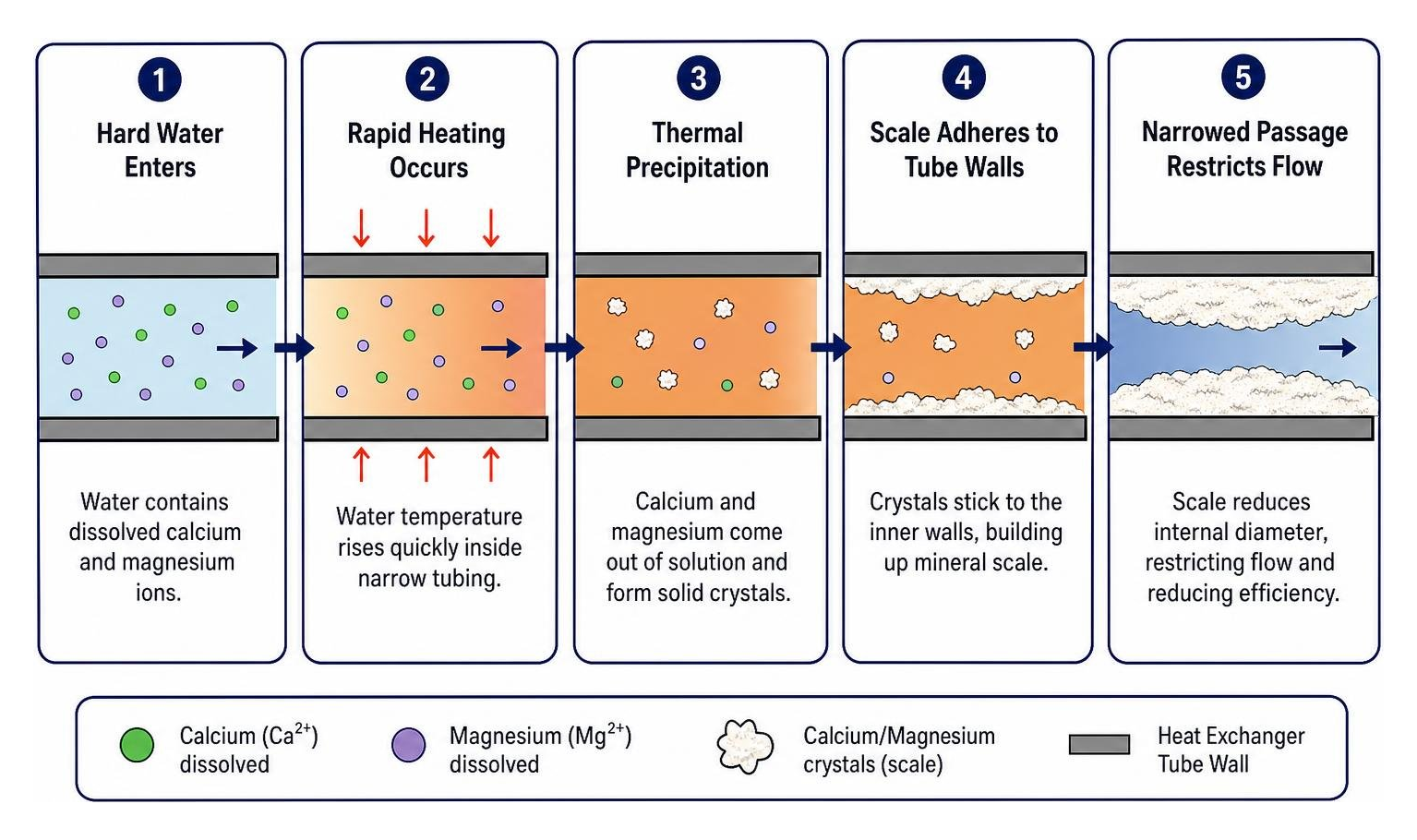
Unlike traditional tank-style water heaters that hold 40 to 50 gallons of standing water in a wide cylinder, tankless systems heat water on demand using ultra-compact, high-output heat exchangers. Water passes through narrow copper or stainless steel tubing surrounded by powerful gas burners or electrical elements. As the temperature of the incoming cold water surges by 50 to 70 degrees in a matter of seconds, dissolved calcium and magnesium ions undergo rapid thermal precipitation.
The heat forces these dissolved solids out of solution, transforming them into solid, chalky mineral crystals known as calcite or limescale. Because the water channels inside a tankless exchanger are extraordinarily tight, these precipitating minerals do not simply float away. Instead, they bake directly onto the interior metal walls of the heat exchanger tubes. To learn more about how this affects performance, explore our detailed breakdown of Tankless Water Heater Scale Issues.
Thermal Insulation Loops: How Mineral Scale Buildup in Albuquerque Hard Water Destroys Tankless Heat Exchangers
Once a base layer of mineral scale forms inside the heat exchanger, a dangerous thermal feedback loop begins. Metal heat exchangers are specifically engineered using copper or high-grade stainless steel because these materials possess high thermal conductivity. They are meant to transfer heat from the gas burner directly to the flowing water instantly and efficiently.
Limescale, on the other hand, is an exceptionally effective thermal insulator. When a layer of scale sticks to the inside of the heat exchanger tubing, it acts like a thick winter blanket thrown over the heat source.
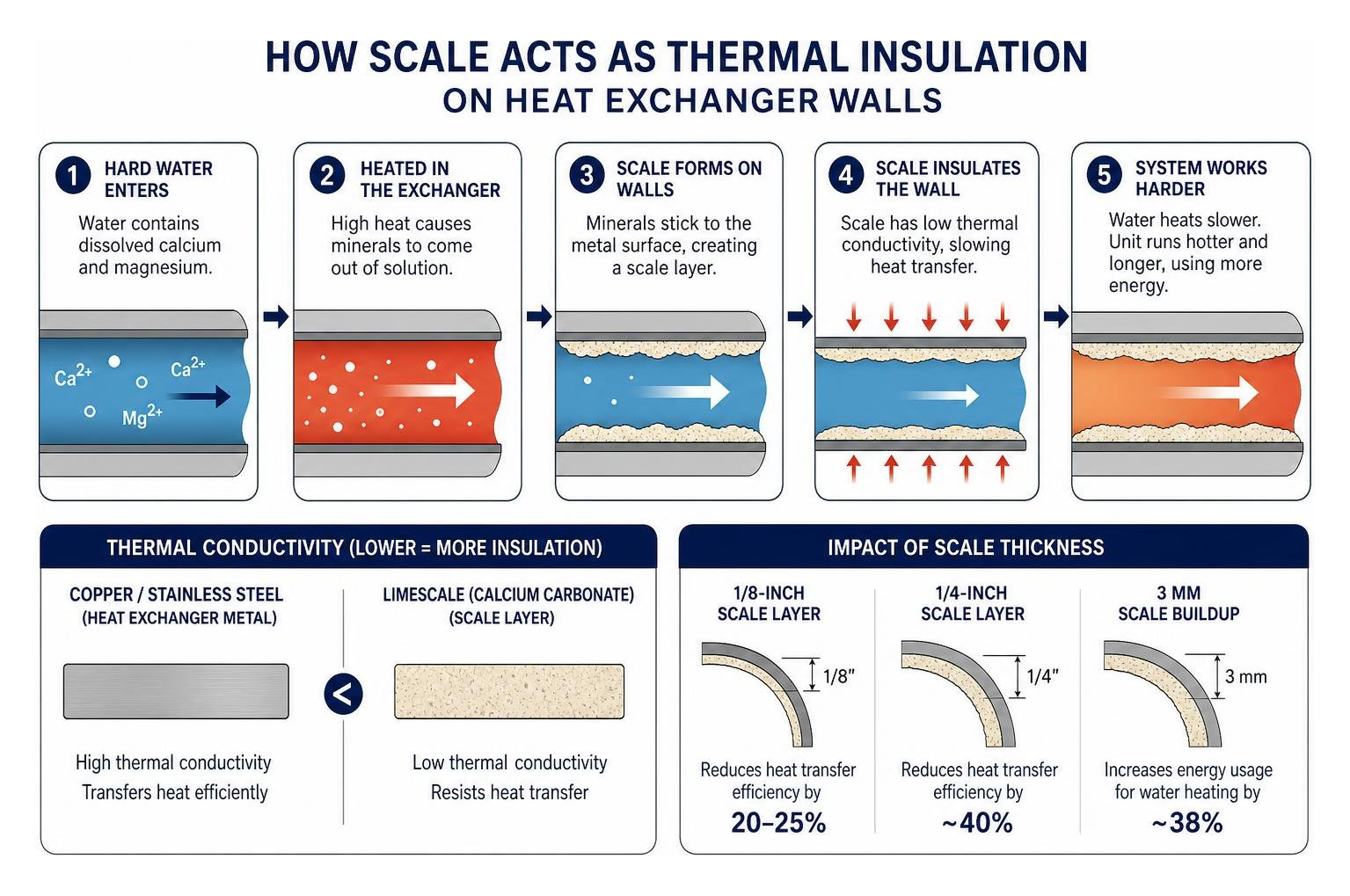
The thermal conductivity numbers show just how quickly performance degrades:
- 1/8-Inch Scale Layer: Reduces heat transfer efficiency by 20 to 25 percent.
- 1/4-Inch Scale Layer: Reduces heat transfer efficiency by nearly 40 percent.
- 3 mm Scale Buildup: Increases energy usage for water heating by roughly 38 percent.
Because the scale layer acts as a barrier, the water flowing through the exchanger cannot absorb the heat generated by the burner fast enough. The internal thermostat detects that the output water is not reaching your desired temperature, so it signals the system burner to fire longer and at maximum output. The burner blazes at full capacity, but because the scale insulates the water side, the heat gets trapped inside the metal walls of the exchanger itself.
This creates a destructive heat trap. The metal exchanger reaches temperatures far beyond its intended operating threshold, while your household experiences lukewarm water at the tap. The unit consumes vast amounts of extra gas or electricity trying to push heat through a solid rock wall, driving up utility bills month after month while accelerating internal component decay.
Mechanical Stress and Metal Fatigue: How Mineral Scale Buildup in Albuquerque Hard Water Destroys Tankless Heat Exchangers
The physical destruction of the heat exchanger goes far beyond simple thermal inefficiency. The true killer of tankless systems in Albuquerque is the extreme mechanical stress caused by thermal expansion and contraction cycles.
Copper and stainless steel are ductile metals that expand when heated and contract when cooled. Under normal conditions with clean internal walls, this thermal expansion is uniform across the entire heat exchanger assembly. However, when mineral scale coats the interior unevenly, serious structural issues develop:
- Hot Spot Formation: Scale does not deposit evenly; it accumulates thickest at the highest temperature contact points. This creates extreme localized temperature differences across the same piece of metal.
- Uneven Thermal Expansion: The unscaled sections of the pipe remain cooler and expand at a normal rate, while the scaled sections overheat and try to expand much further.
- Severe Metal Fatigue: As the burner cycles on and off dozens of times every day, the localized hot spots undergo intense expansion stress. Over time, this constant bending and pulling on a microscopic level leads to metal fatigue.
- Stress Fractures and Pinhole Leaks: Eventually, the metal crystallizes, becomes brittle, and cracks. Microscopic stress fractures open up along the seams or curves of the heat exchanger coils, leading to internal water leaks.
At the same time, physical scale deposits reduce the inner diameter of the water passages. As water flow becomes restricted, internal pressure spikes inside the heat exchanger. This combination of intense thermal fatigue, localized structural overheating, and elevated internal water pressure will crack even high-grade metal components, resulting in full heat exchanger failure.
Signs of Exchanger Scale Damage and Impact on Warranty and Lifespan
Recognizing the early warning signs of mineral scale damage can mean the difference between a simple maintenance flush and having to replace your entire heating unit. Because scale forms quietly inside hidden internal channels, homeowners often miss the initial warning signs until performance drops significantly.
Pay close attention to these early symptoms of scale buildup in your home:
- Fluctuating Water Temperatures: If your hot water starts cycling between hot and cold during a shower (often referred to as a “cold water sandwich”), scale is likely interfering with temperature sensors and heat transfer.
- Reduced Hot Water Pressure: If cold water pressure remains strong throughout your home, but hot water pressure at taps and showerheads drops noticeable, scale has narrowed the internal diameter of the exchanger tube.
- Popping or Rattling Noises: Hearing strange crackling, whistling, or popping sounds when the unit turns on indicates localized boiling. Water trapped underneath mineral scale pockets is overheating into steam bubbles.
- Frequent Error Codes: Modern tankless units monitor their own internal temperature and exhaust gas conditions. Error codes signaling ignition failure, high limit temperature limits, or air supply/exhaust issues often trace directly back to an overheating, scale-choked heat exchanger. You can review common diagnostic warnings with our guide on Tankless Water Heater Service Signs.
Ignoring these warning signs has severe long-term financial and operational consequences. While a high-quality tankless water heater installed in an area with soft water can easily last 15 to 20 years, an unmaintained tankless system operating in Albuquerque’s hard water often fails in just 7 to 10 years.
Furthermore, ignoring scale maintenance puts your manufacturer warranty at serious risk. Most major tankless manufacturers explicitly state in their warranty documentation that damage caused by lime, scale, or mineral buildup is not covered under the standard parts or heat exchanger warranty.
If a heat exchanger cracks after five years due to thermal stress caused by scale insulation, manufacturers will routinely reject warranty claims unless you can provide documented proof of regular descaling flushes performed by licensed professionals. Protecting your investment requires proactive care—read more on how to Extend Tankless Water Heaters Life.
Effective Prevention Strategies: Descaling Flushes vs Water Treatment
Protecting your tankless heat exchanger from the aggressive hard water in Albuquerque, Corrales, and Rio Rancho requires a practical maintenance strategy. Homeowners generally have two main defense mechanisms: reactive physical removal of scale through flushing, and proactive water treatment to prevent scale from entering the system in the first place.
Routine descaling flushes are the foundational requirement for any tankless system in New Mexico. During a descaling service, a specialized recirculation pump is connected to the unit’s isolation service valves. A non-toxic acidic solution—such as food-grade vinegar or dedicated chemical descaling agents—is pumped through the internal heat exchanger loops for 45 to 60 minutes. The acid chemically dissolves the solid calcium carbonate and magnesium scale, breaking it back down into liquid form and restoring clean metal surfaces.
However, in areas with severe water hardness (10+ GPG), relying only on periodic descaling flushes has clear limitations. Household vinegar is a relatively mild acid; while it works well for light maintenance, heavy scale accumulation can require industrial descaling compounds or professional intervention. If you wait too long between flushes, the scale layer becomes so dense and calcified that a standard flush cannot fully penetrate it, leaving behind trapped pockets of scale that continue to cause hot spots.
For complete, long-term protection against hard water damage, installing a water treatment solution at the point of entry into your home is highly recommended.
Here is how the most common prevention methods compare:
| Protection Strategy | Primary Function | Scalability & Coverage | Maintenance Requirement | Heat Exchanger Protection Level |
|---|---|---|---|---|
| Routine Descaling Flush | Dissolves scale that has already stuck to internal copper/steel surfaces. | Tankless unit heat exchanger only. | Performed every 3 to 12 months depending on hardness. | Moderate (Protects system reactively, but scale forms between flushes). |
| Ion-Exchange Water Softener | Removes calcium and magnesium minerals entirely by swapping them with sodium ions. | Whole-house plumbing, appliances, fixtures, and heat exchangers. | Periodic salt replenishment and system valve checks. | Maximum (Prevents up to 99% of scale formation inside the exchanger). |
| Physical Water Conditioner / Descalers | Alters mineral crystal structures so calcium cannot easily stick to metal surfaces. | Whole-house plumbing lines. | Zero salt required; media replacement every few years. | High (Significantly reduces scale adhesion without salt). |
| Inline Cartridge Filters | Traps large sediment and uses polyphosphates to sequester minerals. | Dedicated feed line entering the tankless unit. | Replacing filter cartridges every 6 months. | Moderate (Good secondary defense for isolated appliances). |
Combining a whole-house water softener or physical conditioner with regular maintenance flushes gives your system the absolute best defense. Learn the exact process behind servicing these units in our resource on How to Flush Your Water Heater in Hard Water Areas Like Albuquerque.
Frequently Asked Questions About Tankless Exchanger Scale in Albuquerque
How often should a tankless water heater be descaled in Albuquerque?
Due to our regional water hardness levels consistently exceeding 10 grains per gallon (GPG), tankless water heaters installed in Albuquerque, Placitas, Corrales, and surrounding communities should be descaled at least once every 12 months. In areas with extreme hardness (12 to 17 GPG) or in homes with high daily hot water usage, maintenance flushes may be required every 3 to 6 months to prevent mineral accumulation.
If you have a whole-house salt-based water softener installed that actively removes minerals from your incoming supply, you can usually extend your descaling cycle to once every 18 to 24 months. Check out our comprehensive Tankless Water Heater Maintenance Albuquerque NM Guide to establish the ideal schedule for your neighborhood’s specific water quality.
Can a water softener completely protect a tankless heat exchanger?
Yes, a properly sized and correctly maintained ion-exchange water softener provides nearly complete protection for a tankless heat exchanger. By replacing dissolved calcium and magnesium ions with sodium or potassium ions before the water ever touches your home’s internal plumbing, the softener removes the root cause of limescale precipitation.
However, “completely protect” assumes the water softener is always functioning properly and never runs out of salt. If a water softener runs dry on salt, hard water will immediately enter the tankless unit and begin depositing scale on the hot heat exchanger walls. Furthermore, physical water descalers and salt-free conditioners alter mineral structure to prevent adhesion, but under extreme temperatures, tiny amounts of surface film can still accumulate over many years. Therefore, even with a softener installed, periodic inspection of your heat exchanger remains a smart practice.
Will manufacturer warranties cover heat exchanger replacement caused by scale?
No. Almost all major tankless water heater manufacturers specifically exclude scale buildup, mineral deposits, and lime accumulation from their standard warranty coverage. Manufacturer warranties cover defects in materials or factory workmanship—not damage caused by untreated local water conditions.
If a heat exchanger fails or cracks because mineral scale insulated the metal tubing and caused localized thermal fatigue, the manufacturer will deem the failure a result of improper maintenance or adverse operating conditions. To protect yourself, keep a dedicated maintenance logbook along with professional invoices and service receipts for every descaling flush performed on your unit. Having documented proof of regular maintenance is essential if you ever need to submit a valid warranty claim for non-scale-related manufacturing defects.
Conclusion
Understanding how mineral scale buildup in Albuquerque hard water destroys tankless heat exchangers highlights why routine maintenance is essential in New Mexico. Left unchecked, hard water minerals act as a thermal insulator, driving up energy costs, straining metal heat exchangers through thermal stress, and leading to premature system leaks or total failure.
By staying ahead of hard water damage with routine descaling flushes and whole-house water conditioning, you can protect your hot water investment, preserve your manufacturer warranty, and enjoy endless hot water for years to come.
With over 25 years of experience serving Albuquerque, Rio Rancho, Placitas, Corrales, Cedar Crest, Tijeras, and Bernalillo, our licensed, bonded, and insured technicians at Wolff Heating, Cooling, and Plumbing are here to keep your home running smoothly with honest estimates and superior craftsmanship.
Protect your equipment today—explore our comprehensive options for Tankless Water Heaters Albuquerque NM or contact our friendly team to schedule your system’s routine maintenance flush!