
 Menu
Menu
Should You Switch From Swamp Cooler to AC This Summer in Placitas?
If you’re wondering should you switch from swamp cooler to AC this summer, the short answer depends on your home, your health needs, and — most importantly — your local humidity levels. For many Placitas homeowners, the answer is yes, especially once monsoon season arrives and evaporative cooling simply stops working.
Quick Answer: Should You Switch?
| Your Situation | Recommended System |
|---|---|
| Dry heat only, low humidity all summer | Swamp cooler is fine |
| Humidity spikes during monsoon season | Switch to AC |
| Household members have allergies or asthma | Switch to AC |
| You want windows closed (dust, smoke, noise) | Switch to AC |
| Tight budget, dry climate, minimal health concerns | Keep swamp cooler |
| Planning to sell your home | Switch to AC |
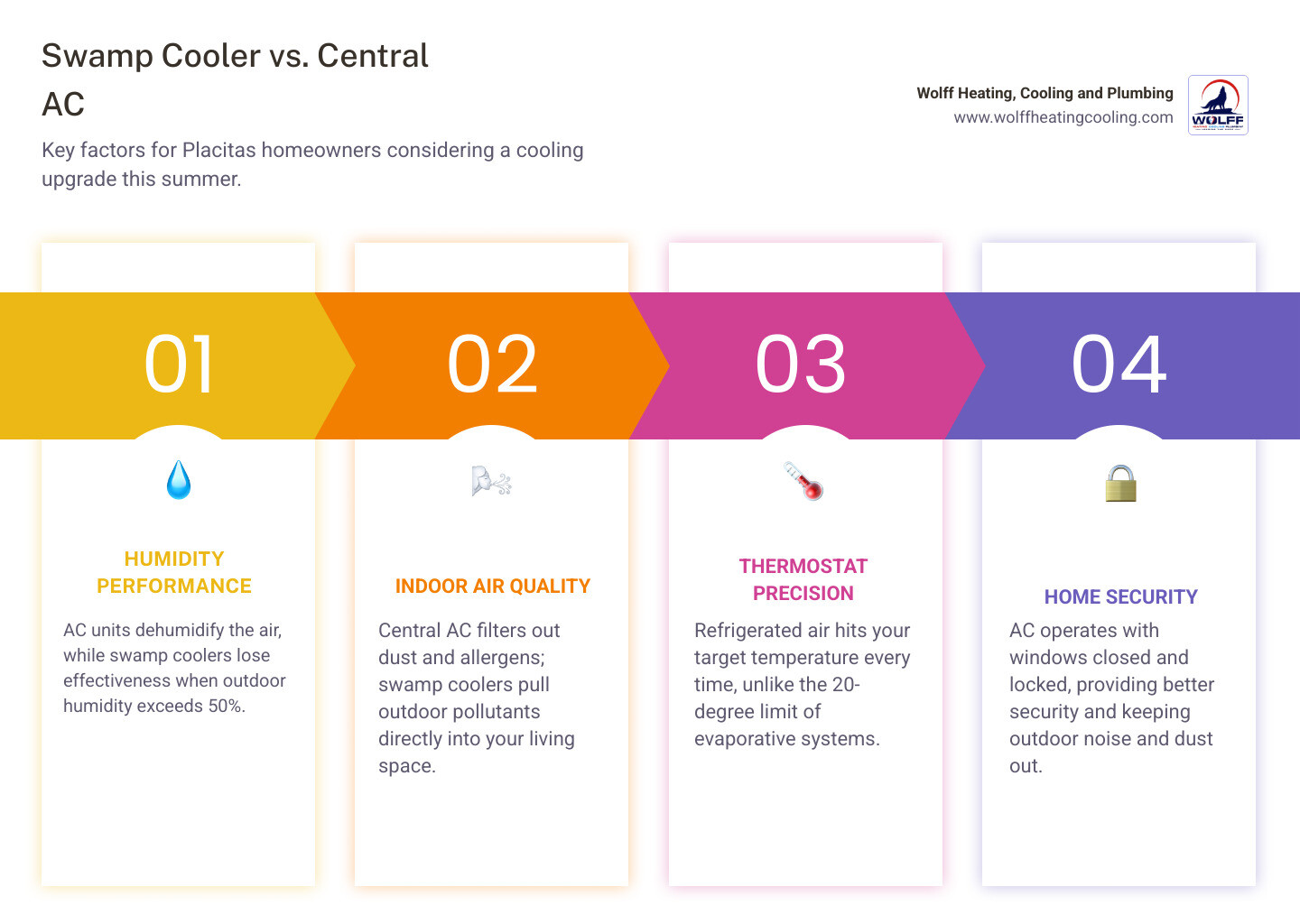
In Placitas and across the greater Albuquerque area, swamp coolers work well through the dry spring months. But come July, when the monsoon rolls in and outdoor humidity climbs past 50%, evaporative cooling loses its edge fast. Instead of cool, dry air, you get warm, sticky air — your cooler is running hard but your home feels like a sauna.
That seasonal shift is the moment most homeowners start asking the real question: is it finally time to make the switch to central air?
This guide breaks down exactly what to consider before you decide.
Understanding the Mechanics: Evaporation vs. Refrigeration
To decide if you should you switch from swamp cooler to AC this summer, it helps to understand how these two systems differ. They aren’t just different machines; they use completely different scientific principles to keep you comfortable.
The Evaporative Process (Swamp Coolers)
A swamp cooler is essentially a large fan and a water pump. It pulls hot, dry outdoor air through water-saturated pads. As the air passes through, the water evaporates, absorbing heat and lowering the air temperature. This “fresh air” system requires you to keep windows or doors cracked open to allow the air to exhaust. Without proper airflow, the humidity builds up inside, and the cooling effect vanishes.
For a deeper dive into this process, check out A Simple Guide to How Your Swamp Cooler Actually Works.
The Refrigerant Cycle (Central AC)
Central air conditioning is a “closed-loop” system. It doesn’t bring in outside air. Instead, it pulls the air from inside your home, passes it over cold evaporator coils filled with refrigerant, and removes both heat and moisture. The heat is exhausted outside, and the cooled, dehumidified air is recirculated through your vents. Because it removes moisture, it acts as a powerful dehumidifier — a feature you’ll appreciate during a New Mexico July.

Quick Comparison Table
| Feature | Swamp Cooler | Central Air Conditioning |
|---|---|---|
| Airflow Style | Open (requires cracked windows) | Closed (requires sealed home) |
| Moisture Control | Adds humidity to the air | Removes humidity (dehumidifies) |
| Temperature Stability | Fluctuates with outdoor weather | Precise and consistent |
| Cooling Limit | Usually drops air by 15–20°F | Can maintain any set temperature |
| Best Climate | Bone-dry (under 20% humidity) | Any climate, including humid monsoons |
Why You Should Switch From Swamp Cooler to AC This Summer
In Placitas, we are lucky to have beautiful views and a high-desert climate, but that climate is changing. We’re seeing hotter summers and more intense monsoon seasons in 2026 than in decades past.
One of the biggest arguments for switching is consistent comfort. A swamp cooler is at the mercy of the weather. If it’s 100°F outside with 10% humidity, a swamp cooler might get your home down to a pleasant 80°F. But if it’s 95°F with 45% humidity, that same cooler might only get your home down to 85°F — and it will feel much warmer because of the added moisture.
Central AC, on the other hand, doesn’t care about the humidity. It will keep your home at exactly 72°F (or whatever you prefer) regardless of whether there’s a thunderstorm outside or a record-breaking heatwave. If you’re weighing the pros and cons, our guide on Is a Swamp Cooler Better Than AC for Your Home? can help you see which fits your lifestyle better.
For those ready to move toward refrigerated air, Choosing the Best AC in Albuquerque provides insights into the types of systems that handle our local elevation and temperature swings most effectively.
Signs You Should Switch From Swamp Cooler to AC This Summer
Sometimes your home tells you it’s time for an upgrade before you even realize it. Here are the clear signs that you should you switch from swamp cooler to AC this summer:
- The “Sticky” Morning: You wake up in July feeling damp and hot, even though the cooler has been running all night.
- Indoor Mugginess: Your wooden furniture feels slightly tacky, or your salt shakers are clumping — clear signs of excess indoor humidity.
- Rising Utility Usage: While swamp coolers use less electricity, many homeowners end up running multiple supplemental fans or window units because the main system can’t keep up, which eats away at those savings.
- Security Concerns: You’re uncomfortable leaving windows cracked open while you sleep or when you’re away from home.
- Allergy Flare-ups: You notice more dust and pollen inside your home because the swamp cooler is constantly pulling in unfiltered outdoor air.
If your current unit is frequently breaking down or requiring expensive pad replacements and motor repairs, it might be more practical to look into AC Replacement in Albuquerque rather than sinking more money into an aging evaporative system.
How Local Humidity Affects Whether You Should Switch From Swamp Cooler to AC This Summer
In New Mexico, the “Monsoon Factor” is the primary reason people switch. From May through June, swamp coolers are the kings of the desert. They are cheap to run and provide a nice, moist breeze.
However, once the humidity hits that 50% threshold, the evaporation process slows down significantly. Water cannot evaporate into air that is already saturated with moisture. When this happens, your swamp cooler stops being a cooling machine and starts being a humidifier.
This is where the debate of Refrigeration vs Evaporation: Which System Wins? is usually settled. If you value being able to sleep comfortably through July and August without a layer of sweat, refrigerated air is the clear winner.
Infrastructure and Installation: Preparing Your Placitas Home
Switching from a swamp cooler to central AC isn’t always a “plug-and-play” situation. Because the systems function so differently, your home may need some infrastructure adjustments.
Ductwork Compatibility
This is the most common hurdle. Swamp coolers move a massive volume of air at low pressure. Central AC moves a smaller volume of air at high pressure. If your existing ducts are too small or aren’t sealed properly, the AC system will have to work much harder, leading to higher bills and potential equipment failure. We often need to evaluate and sometimes resize or seal ductwork to ensure the new system runs efficiently.
Electrical Panel Upgrades
A swamp cooler usually runs on a standard 120-volt circuit, similar to a toaster or a vacuum. A central AC compressor is a powerful machine that typically requires a dedicated 240-volt circuit. Many older homes in Placitas may need an electrical panel upgrade to handle this increased load.
Building Envelope Sealing
AC is a closed system. To get the most out of your investment, you want your home to be as airtight as possible. This means sealing air leaks around windows, doors, and recessed lighting. While a swamp cooler thrives on “leaky” houses, an AC system thrives on insulation and tight seals.
If you’re curious about the technical steps involved in this transition, you can read more about AC Installation in Albuquerque.
Comparing Air Quality, Maintenance, and Environmental Impact
Beyond just temperature, your cooling choice affects the very air you breathe.
Indoor Air Quality and Allergens
If you suffer from seasonal allergies or asthma, the choice is clear. Swamp coolers pull in outdoor air, and while the wet pads catch some dust, they also act as a gateway for pollen and mold spores. Central AC uses high-quality filters (often up to HEPA standards) to scrub the air as it recirculates. This results in a significant reduction in indoor dust and allergens.
Maintenance Requirements
Swamp coolers are high-maintenance. They require a “seasonal changeover” twice a year — once to get them running in the spring and once to drain and winterize them in the fall to prevent frozen pipes. You also have to deal with mineral buildup (scale) on the pads and in the pan.
Central AC requires much less frequent hands-on work. A professional tune-up once a year is usually enough to keep things running smoothly. You can compare the different needs by looking at our Swamp Cooler Services in Albuquerque page versus our AC maintenance guides.
Environmental Impact: Water vs. Electricity
This is a balancing act.
- Swamp Coolers: Use up to 75% less electricity but can consume between 3 and 15 gallons of water per hour. In a drought-prone state like New Mexico, this water usage is a significant consideration.
- Central AC: Uses significantly more electricity (drawing 2,000 to 5,000 watts compared to a swamp cooler’s 200 to 400 watts) but uses zero water.
Modern AC units with high SEER2 ratings are more efficient than ever, helping to bridge the gap in electricity costs. When Selecting the Right AC System, we look for units that offer the best balance of power and efficiency for our specific climate.
Frequently Asked Questions About Cooling Conversions
Can a home utilize both a swamp cooler and an AC system simultaneously?
Yes, this is known as a hybrid or “dual-cooling” strategy. Some homeowners keep their swamp cooler for the bone-dry months of May and June to save on electricity, then switch over to a ductless mini-split or a separate AC system during the humid monsoon months. While this requires maintaining two systems, it offers the ultimate flexibility in comfort and energy savings.
Does switching to central air conditioning significantly increase the resale value of a home?
Absolutely. In the current 2026 real estate market, refrigerated air is often at the top of a buyer’s “must-have” list. Many modern homebuyers view swamp coolers as outdated or high-maintenance. Upgrading to central AC can make your home much more competitive and often allows for a higher asking price, providing a solid long-term return on investment.
What are the monthly operating expenses for both options?
Typically, a swamp cooler might cost between $15 and $40 a month to run, depending on how often you use it. Central AC is more expensive, often ranging from $75 to $200 per month during the peak of summer. However, the trade-off is the precision of comfort and the lack of water costs. To keep your AC bills as low as possible, Prepare Your AC for Albuquerque Summer with a professional inspection to ensure it’s running at peak efficiency.
Conclusion
Deciding should you switch from swamp cooler to AC this summer is a big step toward year-round comfort in your Placitas home. While swamp coolers have served New Mexico well for decades, the increased humidity and rising temperatures of recent years have made refrigerated air the new standard for modern living.
At Wolff Heating, Cooling, and Plumbing, we have over 25 years of experience helping our neighbors in Placitas, Albuquerque, and Rio Rancho find the perfect cooling solutions. We pride ourselves on superior work, excellent service, and providing honest estimates that help you make the best choice for your family.
Whether you need a seasonal swamp cooler tune-up or are ready to discuss a full central air conversion, we are here to help. Don’t spend another “sticky” July wondering why your cooler isn’t cooling. Schedule your cooling consultation for the 2026 season today and let us help you stay chill all summer long!