
 Menu
Menu
Why Dry Climate Homeowners Need to Get Humidification Right
Whole home humidifier vs portable in dry climates is one of the most important decisions you can make for your Albuquerque home’s comfort and health. In New Mexico’s high desert, outdoor humidity regularly drops below 30% — and once your heating system kicks on, indoor levels can fall even further, sometimes reaching as low as 10-20%.
Here’s the quick answer most homeowners are looking for:
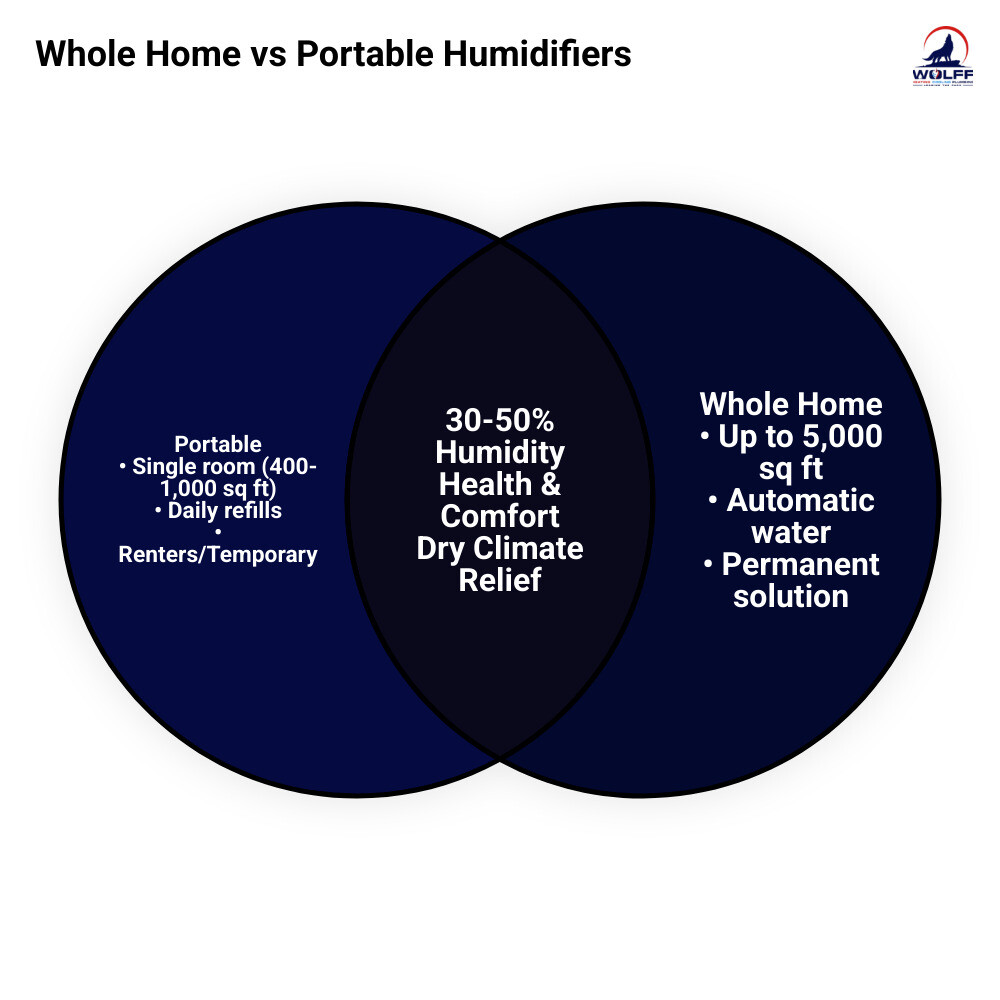
| Factor | Whole Home Humidifier | Portable Humidifier |
|---|---|---|
| Coverage | Up to 5,000 sq ft | 400–1,000 sq ft per unit |
| Best for | Whole-house dry air problems | Single room or temporary relief |
| Maintenance | Annual service | Every 2–3 days |
| Water supply | Automatic (connected to plumbing) | Manual refilling |
| HVAC integration | Yes | No |
| Ideal for renters? | No | Yes |
| Long-term value | Higher | Lower (especially with multiple units) |
Bottom line: If dry air is affecting your whole home — your sinuses, your wood floors, your sleep — a whole home humidifier is the more effective, lower-maintenance solution. Portable units work well for targeted, temporary relief in a single room.
The problem in desert climates like Albuquerque is that dry air doesn’t stay in one room. It spreads through every hallway, bedroom, and living space your forced-air heating system reaches. Static shocks, cracked wood floors, scratchy throats, and restless nights are all signs that one small portable unit simply can’t keep up.
The EPA recommends keeping indoor humidity between 30% and 50% for comfort and health. Hitting that target consistently in an arid environment takes the right system — and knowing which one fits your home is the first step.
Signs You Need a Whole Home Humidifier vs Portable in Dry Climates
Living in the high desert means we are used to sunshine and low humidity, but our homes often pay the price. When the indoor relative humidity drops below the EPA-recommended 30-50% range, your home starts to send you distress signals. If you are constantly reaching for the lotion or dreading the “zap” of a doorknob, your Indoor Air Quality needs help.
Common signs of excessively dry air in Albuquerque homes include:
- Static Electricity: If your hair stands on end or you experience frequent static shocks, your air is likely well below 30% humidity.
- Physical Discomfort: Waking up with a scratchy throat, dry nasal passages, or even frequent nosebleeds is a classic symptom of desert air stealing moisture from your body.
- Skin Irritation: Chapped lips and itchy, flaky skin often worsen during the winter heating season.
- Home Damage: You might notice gaps in your hardwood flooring or see that your favorite wood furniture is starting to show small cracks.
To truly Improve Your Home’s Indoor Air Quality, you need a solution that addresses these issues systematically rather than room-by-room.

Understanding the Impact of Arid Air on Your Home
Dry air is aggressive; it seeks out moisture wherever it can find it. In homes across Rio Rancho and Bernalillo, this “moisture-seeking” behavior leads to hardwood floor gaps and creaking. Beyond floors, musical instruments like guitars and pianos can go out of tune or even warp. Sensitive electronics are also at higher risk in dry environments because static discharge can damage internal components. Proper Ventilation for Indoor Air Quality is important, but in the desert, that ventilation must be paired with controlled moisture.
Health Benefits of Balanced Humidity
Maintaining the right humidity level isn’t just about comfort—it’s a health necessity. Research suggests that viruses, including those that cause the common cold and flu, can survive longer and spread more easily in air with low humidity. By keeping your home between 30-50% humidity, you support your body’s natural defenses. Moist nasal passages are better at trapping viruses and bacteria before they reach your lungs. Furthermore, balanced humidity can significantly improve sleep quality by preventing the throat dryness that leads to snoring and restless nights.
Comparing Whole Home Humidifier vs Portable in Dry Climates
When we look at the whole home humidifier vs portable in dry climates debate, the primary difference lies in how they integrate with your life. A portable unit is a standalone appliance you plug into a wall. A whole-home system is a professional upgrade that integrates directly into your forced-air HVAC system.
Whole-home systems, often called furnace humidifiers, are installed into your ductwork. They use a dedicated water line connection, meaning they never run dry. When your furnace or air handler turns on, the system adds a precise amount of water vapor to the air before it is distributed throughout your home. This ensures that the humidity in your master bedroom is the same as the humidity in your kitchen.
How Whole Home Humidifier vs Portable in Dry Climates Handle Large Spaces
Coverage is where the “desert duel” is often won. Portable humidifiers typically cover between 400 and 1,000 square feet. In a standard Albuquerque home, you would need three or four portable units running constantly to achieve the same effect as one whole-home system.
For those with larger residences, Humidifiers Albuquerque NM services often involve installing steam or fan-powered units that can handle up to 5,000 square feet. These systems leverage the existing airflow of your HVAC/Albuquerque NM/Humidifiers setup to push moisture into every corner, bypassing the “airflow barriers” like closed doors and hallways that stop portable units in their tracks.
Energy Efficiency and Long-Term Performance
You might think adding a system to your furnace would spike your bills, but the opposite is often true. Moist air holds heat better than dry air. When your home is properly humidified, 68°F feels like 71°F. This allows you to lower your thermostat by a few degrees, potentially reducing your heating demand and lowering monthly bills. Most bypass whole-home systems run on 24-volt power and utilize the existing furnace blower, making them incredibly energy-efficient compared to running multiple high-wattage portable units.
Maintenance and Water Quality Challenges in the High Desert
Albuquerque is famous for its “hard water,” which is rich in minerals like calcium and magnesium. This creates a unique challenge for humidification.
Managing Hard Water in Albuquerque
If you use tap water in a portable humidifier, you will likely notice a “white powder” settling on your furniture. This is actually vaporized mineral dust. To avoid this, portable units require expensive distilled water.
In contrast, whole-home systems are designed to handle hard water more effectively.
- Bypass and Fan-Powered Units: These use evaporative pads (or water panels). The minerals stay on the pad rather than entering your air. You simply replace the pad once a year.
- Steam Units: These boil water in a canister. While scale buildup occurs, modern canisters are designed for easy replacement or professional descaling during your annual HVAC/Albuquerque NM/Humidifiers service.
Set-and-Forget Convenience vs Daily Refills
The biggest “hidden cost” of portable units is your time. In a dry climate, a portable tank might need refilling every 8 to 12 hours. If you forget, the humidity drops immediately. Furthermore, portable units must be cleaned every 2–3 days to prevent bacterial growth and mold in the standing water.
A whole-home system offers “set-and-forget” convenience. Because it is connected to your plumbing, it refills itself. A digital humidistat monitors the air and only adds moisture when needed. Maintenance usually consists of a single annual visit to replace the water panel and check the drain lines.
Choosing the Right System for Your Arid Environment
Selecting the right system depends on your living situation and your home’s specific needs.
When to Choose a Whole Home Humidifier vs Portable in Dry Climates
- Choose a Portable Unit if: You are a renter in an apartment, you only need relief in one specific room (like a nursery), or you want to test if humidification helps your symptoms before committing to a permanent system.
- Choose a Whole-Home System if: You own your home, you have a forced-air heating system, you are tired of the “fill and scrub” routine of portables, or you want to protect your entire home’s wood flooring and Improve Your Home’s Indoor Air Quality.
Installation Considerations for Forced-Air Systems
Installing a whole-home system is a job for the pros. It involves modifying your ductwork, tapping into a water line, and setting up a drain line for the excess water. We also handle the low-voltage wiring to ensure the humidifier communicates perfectly with your thermostat. This professional calibration is vital to ensure you get the moisture you need without over-humidifying.
Frequently Asked Questions about Desert Humidification
What is the ideal indoor humidity level for dry climates?
The EPA recommends 30-50%. However, in very cold desert nights, you may need to adjust this. If you see condensation on your windows, your humidity is too high for the outdoor temperature. Modern whole-home systems often have outdoor sensors that adjust your indoor levels automatically to prevent this.
Can a portable unit effectively humidify an entire house?
Technically, no. Humidity does not travel well through doorways and around corners on its own. To achieve whole-house results with portables, you would need a unit in almost every room, which leads to high electricity use and a lot of maintenance.
How do I prevent mold when using a humidifier?
Mold thrives when humidity exceeds 60%. The best prevention is a professional humidistat that keeps your levels below 50%. For portable units, the key is frequent cleaning (every 48-72 hours) and using distilled water to prevent organic buildup.
Conclusion
When it comes to the whole home humidifier vs portable in dry climates debate, the whole-home system is the clear winner for Albuquerque homeowners who want consistent, low-maintenance comfort. While portable units have their place for temporary or single-room use, they simply cannot match the efficiency and coverage of a system integrated into your HVAC ductwork.
At Wolff Heating, Cooling and Plumbing, we have over 25 years of experience helping our neighbors in Albuquerque, Rio Rancho, and the surrounding mountain communities breathe easier. We understand the unique challenges of the New Mexico climate and can help you select the perfect system for your home’s layout and your family’s health.
Schedule your professional humidifier consultation today and say goodbye to the desert dry-out for good.