
 Menu
Menu
Is a Whole Home Dehumidifier Worth It in a Desert Climate Like Albuquerque?
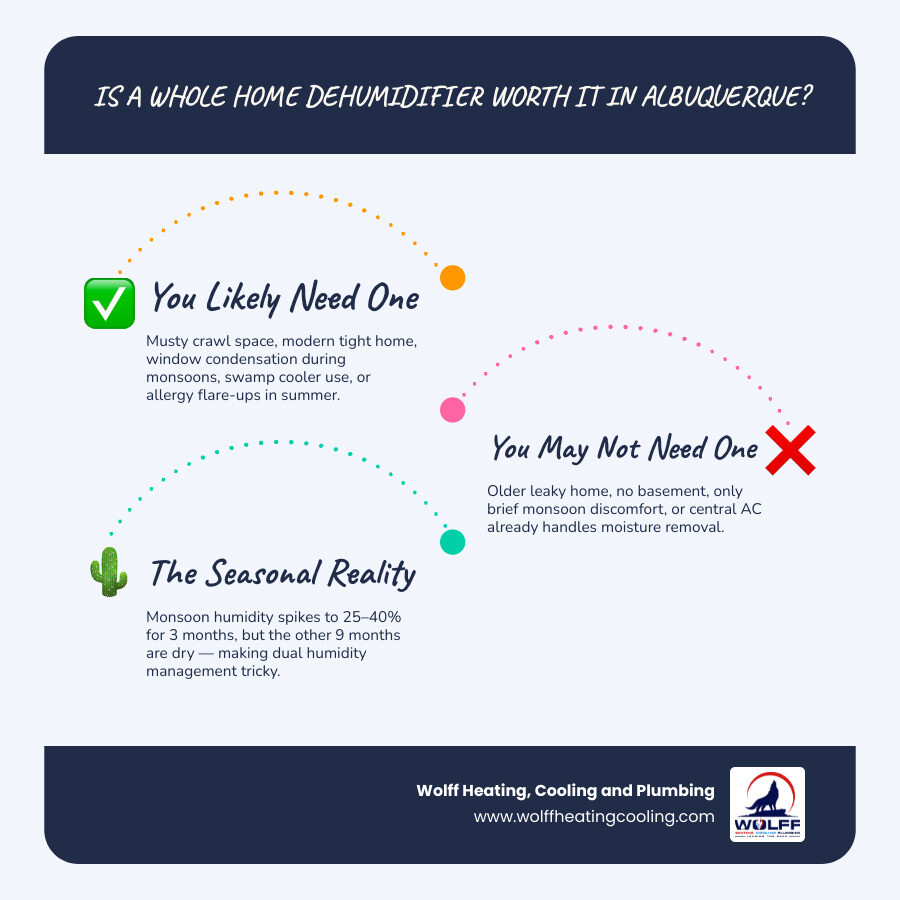
Is a whole home dehumidifier worth it in a desert climate like Albuquerque? For most homeowners, the answer is: it depends on your specific situation — but more often than not, yes, at least seasonally.
Here is a quick breakdown to help you decide:
You likely need a whole home dehumidifier if you:
- Have a basement or crawl space that smells musty during summer
- Live in a modern, tightly sealed, energy-efficient home
- Notice condensation on windows or walls from July through September
- Run a swamp cooler, which actively adds moisture to your indoor air
- Experience allergy flare-ups or mold spots during monsoon season
You may not need one if you:
- Have an older home with natural air leakage and no basement
- Only experience minor discomfort during the brief monsoon window
- Already run central AC, which removes some moisture as a byproduct of cooling
Most people assume Albuquerque’s desert air means humidity is never a problem indoors. That assumption holds up for about nine months of the year. But from July through September, the monsoon season pushes outdoor humidity from the usual 5–15% up to 25–40% or higher. That shift is fast, intense, and — inside a tightly built home — it can cause real damage.
At the same time, Albuquerque’s dry climate means the other 9 months of the year often call for the opposite solution: adding moisture, not removing it. That tension between too dry and occasionally too humid is what makes humidity management in New Mexico genuinely complicated.
This guide breaks down exactly when a whole home dehumidifier makes sense here, how it fits with your existing HVAC system, and what Albuquerque-specific factors — like hard water, high altitude, and desert dust — mean for installation and maintenance.
The Desert Humidity Paradox: Why Dry Climates Have Moisture Problems
It sounds like a riddle: why would a home in the high desert, surrounded by sagebrush and sun-baked mesas, ever suffer from high humidity? The reality of indoor comfort is that your home is its own self-contained ecosystem. While the outdoor climate in places like Rio Rancho, Corrales, and Placitas is famously dry, the air inside our homes is heavily influenced by how we live, how our homes are built, and sudden seasonal shifts.
When indoor moisture levels rise, it directly impacts your comfort, health, and property. This is why we often recommend starting with professional indoor air quality testing albuquerque to get an accurate baseline of what is happening inside your living spaces.
Is a whole home dehumidifier worth it in a desert climate like albuquerque during the summer monsoons?
Every year, around the second week of July, the wind shifts. The dry continental air is replaced by moist air sweeping up from the Gulf of California and the Gulf of Mexico. This marks the official start of Albuquerque’s monsoon season, which lasts through September.
During this period, outdoor relative humidity levels can climb from a bone-dry 5% to 15% up to 40% or higher. While a 40% humidity level might sound mild to someone from the East Coast, it represents a massive surge for our high-desert environment.
This moisture spike hits crawl spaces and basements particularly hard. Because subterranean spaces are naturally cooler than the rest of the house, warm, humid monsoon air entering these areas cools rapidly. As the air cools, its capacity to hold moisture drops, leading to condensation on concrete walls, floor joists, and stored belongings. Without intervention, these brief but intense seasonal spikes can lead to structural rot, musty odors, and localized mold growth in below-grade spaces. If you find yourself asking is a whole home dehumidifier worth it in a desert climate like albuquerque when the monsoons hit, the protection it offers to your home’s foundation and basement is often the deciding factor.
How modern home construction traps indoor moisture
Modern homes in communities like Cedar Crest, Tijeras, and Bernalillo are built to be incredibly energy-efficient. They feature tight seals, heavy insulation, and advanced weatherstripping designed to keep cooled air inside during the summer and warm air inside during the winter.
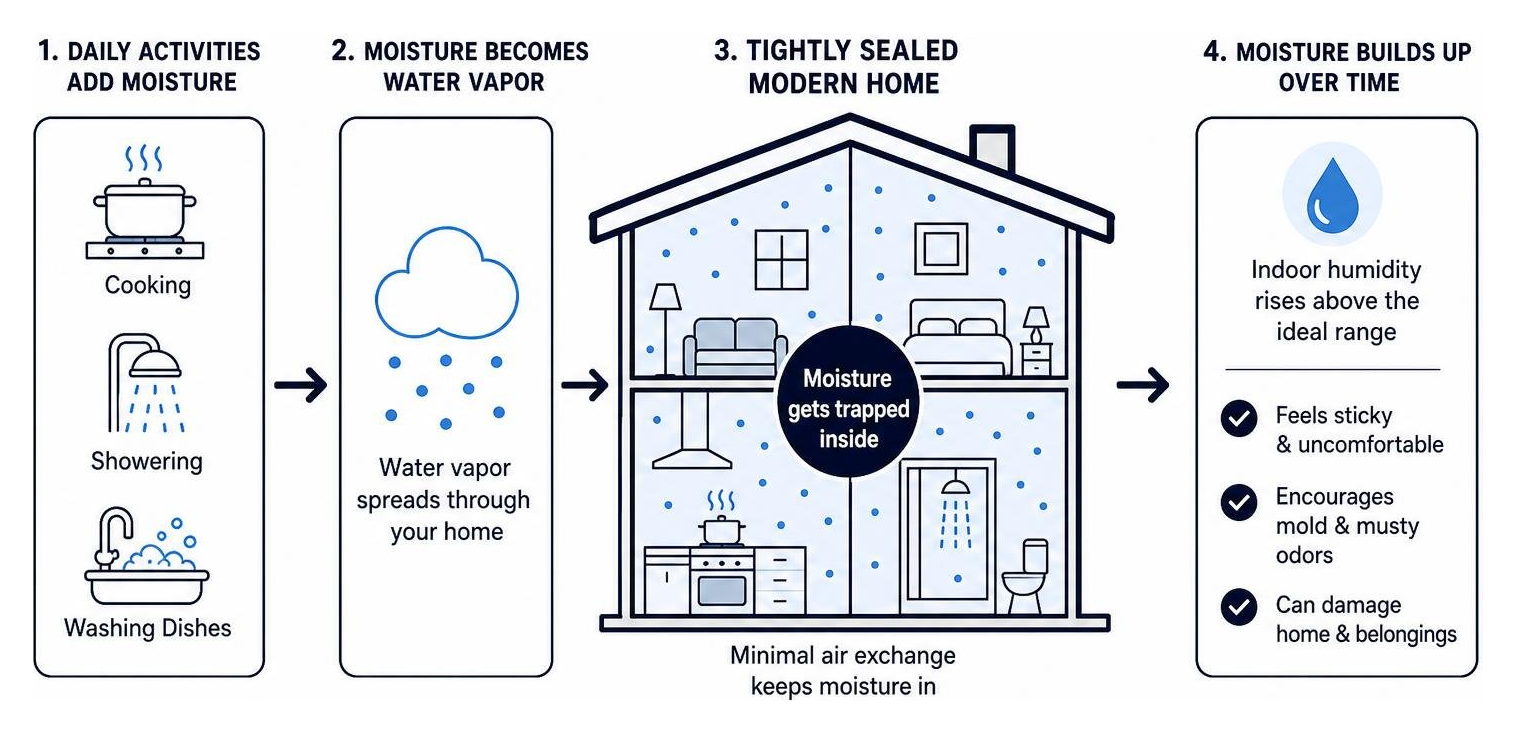
However, this airtight building style has a major side effect: it traps indoor moisture. Every time you take a shower, boil water for dinner, wash dishes, or even breathe, you release water vapor into your home. In an older, draftier home, this moisture easily escapes through cracks around windows and doors. In a tightly sealed modern home, it has nowhere to go.
Over time, this trapped humidity builds up, pushing indoor relative humidity levels past the ideal 30% to 50% range. When indoor moisture remains consistently high, it creates a breeding ground for dust mites and mold. To keep your family safe and healthy, finding ways to vent or extract this moisture is essential to improve your homes indoor air quality.
Evaluating the Investment: Is a Whole Home Dehumidifier Worth It in a Desert Climate Like Albuquerque?
Investing in a whole-home indoor air quality system is a decision that requires weighing long-term protection against seasonal needs. While a dehumidifier might only run at full capacity during the humid summer months, the protection it provides to your home’s infrastructure and your HVAC system operates year-round.
Integrating a dedicated moisture-control system directly into your ductwork ensures that every room remains perfectly balanced, protecting your drywall, wood flooring, and structural beams from the expansion and contraction caused by sudden humidity swings. If you are exploring options to protect your property, our team specializes in installing high-efficiency dehumidifiers albuquerque nm to keep your indoor air perfectly balanced.
Comparing whole-home systems to portable dehumidifiers
When faced with a damp basement or sticky indoor air during the monsoons, many homeowners buy a few retail portable dehumidifiers. While portable units can offer temporary relief for a single small room, they come with significant drawbacks compared to a centralized system.
| Feature | Whole-Home Dehumidifier | Portable Dehumidifier |
|---|---|---|
| Coverage Area | Entire home (multi-room or whole-house) | Single room or small localized area |
| Maintenance Requirements | Minimal (annual filter change and professional check) | High (must empty water tank daily; frequent cleaning) |
| Drainage | Continuous, automatic drain line | Manual tank emptying or gravity hose |
| Noise Levels | Extremely quiet (located in utility closet or garage) | Noisy (compressor and fan run directly in living space) |
| Lifespan | Long-lasting (typically integrated with HVAC system) | Short-lived (often needs replacement within 3 years) |
Portable units require constant attention. If you forget to empty the water reservoir, the unit shuts off, allowing humidity to rise again. Additionally, running multiple portable units throughout your home consumes a significant amount of electricity and adds clutter and noise to your living spaces. A whole-home system, connected directly to your plumbing drain lines and HVAC system, offers a “set-it-and-forget-it” solution.
How dehumidification interacts with your cooling system
Your air conditioner is naturally designed to cool the air, and as a byproduct of that process, it removes some moisture. However, standard air conditioning systems are sized for cooling loads (temperature control), not latent loads (moisture removal). On mild but humid monsoon days, your AC may cool your home so quickly that it “short-cycles,” turning off before it has run long enough to pull excess humidity out of the air. This leaves you feeling cold but sticky.
By adding a dedicated whole-home dehumidifier, you separate temperature control from humidity control. The dehumidifier removes moisture efficiently without lowering the temperature.
This interaction actually improves your cooling system’s energy efficiency. Dry air feels cooler than damp air; in fact, reducing your indoor humidity by just 10% can make your home feel 2 to 3 degrees Fahrenheit cooler without actually lowering the thermostat. This allows you to set your thermostat higher, reducing your central AC run time by up to 30% and lowering your summer utility bills. If you want to optimize how your cooling systems handle seasonal humidity, our team can evaluate your current setup through our comprehensive Hvac/Albuquerque Nm/Air Conditioning Services.
Local Environmental Challenges: Altitude, Hard Water, and Dust
Managing indoor air quality in the Albuquerque metro area requires a deep understanding of our unique geography. Our high altitude, extremely hard water, and frequent dust storms create specific operational challenges for mechanical systems that HVAC companies in other regions of the country never have to consider.
Managing hard water and high-altitude drainage
Approximately 95% of New Mexico homes have hard water. The high concentration of calcium and magnesium in our water supply poses a constant threat to plumbing and HVAC equipment. When a dehumidifier extracts water vapor from your indoor air, that moisture condenses on cold metal coils and drains into a condensate pan before exiting through a drain line.
At our high altitude of 5,300+ feet, the air is thinner, which affects evaporation rates and system drainage. Over time, the combination of hard water minerals, airborne dust, and high-altitude drainage patterns can cause scale and mineral deposits to build up rapidly inside your dehumidifier’s condensate pan and drain lines.
If this scale is left unmanaged, it can clog the drain line, leading to water overflows, water damage to your drywall, or system shut-offs. Regular preventative maintenance, including flushing the drain lines and cleaning the condensate pans, is essential to keep your system running smoothly. If you want to ensure your home’s air systems are properly balanced and vented, exploring professional Hvac/Albuquerque Nm/Ventilation options is a smart step.
The impact of high desert dust on filter life
Our dry, windy climate means that fine particulate dust, pollen, and tumbleweed debris are constantly swirling through the air, especially during spring and summer windstorms. This high concentration of airborne dust can quickly clog the air filters on your dehumidifier and HVAC system.
When a filter becomes clogged with desert dust, it restricts airflow. This restriction forces the dehumidifier’s compressor to work harder to pull air across the coils, leading to increased energy consumption, reduced moisture extraction, and a shorter equipment lifespan.
To protect your investment, we recommend checking and replacing your filters more frequently than the standard manufacturer guidelines suggest. To keep your indoor air truly clean and free of fine desert dust, we often recommend pairing your humidity control system with high-performance air purifiers albuquerque nm to capture microscopic particles before they recirculate.
Balancing Moisture: Dehumidifiers vs. Humidifiers in New Mexico
In New Mexico, managing indoor comfort is a game of two halves. While the summer monsoons bring sticky, humid air that requires dehumidification, the winter months bring freezing, bone-dry air that can drop indoor relative humidity levels well below 20%. This extreme dryness can cause chapped lips, nosebleeds, static shocks, and permanent damage to hardwood floors, cabinets, and musical instruments.
Because of these dramatic seasonal shifts, a complete indoor comfort strategy often requires both adding and removing moisture depending on the time of year. If you want to keep your home comfortable year-round, installing whole-home humidifiers albuquerque nm is just as important as managing summer moisture.
Is a whole home dehumidifier worth it in a desert climate like albuquerque when you also need a humidifier?
It might seem counterintuitive to install both a humidifier and a dehumidifier in the same home, but in our high-desert climate, this dual-system strategy is the gold standard for perfect comfort.
During the dry winter months, your whole-home humidifier adds precise amounts of moisture to the air stream, keeping your indoor humidity at a comfortable, healthy level (typically around 30% to 35%). In the summer, when the monsoons arrive or when heavy indoor activities trap moisture inside, your dehumidifier takes over, extracting excess water vapor to prevent mold and clamminess.
This entire process is managed automatically by a smart thermostat or a dedicated humidistat. You simply set your desired humidity range, and the system automatically decides whether to add or remove moisture. For a complete look at how to navigate these seasonal swings, check out our new mexico comfort guide to perfect indoor air.
Frequently Asked Questions about Desert Dehumidification
What is the ideal indoor humidity range for an Albuquerque home?
The ideal indoor relative humidity range for health, comfort, and home protection is between 30% and 50% year-round.
- Below 30%: You may experience dry skin, irritated sinuses, frequent nosebleeds, increased static electricity, and shrinking or cracking in wooden furniture and musical instruments.
- Above 50%: You run an increased risk of dust mite proliferation, mold growth, musty odors, and a sticky, uncomfortable indoor environment that makes your cooling system work harder.
Maintaining a steady level within this sweet spot keeps your home safe and your family comfortable.
Can a dehumidifier help reduce my summer cooling bills?
Yes. High humidity makes the air feel warmer than it actually is because damp air prevents your body’s natural cooling mechanism (sweat evaporation) from working efficiently.
By running a whole-home dehumidifier to lower your indoor humidity, you make the air feel significantly cooler. This allows you to raise your thermostat setting by a few degrees without sacrificing comfort, which reduces the workload on your central air conditioner and lowers your monthly energy bills.
How does a swamp cooler affect the need for a dehumidifier?
Evaporative coolers (commonly known as swamp coolers) work by blowing hot, dry outdoor air across wet pads, which cools the air through evaporation. This process actively adds a massive amount of moisture to your indoor air.
During the dry spring and early summer, this added moisture is a welcome relief. However, when the outdoor humidity rises during monsoon season, swamp coolers lose their cooling efficiency because the air is already too saturated to allow for rapid evaporation. Running a swamp cooler during a monsoon can make your home feel incredibly warm, sticky, and damp.
If you have a swamp cooler, a dehumidifier cannot be run at the same time in the same space, as they work against each other. However, many local homeowners use a hybrid approach: they run a swamp cooler during the dry months, and then switch to refrigerated air conditioning paired with a dehumidifier during the humid monsoon weeks to maintain perfect control.
Conclusion
So, is a whole home dehumidifier worth it in a desert climate like albuquerque? For homeowners dealing with musty basements, damp crawl spaces, tightly sealed modern homes, or the sticky indoor air of monsoon season, the answer is a resounding yes.
While our desert landscape is beautiful and dry for most of the year, our unique seasonal shifts, hard water, high altitude, and modern building techniques mean that humidity control is not a one-size-fits-all solution. Managing your indoor air quality requires local expertise and a tailored approach to ensure your home remains a comfortable, healthy sanctuary year-round.
At Wolff Heating, Cooling, and Plumbing, we have over 25 years of experience helping homeowners in Albuquerque, Rio Rancho, Placitas, Corrales, Cedar Crest, Tijeras, and Bernalillo achieve perfect indoor comfort. Our team of licensed, bonded, and insured professionals is known for superior work, excellent service, and honest estimates.
If you are ready to take control of your home’s humidity, we invite you to explore our specialized Hvac/Albuquerque Nm/Dehumidifiers services or contact us today to schedule a professional indoor air quality assessment. Let us help you find the perfect, energy-efficient solutions for your home and family.