
 Menu
Menu
Why New Mexico Homeowners Need to Understand How Clay and Caliche Soil Damages Their Sewer Lines
How clay and caliche soil in New Mexico shifts and damages sewer lines is one of the most misunderstood threats facing homeowners in Albuquerque, Rio Rancho, and the surrounding high-desert communities. Below is a quick summary of the core mechanisms at work:
How New Mexico Soil Damages Sewer Lines — Quick Answer:
- Expansive clay swells and shrinks with moisture changes, exerting intense pressure on buried pipes and cracking or separating joints
- Caliche hardpan acts as a rigid underground shelf, trapping pipes between an immovable rock-like barrier above and shifting soil below — creating a crushing “vise effect”
- Monsoon rains cause rapid soil saturation, triggering sudden clay expansion and hydrostatic pressure surges against pipe walls
- Drought cycles cause soil to contract and shrink, pulling the ground away from pipes and leaving unsupported voids that cause pipes to sag or “belly”
- Collapsible (hydrocompactive) soils remain stable when dry but can suddenly compact and sink when exposed to water, snapping pipe joints at connection points
- Shallow caliche layers force contractors to install sewer lines at minimal depth, leaving pipes more exposed to surface weight, temperature swings, and tree root intrusion
New Mexico’s geology is uniquely punishing to underground plumbing. Unlike most of the country, the ground beneath Albuquerque-area homes often contains two distinct problem layers stacked on top of each other — reactive clay near the surface and a concrete-hard caliche layer just below it. When the monsoon season arrives each July and pushes moisture into that clay, the expansion forces have nowhere to go except inward, directly against your sewer pipe. Then, when the dry months return, the ground contracts again and the cycle of stress repeats. Over years and decades, even well-installed pipes crack, separate at the joints, or develop low spots where waste pools instead of flowing freely.
The consequences aren’t just a slow drain. In documented cases across New Mexico, collapsible soils have caused craters 150 feet wide and foundations to split — all triggered by the same water infiltration process that quietly stresses your sewer lateral every rainy season.

The Geological Double-Whammy: Expansive Clay vs. Caliche Hardpan
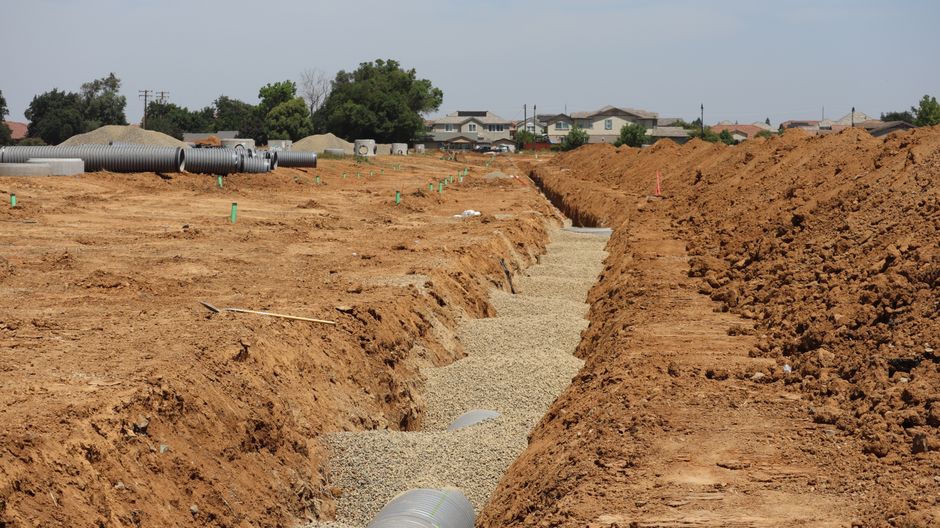
To understand how our underground plumbing systems are put to the test, we have to look closely at the geological makeup of the Middle Rio Grande Valley and the surrounding high-desert mesas. When we dig trenches for sewer installations in Albuquerque, Rio Rancho, or Bernalillo, we rarely find uniform, cooperative dirt. Instead, we encounter a complex, layered matrix of highly expansive clay and rock-hard caliche.
The Chemistry of New Mexico Clay
The clay found in our local soil contains highly active smectite minerals (such as montmorillonite). On a microscopic level, these clay particles have a flat, plate-like structure with a massive surface area that eagerly attracts and holds water molecules. When water is introduced, the molecular structure of the clay expands dramatically. While pure montmorillonite clay can expand up to 15 to 20 times its dry volume under laboratory conditions, the mixed clay soils in our New Mexico yards commonly experience volume changes of 25% to 50%.
According to official New Mexico Environment Department standards (such as those outlined in NMAC 20.7.3.7), clay is defined as a soil separate consisting of particles less than 0.002 millimeters in diameter, or a soil textural class containing 40% or more clay. This dense concentration of tiny particles makes the soil highly plastic, poorly drained, and incredibly powerful when it begins to swell. If you want to learn more about the general plumbing challenges of our region, check out our Plumbing Albuquerque Complete Guide.
The Concrete of the Desert: Caliche
Directly beneath or mingled with this expansive clay is caliche. Caliche is not a simple rock; it is a subsurface sedimentary layer where sand, silt, and gravel have been cemented together by calcium carbonate ($CaCO_3$) and magnesium carbonate. Over thousands of years, rainwater dissolves these carbonates from the upper soil layers and carries them downward. As the water evaporates in our arid high-desert climate, the minerals deposit and harden into what geologists call a petrocalcic horizon.
Caliche exists in varying states of induration (hardness):
- Soft/Non-indurated Caliche: Chalky, crumbly accumulations that can be broken with hand tools.
- Moderately Indurated Caliche: Semi-hard layers that require heavy machinery or pickaxes to fracture.
- Strongly Indurated Caliche: A concrete-like, impermeable barrier that can be several feet thick.
In central New Mexico, soil series like the Madurez loam feature calcic horizons starting anywhere from 16 to 60 inches below the surface. In other parts of the state, such as the Kimbrough loam or Kimbrough-Lea complex, hardened caliche can sit as shallow as 6 to 16 inches down.
Caliche possesses a unique hydrological property: it can absorb up to 13% water by weight. However, because of its dense, cemented structure, it does not easily release this water or allow it to flow through. Instead, it behaves like an underground concrete slab, blocking downward water movement and forcing subsurface water to pool laterally on top of it.
The Science Behind How Clay and Caliche Soil in New Mexico Shifts and Damages Sewer Lines
Underground sewer lines are designed to rely on a precise, gravity-assisted slope (usually a 1/4-inch drop per linear foot) to carry wastewater away from your home. Any physical disruption to this slope, or any structural compromise of the pipe wall, leads to system failure. The physical properties of clay and caliche work in tandem to systematically destroy this delicate balance.
When expansive clay absorbs water, it exerts massive vertical and horizontal forces known as swelling pressures. In highly active clay soils, these absorption pressures can routinely exceed 430 $KN/m^2$ (Kilonewtons per square meter). Because the sheer weight of the overlying soil prevents the ground from expanding upward easily, these massive swelling forces are directed inward and laterally — pressing directly against buried PVC, cast iron, or old clay sewer pipes.
| Soil Property / Characteristic | Expansive Smectite Clay | Indurated Caliche Hardpan |
|---|---|---|
| Primary Composition | Microscopic silicate minerals ($<0.002$ mm) | Calcium & magnesium carbonate cement |
| Water Behavior | Swells up to 50%; highly retentive | Absorbs up to 13% by weight; blocks vertical flow |
| Physical Movement | Continuous shrink-swell cycles | Rigid, brittle, and structurally immovable |
| Typical Depth in Central NM | Surface level down to several feet | 16 to 60 inches (Madurez series) |
| Primary Pipe Damage Mechanism | Shear stress, upward heave, and sagging | The “Vise Effect,” root redirection, shallow lines |
| Soil pH Range | Highly alkaline (7.5 to 8.5) | Highly alkaline (7.5 to 8.5) |
The Vise Effect: How Clay and Caliche Soil in New Mexico Shifts and Damages Sewer Lines
The most destructive geological phenomenon occurs when a sewer line is laid directly over or through a caliche shelf. This creates what geologists and structural engineers call the “vise effect.”
Because the caliche layer is completely rigid and immovable, it acts as an anvil. When the clay layer directly above the pipe absorbs moisture from a rainstorm or a minor plumbing leak, it expands rapidly. The sewer pipe is trapped in the middle. The expanding clay pushes downward with immense hydrostatic pressure, while the rock-hard caliche below refuses to budge.
This concentrated shear stress causes rigid, older pipe materials like cast iron or vitrified clay to crack or completely snap. While cast iron is strong, its high silicon content makes it brittle under localized physical bending forces. Modern plastic pipes like PVC are more flexible, but under the extreme, uneven pressures of the vise effect, they can easily warp, flatten, or experience joint separation. If you suspect your sewer line is struggling with these underground forces in Rio Rancho, our team is ready to assist with dedicated Sewer Line Service Rio Rancho.
Identifying the Warning Signs of How Clay and Caliche Soil in New Mexico Shifts and Damages Sewer Lines
Because sewer lines are buried deep underground, soil-induced damage often goes unnoticed until a major backup occurs. However, there are several distinct warning signs that the shifting ground is taking a toll on your home’s plumbing:
- Multiple Slow Drains: If a single sink or tub drains slowly, it is likely a localized clog. If every drain in your home is sluggish, the main sewer lateral is restricted or sagging.
- Gurgling Toilets: When you run the washing machine or take a shower, do your toilets bubble or make a distinct gurgling sound? This is caused by air trapped in the sewer line, unable to escape past a “belly” or a soil-induced blockage.
- Unexplained Wet or Lush Patches in the Yard: In our dry high-desert climate, a sudden, thriving green patch of grass or weeds in an otherwise dry xeriscaped yard is a major red flag. Escaping sewage acts as a potent fertilizer, and water pooling on top of a shallow caliche layer will keep that spot damp.
- Sewer Line Bellies: As clay soil dries and shrinks, it can leave empty pockets or “voids” beneath the pipe. Lacking support, the pipe sags under its own weight, creating a U-shaped dip or “belly.” Waste and solids collect in this low spot, leading to chronic, recurring clogs.
- Foundation Separation and Cracks: When soil shifts violently enough to damage a sewer lateral, it often affects the home’s concrete slab as well. Look for new cracks in your drywall, exterior brickwork, or a physical separation where the plumbing line exits the foundation.
If you are experiencing any of these issues, it is critical to contact professional Plumbers Albuquerque Nm to perform a diagnostic inspection before the pipe completely collapses.
Collapsible Soils vs. Caliche: Different Mechanisms of Destruction
While caliche is a hardened, cemented barrier, New Mexico is also home to another geological hazard: collapsible (or hydrocompactive) soils. These soils are primarily loose, wind-blown silts and sands deposited on valley margins and mountain foothills, such as the areas near Algodones and the margins of the Sandia Mountains.
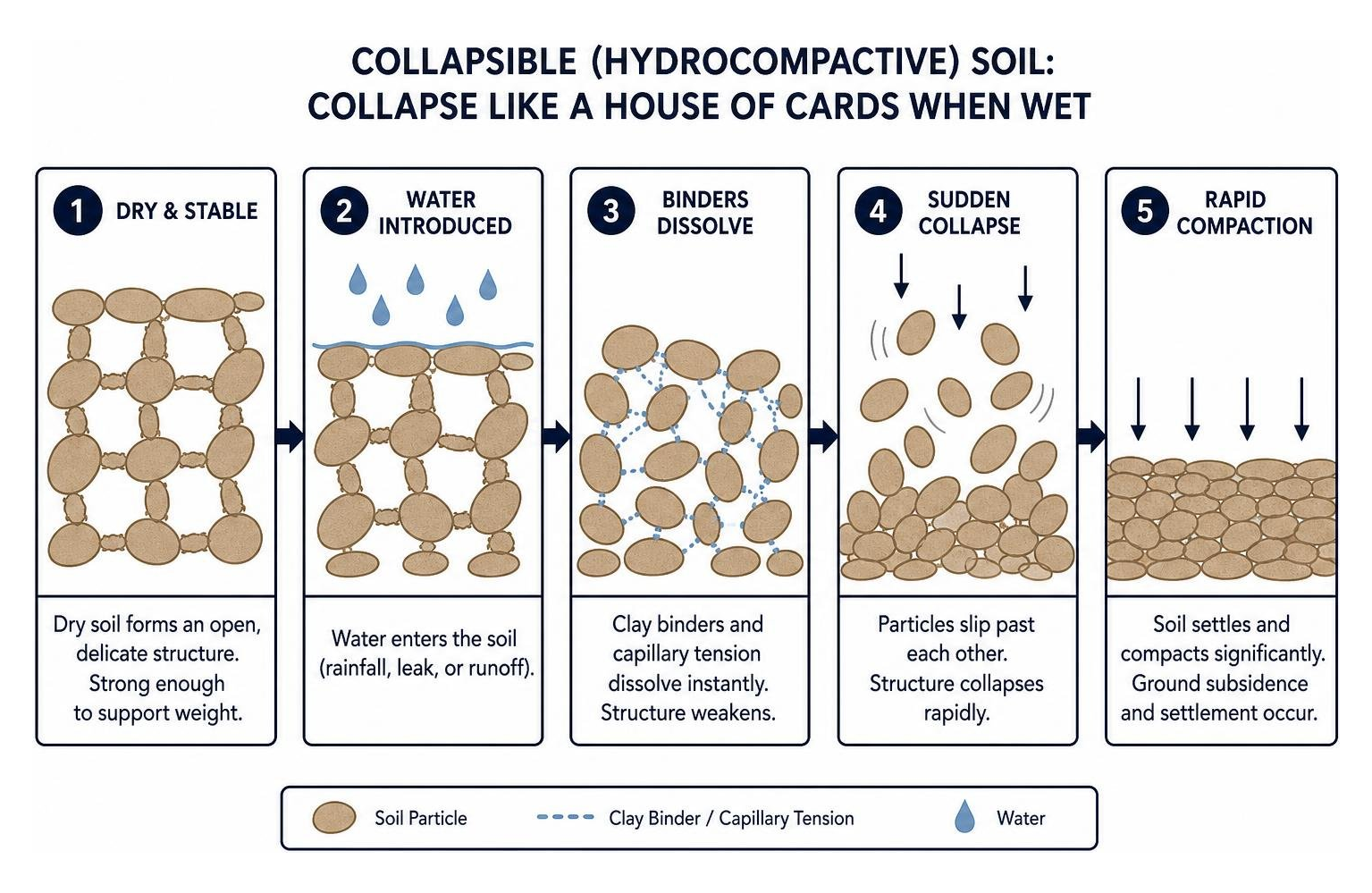
The structural difference between collapsible soil and caliche is stark:
- Caliche is already cemented and highly dense; it damages pipes by acting as an unyielding barrier.
- Collapsible Soil is incredibly loose and dry. The soil particles are held together only by soluble clay binders or capillary tension, forming a delicate, “house of cards” structure.
When collapsible soil is dry, it can support incredible weight. However, the moment water is introduced (from a leaky water line, a septic tank drain field, or localized monsoon runoff), the clay binders dissolve instantly. The soil particles slip past one another, and the entire structure undergoes rapid, catastrophic compaction and ground subsidence.
The destructive power of this mechanism is well-documented in New Mexico:
- In one famous area of El Llano, New Mexico, a collapse crater from collapsible soil measured 150 feet across and 5 feet deep in the center, after loose soil originally more than 50 feet thick collapsed, splitting and tilting the foundations of nearby homes.
- In controlled engineering tests, injecting nearly 17,000 gallons of water (equivalent to the monthly septic tank output of a family of four) into collapsible soil at a depth of 10 feet over 16 days caused a sudden ground subsidence of 2.2 feet over an area of 600 square feet.
When a sewer line runs through collapsible soil, a minor joint leak becomes a self-destruct trigger. The escaping water causes the surrounding soil to collapse, removing all structural support from beneath the pipe. The pipe snaps under the weight of the earth above, leading to immediate, total system failure. If you suspect a hidden leak is destabilizing the ground around your home, we recommend scheduling professional Leak Detection Albuquerque immediately.
Seasonal Triggers: Monsoons, Droughts, and Temperature Swings
Underground pipes do not exist in a static environment. In New Mexico, our dramatic seasonal weather shifts act as the primary catalyst for soil movement and subsequent sewer pipe damage.
The Monsoon Saturation Spike
Our annual monsoon season (running from July through September) brings sudden, torrential downpours that dump massive amounts of water onto dry desert ground. Because our clay-heavy soils are highly compact and often underlaid by impermeable caliche, this water cannot drain downward quickly.
Instead, the water pools, saturating the upper clay layer. The dry clay absorbs this moisture rapidly, triggering sudden, violent swelling. This rapid transition from dry contraction to wet expansion puts immense, uneven hydrostatic pressure on buried sewer lines, often pushing pipe joints completely out of alignment in a matter of days.
The Drought Contraction Cycle
Conversely, during our long, dry winter and spring months, the soil loses its moisture and undergoes severe shrinkage. As the clay contracts, it pulls away from the sewer lateral, leaving empty voids beneath the pipe. Without the structural support of the surrounding earth, the pipe is highly vulnerable to bending or cracking under the weight of the soil above or from vehicles driving over the yard.
Extreme Daily Temperature Swings
Albuquerque and the surrounding high-desert areas are famous for daily temperature swings of 30 to 40 degrees Fahrenheit (and up to 50 degrees in some seasons). These extreme thermal cycles cause the ground to expand and contract thermally, putting additional physical stress on the buried pipes.
The “Water Perching” Root Threat
Because caliche acts as an underground waterproof floor, any water from rains or lawn irrigation pools on top of the caliche layer, creating a zone of “perched water.” Thirsty desert trees — such as cottonwoods near the Rio Grande bosque or invasive Siberian elms — actively seek out these underground moisture pockets.
When a shifting soil cycle creates a hairline crack or a loose joint in your sewer pipe, moisture and nutrients escape. Tree roots will travel long distances along the top of the caliche layer, find the crack, and grow inside the pipe. Over time, these roots expand, shattering the pipe from the inside out. If you are dealing with persistent blockages, check out our Drain Cleaning Albuquerque Nm Guide to see how we clear these obstructions safely.
Mitigation and Repair: Protecting Sewer Lines in Challenging Soils
Dealing with New Mexico’s tough soil requires specialized engineering, proper materials, and modern plumbing techniques. Traditional methods of digging up entire yards are incredibly difficult in areas with thick caliche, often requiring heavy excavation equipment, jackhammers, or pneumatic line-ripping tools.
Fortunately, modern plumbing technology offers highly effective ways to protect and repair sewer lines without destroying your landscaping or xeriscaping:
1. Trenchless Sewer Repair (CIPP Lining)
Cured-In-Place-Pipe (CIPP) lining is the gold standard for repairing pipes damaged by soil movement. Instead of digging a massive trench through caliche and clay, we access the sewer line through small, existing cleanouts.
- We insert a flexible, felt tube saturated with a two-part epoxy resin directly into the damaged pipe.
- An internal bladder is inflated, pressing the resin-coated tube flat against the inner walls of the old pipe.
- Once the epoxy cures, it creates a seamless, jointless, rock-hard “pipe within a pipe” that is incredibly strong and completely impervious to root intrusion.
- High-quality lining materials (like Perma-Liner) have an estimated lifespan of 50 years or more, giving your home long-term protection against future soil shifts.
2. Pipe Bursting
If a pipe is too badly collapsed or misaligned to be lined, pipe bursting is another excellent trenchless option. We pull a heavy steel bursting head through the old pipe, shattering it outward into the surrounding soil, while simultaneously pulling a brand-new, highly flexible High-Density Polyethylene (HDPE) pipe in behind it. HDPE is incredibly durable and can flex slightly with clay expansion without cracking or separating at the joints.
3. Proper Backfill and Sand Bedding
When conventional excavation is required, the way the trench is backfilled makes all the difference. We never reuse the native, highly active clay or caliche chunks to backfill around a new pipe. Instead, we surround the pipe with a thick bed of compacted, non-active sand or fine gravel. This sand envelope acts as a cushion, absorbing the expansion and contraction forces of the surrounding clay and protecting the pipe from direct contact with hard caliche rocks.
4. Compliance with NMAC and Local Codes
All sewer line installations and major repairs must comply with the New Mexico Construction Industries Division (CID) and local municipal codes. For example, when evaluating soil for liquid waste or sewer systems, state regulations require digging a test hole at least 7 feet deep to visually inspect the soil layers and identify any limiting clay or caliche horizons. Our team ensures every job is fully permitted, inspected, and structurally sound. To learn more about our repair process, read our comprehensive Sewer Line Repair Albuquerque Guide.
Frequently Asked Questions about New Mexico Soil and Sewer Lines
Does Albuquerque’s clay soil really damage sewer pipes?
Yes, absolutely. The clay soil in Albuquerque contains active smectite minerals that swell dramatically when wet and shrink when dry. This continuous movement exerts intense physical pressure on buried pipes, causing rigid materials like cast iron or clay tile to crack, warp, or separate at the joints.
What is caliche and why does it cause sewer line bellies?
Caliche is a subsurface layer of sand, gravel, and silt cemented together by calcium carbonate, forming a concrete-like barrier. If a sewer pipe is laid over an uneven caliche shelf, the softer soil around it may settle during dry periods while the section over the caliche remains pinned. This uneven support causes the pipe to sag, creating a “belly” where waste pools and causes chronic clogs.
How does New Mexico’s monsoon season trigger sewer line damage?
During the monsoon season, sudden heavy rains rapidly saturate the dry, clay-heavy ground. The clay absorbs this water and expands quickly, putting intense, sudden hydrostatic pressure on buried sewer pipes. This rapid soil movement is the primary catalyst for pipe misalignment, joint failure, and cracking.
Conclusion
The ground beneath our feet in New Mexico is constantly in motion. The combination of highly expansive clay, concrete-like caliche, and highly unstable collapsible soils creates a challenging environment for underground sewer lines. Understanding how these soils behave — and recognizing the early warning signs of pipe damage — is the key to protecting your home’s foundation and plumbing system from catastrophic failure.
At Wolff Heating, Cooling, and Plumbing, we bring over 25 years of local experience to every job. We understand the unique geology of Albuquerque, Rio Rancho, Bernalillo, and the surrounding areas, and we have the specialized tools and expertise to solve your sewer line issues for good. Whether you need a high-definition sewer camera inspection, localized leak detection, or state-of-the-art trenchless sewer repair, we are here to provide honest estimates and superior service.
Don’t let shifting soil ruin your home’s plumbing. Contact us today to schedule a professional diagnostic inspection and keep your sewer lines flowing smoothly for decades to come. For more information on our services, visit our Sewer Line Repair Albuquerque Guide.