
 Menu
Menu
Is a Water Softener Worth It for an Albuquerque Home? Here’s What You Need to Know
Is a water softener worth it for an Albuquerque home? Yes — for most households, it is. Albuquerque’s water is classified as very hard, carrying high levels of calcium and magnesium that quietly damage appliances, clog pipes, and drive up your energy bills year after year. If you’ve noticed white crusty buildup around your faucets, spots on your dishes, or skin that feels dry after showering, that’s your water at work.
Here’s a quick summary of whether a water softener makes sense for your home:
Water softener value at a glance for Albuquerque homeowners:
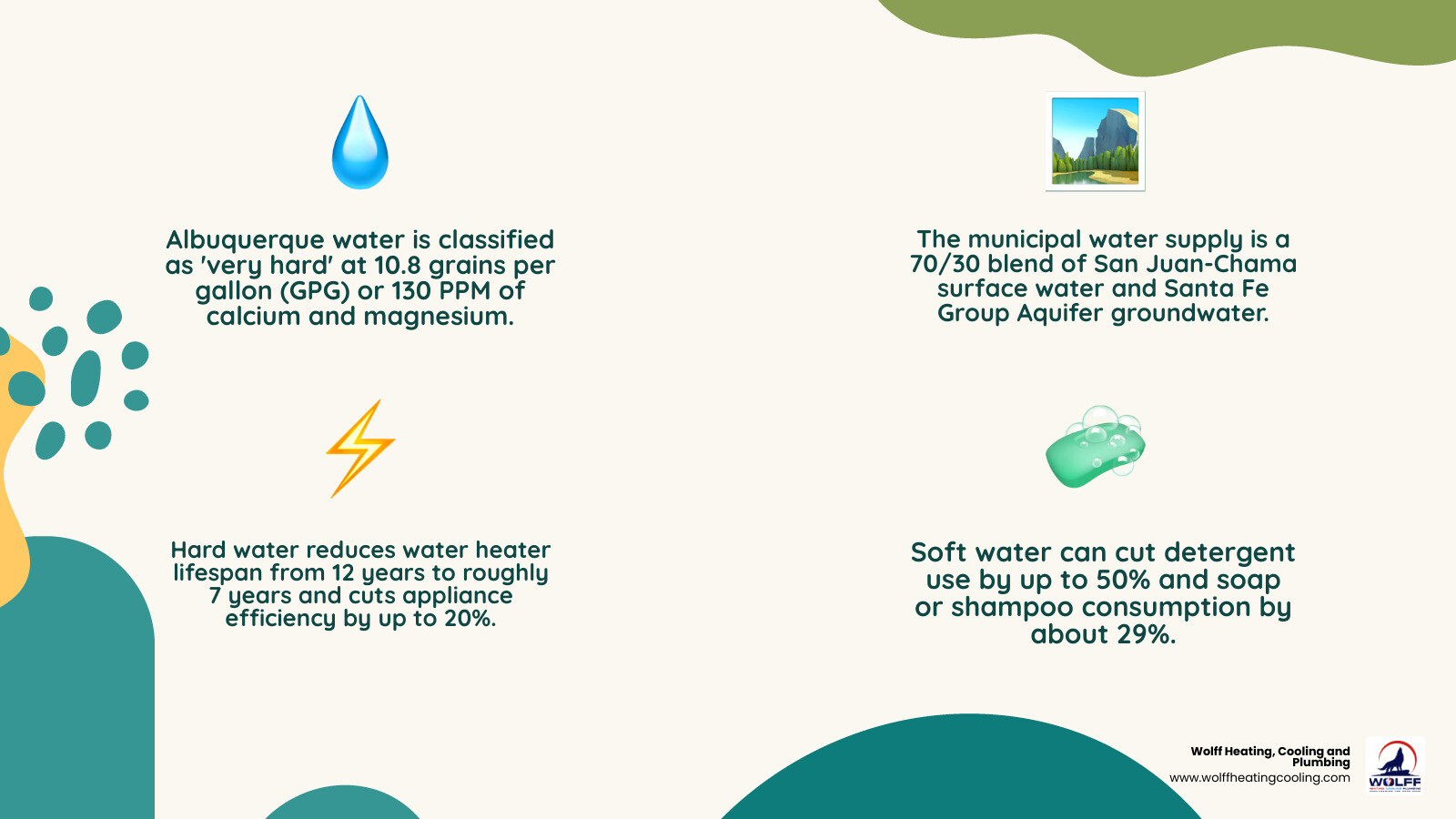
- Water hardness: Albuquerque’s water measures approximately 10.8 grains per gallon (GPG) — classified as “very hard”
- Appliance impact: Hard water can reduce water heater lifespan from 12 years down to roughly 7 years and cut appliance efficiency by up to 20%
- Soap savings: Soft water can reduce detergent use by up to 50% and soap/shampoo use by about 29%
- Energy costs: Mineral scale on heating elements forces appliances to work harder, adding to your monthly utility bills
- Who benefits most: Homeowners with scale buildup, aging appliances, dry skin or hair, and spotty dishes or glassware
- Who may not need one: Households with no visible hard water symptoms or those renting short-term
The bottom line: given Albuquerque’s local water conditions, a water softener is a practical investment for most homeowners — not just a nice-to-have. The rest of this guide breaks down exactly what you’re dealing with, what a softener can and can’t fix, and how to choose and maintain the right system for your home.
Understanding Albuquerque’s “Very Hard” Water Profile
To understand why hard water is such a persistent issue in our region, we have to look underground. The Albuquerque Bernalillo County Water Utility Authority (ABCWUA) sources our municipal supply from a 70/30 mix of surface water from the San Juan-Chama Drinking Water Project and groundwater from the Santa Fe Group Aquifer.
As groundwater filters through the ancient, mineral-rich basin-fill sediments of the Rio Grande Valley, it dissolves surrounding rock. This process infuses our water with high concentrations of calcium and magnesium ions.
While these minerals are entirely safe to drink and pose no threat to your health, they are highly destructive to home infrastructure. Water hardness is commonly measured in Grains Per Gallon (GPG) or Parts Per Million (PPM):
- Albuquerque Average Hardness: 10.8 GPG (approximately 130 to 179 PPM).
- The Classification: Anything over 10.5 GPG is officially designated as “Very Hard” by the U.S. Geological Survey.
This means every gallon of water traveling through your home carries dissolved rock. Over time, these minerals precipitate out of the water—especially when heated—forming a rock-hard layer of scale inside your pipes, fixtures, and appliances. For a deeper look at how local water quality interacts with your home’s pipes, check out our Plumbing Albuquerque Complete Guide.
Is a Water Softener Worth It for an Albuquerque Home?
When evaluating whether is a water softener worth it for an Albuquerque home, it helps to look at the hidden “hard water tax” that untreated water imposes on local households. This tax isn’t a bill you pay to the city; rather, it’s the accumulated cost of wasted energy, prematurely ruined appliances, plumbing repairs, and excessive cleaning supplies.
By installing a water softener, you can expect significant benefits across several areas of your daily life:
- Restored Energy Efficiency: Hard water minerals act as an insulator. When scale coats the heating elements of your water heater, the system has to run longer and hotter to heat the water. Soft water keeps heating elements clean, protecting your monthly utility budget from unnecessary spikes.
- Significant Soap and Detergent Savings: Hard water minerals actively neutralize the cleaning power of soaps and detergents. Instead of lathering, the soap bonds with calcium to create sticky soap scum. With soft water, you can use up to 50% less laundry detergent and 29% less personal soaps and shampoos while achieving a much cleaner result.
- Healthier Skin and Hair: If you struggle with chronic dry skin, eczema, or brittle hair, your water might be the culprit. Soft water rinses away cleanly without leaving a drying mineral film on your body, keeping your skin’s natural moisture barrier intact.
- Easier Household Cleaning: Say goodbye to scrubbing stubborn white chalky deposits off your glass shower doors, chrome fixtures, and kitchen countertops.
To prevent these mineral deposits from causing permanent plumbing clogs and fixtures to wear out early, we always recommend incorporating water treatment into your proactive Preventive Plumbing Maintenance routine.

Why Is a Water Softener Worth It for an Albuquerque Home with Municipal Water?
A common misconception is that water softeners are only necessary for rural homes relying on private well water. While private wells in parts of New Mexico can have extreme mineral levels, municipal water in Albuquerque, Rio Rancho, and Bernalillo is still incredibly hard.
Although the city treats our water to ensure it meets all federal and state safety standards, municipal treatment plants do not soften the water. Doing so at a city-wide scale would be cost-prohibitive and unnecessary for tasks like fighting fires or watering lawns.
Furthermore, city water is treated with chlorine or chloramines to keep it sanitary as it travels through miles of main lines. This chemical treatment, combined with high mineral hardness, can accelerate the oxidation and corrosion of older copper pipes and brass fixtures. Having our licensed Plumbers Albuquerque NM install a whole-house softening system ensures your home’s internal plumbing network remains fully protected from both scale and corrosive wear.
How Appliance Protection Proves Is a Water Softener Worth It for an Albuquerque Home
The most compelling financial argument for water softening is appliance preservation. Hard water is notoriously tough on water-using appliances, often cutting their operational lifespans nearly in half.
Consider how Albuquerque’s 10.8 GPG water affects major household systems:
- Water Heaters: A standard water heater in a soft-water city easily lasts 12 to 15 years. In Albuquerque’s untreated hard water, that average lifespan plummets to just 6.8 to 7 years due to heavy sediment buildup choking the tank.
- Tankless Water Heaters: Modern, highly efficient systems are even more sensitive. Major manufacturers (such as Rheem and Rinnai) often explicitly state in their warranty terms that operating the unit with water hardness exceeding 7 GPG can void your warranty coverage. Protecting your investment requires keeping the water soft.
- Washing Machines & Dishwashers: Hard water scale degrades internal pumps, heating elements, and seals. A washing machine that should last 12 years often fails by year 9 when forced to process untreated hard water.
If you want to maximize the lifespan of your traditional Water Heaters Albuquerque NM or modern Tankless Water Heaters Albuquerque NM, installing a water softener is the single most effective step you can take.
Comparing Salt-Based Softeners vs. Salt-Free Conditioners
If you’ve started researching water treatment options, you’ve likely encountered both salt-based water softeners and salt-free water conditioners. It is important to understand that these systems use entirely different technologies and yield different results.
| Feature | Salt-Based Water Softeners | Salt-Free Water Conditioners |
|---|---|---|
| Primary Technology | Ion Exchange (physically removes minerals) | Template-Assisted Crystallization (TAC) |
| Mineral Removal | Yes (reduces calcium & magnesium to near zero) | No (minerals remain in the water) |
| Limescale Prevention | Excellent (prevents scale in pipes and appliances) | Good (neutralizes scale-causing properties) |
| Water Feel | Distinctly smooth, “slippery” feel in the shower | Standard water feel; no slippery sensation |
| Soap Lathering | Excellent; significantly reduces soap usage | Minimal to no improvement in soap lathering |
| Wastewater & Electricity | Requires periodic regeneration backwash & power | No wastewater, no drain required, no electricity |
| Maintenance | Regular salt replenishment & annual checkups | Media replacement every 3 to 5 years |
Ion Exchange vs. Template-Assisted Crystallization (TAC)
Traditional salt-based water softeners utilize an ion exchange process. The system contains a tank filled with millions of tiny, negatively charged polystyrene resin beads. These beads hold onto sodium ions. As hard water flows through the tank, the stronger positive charge of the calcium and magnesium ions causes them to cling to the resin, displacing the sodium ions into the water. The result is true soft water.
Salt-free water conditioners, on the other hand, do not actually soften the water because they do not remove the minerals. Instead, they use Template-Assisted Crystallization (TAC) media to alter the physical structure of the calcium and magnesium ions. This process transforms the minerals into microscopic crystals that cannot easily stick to the inner walls of your pipes and appliances.
While salt-free systems are excellent for scale prevention and require very little maintenance, they will not help with soap lathering, dry skin, or hard water spots on your dishes. Understanding these differences can prevent many Common Plumbing Problems Solved by choosing the correct technology for your family’s needs.
Sizing, Installation, and Maintenance for Local Systems
Choosing the right water softener requires careful planning and precise sizing. If a system is too small, it will regenerate too frequently, wasting water and salt while wearing out the resin bed prematurely. If it is too large, you will pay for capacity you do not need.
To calculate the ideal grain capacity for your home, we use a standard industry formula:
(Number of Occupants x 75 Gallons Per Day) x Water Hardness (10.8 GPG) x 7 Days (Regeneration Cycle Frequency)
For a typical four-person household in Albuquerque, the math looks like this:
300 gallons of daily water use x 10.8 GPG = 3,240 grains of hardness to remove daily.- Over a 7-day cycle, the system must remove
22,680 grains. - Adding a 20% safety buffer ensures the system doesn’t run out of soft water during high-use days, making a standard 32,000-grain capacity system the ideal size for most local families.
The Importance of Professional Installation
While retail home improvement stores sell DIY water softening kits, professional installation by a trusted Plumbing Company Albuquerque NM is highly recommended.
Our technicians ensure the system is positioned correctly on your main cold water line—after your water meter but before the water branches off to your water heater. We also install a dedicated bypass valve. This allows you to easily bypass the water softener when watering your lawn or filling a swimming pool, preserving your salt and resin life.
Furthermore, if your home has older copper plumbing, we carefully calibrate the system’s control head. Completely softening water to zero GPG can occasionally make the water slightly aggressive toward copper. By programming the system to target a comfortable output of 2 to 3 GPG, we protect your copper pipes from pinhole leaks while still delivering all the incredible benefits of soft water.
Ongoing Maintenance Requirements
To keep your salt-based system running efficiently for years to come, we recommend a simple maintenance schedule:
- Monthly: Check the salt level in your brine tank. Ensure the salt remains at least six inches above the water level. We highly recommend using high-purity evaporated salt pellets, as they dissolve cleanly without leaving behind a muddy residue that can clog the system.
- Annually: Check for “salt bridging”—a hard crust that can form in the brine tank, preventing the salt from mixing with the water.
- Every Few Years: Flush the resin bed with a specialized resin cleaner to remove any accumulated iron or trace impurities.
What Water Softeners Can and Cannot Remove
It is incredibly common for homeowners to confuse water softeners with whole-house water filters. While they look similar, they serve entirely different purposes.
- What a Water Softener Removes: Calcium, magnesium, and small amounts of ferrous (clear-water) iron.
- What a Water Softener CANNOT Remove: Chlorine, chloramines, heavy metals (like arsenic), fluoride, PFAS, bacteria, or sediment.
Albuquerque’s municipal water supply contains trace levels of chloramine (used as a disinfectant), fluoride, and naturally occurring arsenic (typically ranging from 2 to 6 parts per billion). Because a standard water softener will not address these issues, many local homeowners choose a dual-system approach.
By installing a whole-home carbon filtration system or an under-sink Reverse Osmosis (RO) system alongside your water softener, you can enjoy perfectly soft water for your plumbing and appliances, and highly purified, bottle-quality water for drinking and cooking. You can explore All of Wolff Heating Cooling Plumbings Services to find the perfect combination of filtration and softening for your home.
Frequently Asked Questions About Albuquerque Water Quality
How long does a water softener last in Albuquerque?
With proper maintenance, a high-quality water softener installed in our service area (including Rio Rancho, Corrales, and Placitas) typically lasts 10 to 15 years. The primary wear-and-tear component is the resin bed inside the tank. Over a decade of constant exposure to municipal chlorine and hard minerals, these resin beads gradually lose their structural integrity and their ability to hold sodium ions, eventually requiring a resin replacement or a system upgrade.
Are there local permits or regulations for water softeners in Albuquerque?
Yes. To ensure your system is installed safely and in compliance with local building codes, a standard city plumbing permit is required for installation in Albuquerque. Additionally, local plumbing codes dictate that the system’s brine discharge (the salty wastewater produced during the self-cleaning regeneration cycle) must be routed directly into your home’s sanitary sewer system—never into a storm drain or onto your backyard landscaping, as salt runoff can damage local soil and plant life.
How quickly will I notice results after installing a water softener?
You will notice the difference immediately. The very first shower you take after installation will feel noticeably different—your soap will lather effortlessly, and your skin won’t have that tight, dry feeling afterward. Within a few days, you will notice your dishes drying spot-free, your laundry coming out of the wash feeling softer, and any existing light scale on your showerheads starting to dissolve.
Conclusion
So, is a water softener worth it for an Albuquerque home? When you weigh the long-term protection of your plumbing system, the extended lifespan of your water heater and appliances, the daily savings on soaps and detergents, and the massive improvement to your skin and hair health, the answer is a resounding yes.
At Wolff Heating, Cooling, and Plumbing, we have spent over 25 years helping homeowners in Albuquerque, Rio Rancho, Corrales, Placitas, Cedar Crest, Tijeras, and Bernalillo enjoy safer, more comfortable homes. Our fully licensed, bonded, and insured technicians are ready to provide honest estimates and professional water testing to help you find the perfect system for your household.
Don’t let hard water quietly wear down your home’s plumbing and appliances. Schedule your consultation today and let our family take care of yours!