
 Menu
Menu
What Homeowners Need to Know About Federal Tax Credits for Heat Pump Upgrades
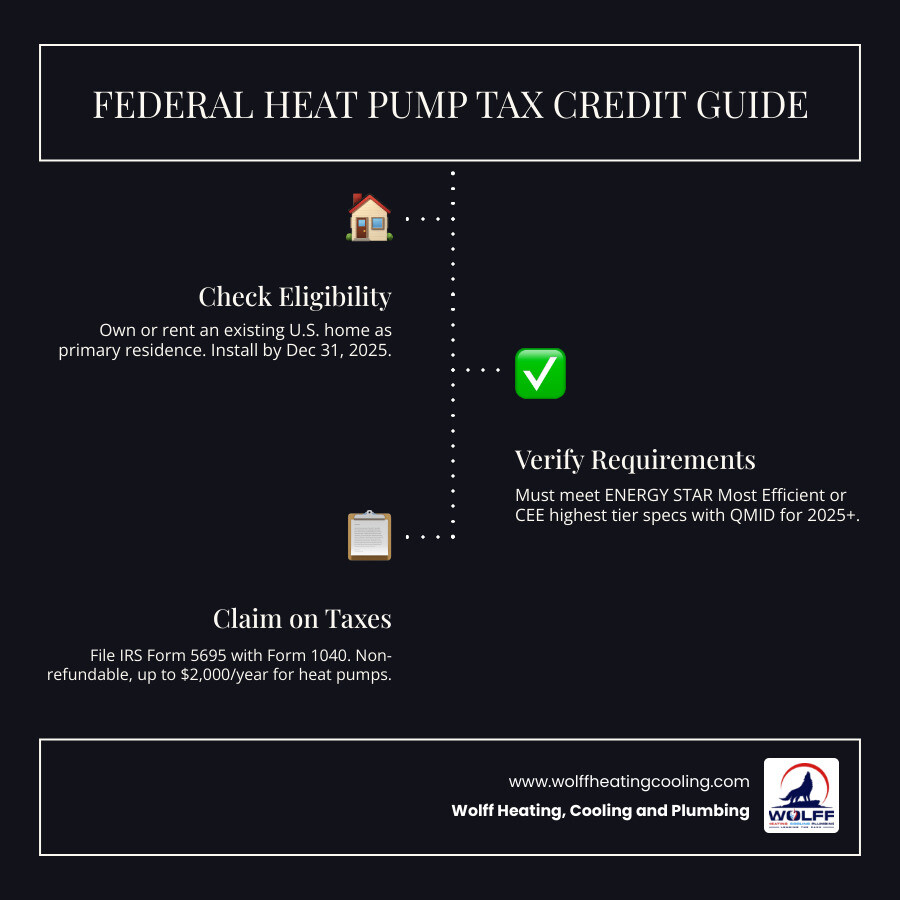
Federal tax credits for heat pump upgrades let eligible homeowners claim 30% of their installation costs back on their federal taxes, up to $2,000 per year — and that’s on top of up to $1,200 more for other energy-efficient improvements like insulation and windows.
Here’s the quick summary:
| What You Need to Know | Details |
|---|---|
| Credit amount | 30% of qualified costs |
| Maximum heat pump credit | $2,000 per year |
| Maximum total annual credit | $3,200 (heat pump + other improvements) |
| Eligible installations | January 1, 2023 – December 31, 2025 |
| Who qualifies | Homeowners and some renters in existing U.S. homes |
| Is it refundable? | No — it reduces your tax bill, not below zero |
| Carry-forward allowed? | No — use it or lose it each year |
| How to claim | IRS Form 5695, filed with your federal tax return |
| 2025 requirement | Qualified Manufacturer ID Number (QMID) required |
If your heat pump was installed and placed in service by December 31, 2025, you can still claim this credit when you file your 2025 taxes during the 2026 tax season — right now.
For Albuquerque homeowners, this is especially timely. Heating and cooling account for the largest share of home energy use, and the Southwest’s wide temperature swings make an efficient heat pump one of the smartest upgrades you can make. The federal tax credit helps offset the upfront cost, and when combined with local utility rebates, the total savings can be significant.
Whether you installed a system last year or you’re still weighing your options, understanding how these credits work helps you make smarter decisions about your home and your budget.
Understanding Federal Tax Credits for Heat Pump Upgrades

The Energy Efficient Home Improvement Credit, established under Section 25C of the Internal Revenue Code, is a cornerstone of the Inflation Reduction Act. For those of us living in the Albuquerque and Rio Rancho areas, this isn’t just a win for the environment; it’s a direct financial incentive to modernize our homes.
The credit allows you to deduct 30% of the total cost of residential energy property from your federal tax liability. While many general home improvements have a $1,200 annual cap, heat pumps are given a “bonus” tier. You can claim up to $2,000 per year specifically for a qualified heat pump or heat pump water heater.
This credit applies to existing homes. If you are building a brand-new home, these specific 25C credits generally do not apply, as new construction falls under different developer-focused incentives. However, if you are adding onto or improving your current residence, you are in the clear. If you’ve recently upgraded, you might be looking at Heat Pump Installation in Albuquerque, NM as the best move you made for your 2025 tax return.
Eligibility for Homeowners and Renters
One of the most common questions we hear is, “Do I have to own the home to get the credit?” The answer is often yes, but with some interesting nuances.
- Primary Residences: Most of the energy-efficient improvements must be made to your principal residence (the place you live most of the time).
- Second Homes: Unlike some other tax credits, the heat pump credit can be used for a second home that you use as a residence. However, you cannot claim it for a property that you rent out and do not live in yourself (landlord restrictions).
- Renters: If you are a tenant and you pay for an eligible upgrade to your primary rental residence, you may actually be eligible to claim the credit.
- U.S. Based: The property must be located within the United States.
If you are a homeowner in Bernalillo or Corrales thinking about the future, you might want to Replace Your Heat Pump in Albuquerque while these incentives are at their peak.
Annual Credit Caps and Total Savings
The federal government has structured these credits to encourage a “whole-home” approach to energy. By combining different categories, you can reach a total annual credit of $3,200.
| Category | Annual Credit Limit |
|---|---|
| Heat Pumps & Heat Pump Water Heaters | $2,000 |
| Building Envelope (Windows, Doors, Insulation) | $1,200 (combined) |
| Exterior Doors | $250 per door ($500 max) |
| Windows & Skylights | $600 |
| Home Energy Audits | $150 |
By strategically planning your upgrades, you can maximize your tax savings. For example, you could claim $2,000 for a heat pump and $1,200 for attic insulation and new windows in the same year, totaling a $3,200 reduction in your tax bill.
Qualifying Standards and Efficiency Requirements
Not every heat pump on the market qualifies for the 30% credit. To ensure the government is subsidizing truly efficient technology, the IRS relies on standards set by the Consortium for Energy Efficiency (CEE).
For an upgrade to qualify for federal tax credits for heat pump upgrades, the unit must meet or exceed the “highest efficiency tier” (excluding any advanced tiers) established by the CEE that was in effect at the start of the year the system was installed. This often means looking for SEER2 (Seasonal Energy Efficiency Ratio), EER2 (Energy Efficiency Ratio), and HSPF2 (Heating Seasonal Performance Factor) ratings that go above and beyond standard entry-level models.
Maintaining these high-efficiency systems is just as important as the initial choice. To keep your unit running at the specs required for peak performance, understanding the Importance of Heat Pump Maintenance is vital for long-term savings.
Technical Standards for Federal Tax Credits for Heat Pump Upgrades
Starting in 2025, the bar was raised. Eligible air-source heat pumps must now generally be recognized as ENERGY STAR Most Efficient.
- Split Systems: These are common in many Albuquerque homes and must meet strict SEER2 and HSPF2 requirements.
- Packaged Units: Often found on rooftops in the Southwest, these also have specific efficiency benchmarks.
- Cold Climate Models: While New Mexico is known for sunshine, our winter nights in places like Cedar Crest or Tijeras can get quite cold. Units labeled for “Cold Climates” meet additional heating capacity requirements at low temperatures.
When selecting a unit, it is helpful to check the Heat Pump Service in Albuquerque, NM page to see what types of high-performance systems are best suited for our local high-desert climate.
2025 and 2026 Requirements: QMID and PINs
As we navigate the 2026 tax season (filing for the 2025 tax year), there is a new administrative requirement you cannot ignore. To claim the credit for a heat pump installed in 2025, you must provide a Qualified Manufacturer Identification Number (QMID) or a Product Identification Number (PIN) on your tax return.
This number confirms that the manufacturer has certified the equipment meets the IRS efficiency standards. Without this number, the IRS may disallow the credit. Most reputable manufacturers provide a written certification statement or a searchable database where you can find this code. If you’ve had a recent Heat Pump Repair in Albuquerque, NM and are wondering if your older unit qualifies, keep in mind that these specific QMID rules apply to new installations placed in service during the 2025 tax year.
Strategic Planning for Maximum Tax Savings
One of the unique features of the Inflation Reduction Act is that it has no lifetime dollar limit through 2025. This means you can claim the maximum annual credit every single year you make eligible improvements.
If you have a long list of home projects, it is often smarter to spread them out. For instance, you might install a heat pump this year (claiming the $2,000 credit) and wait until next year to upgrade your water heater or windows. This “staggering” strategy allows you to reset your annual cap and potentially save thousands more over a three-to-four-year period.
A great first step is a Versatile Heat Pump Installation Upgrade, which serves as the foundation for an energy-efficient home.
Combining Federal Credits with Local Incentives
The federal tax credit is just one piece of the puzzle. In the Southwest, we have access to several local layers of savings:
- PNM Incentives: Our local electric utility often offers “Cool Rebates” for high-efficiency air conditioners and heat pumps.
- New Mexico Gas Company: If you are switching from a gas furnace to a high-efficiency hybrid system, there may be rebates available for the water heating or furnace components.
- State Subsidies: New Mexico has historically offered various energy-related tax credits and programs that can sometimes be “stacked” with federal ones.
Qualifying Energy-Efficient Property Includes:
- Air-source heat pumps
- Heat pump water heaters
- Biomass stoves and boilers
- High-efficiency central air conditioning
- Energy-efficient windows and doors
- Advanced main air circulating fans
Impact of Rebates on Tax Credit Calculations
It is important to understand how rebates affect your “qualified expenses.” The IRS requires you to subtract any “purchase-price adjustments”—like utility rebates or state subsidies—from the total cost of the project before you calculate your 30% credit.
For example, if a heat pump installation costs $10,000 and you receive a $1,000 rebate from your utility company, your “qualified cost” for the federal tax credit is $9,000. You would then take 30% of $9,000 ($2,700), which is then capped at the $2,000 annual limit.
Deciding whether to Repair or Replace Your Heat Pump often comes down to these numbers. If the incentives bring the cost of a new, efficient system close to the cost of a major repair on an old, inefficient one, the replacement is usually the better financial move.
How to Claim Your Federal Tax Credits for Heat Pump Upgrades
Claiming your credit isn’t automatic; you have to ask for it when you file your taxes. You will primarily use IRS Form 5695, “Residential Energy Credits.”
- Part II: This is where you will list your energy-efficient home improvements, including heat pumps.
- Installation Date: The credit is claimed for the tax year the equipment was installed and “placed in service,” not necessarily when you bought it. If you bought a unit in December 2024 but it wasn’t installed until January 2025, you claim it on your 2025 taxes (filed in 2026).
If you’ve recently completed a Heat Pump Replacement in Albuquerque, NM, make sure you have all your paperwork ready for your tax preparer.
Required Documentation for Tax Filing
You don’t need to mail your receipts to the IRS, but you must keep them in your files for at least three years. If you are audited, the IRS will want to see:
- Sales Receipts: Showing the total cost of the unit and labor.
- Manufacturer Certification Statement: A document from the manufacturer certifying that the specific model meets the required efficiency tiers.
- QMID/PIN Codes: Especially important for 2025 installations.
- Auditor Reports: If you are claiming the $150 credit for a home energy audit, you need the written report signed by a certified auditor.
Regular Heat Pump Maintenance in Albuquerque, NM can also help provide a paper trail of your system’s performance and professional care.
Non-refundable Status and Carry-forward Rules
It is vital to remember that the 25C credit is non-refundable. This means it can reduce the amount of tax you owe to zero, but the government won’t send you a check for the “leftover” credit.
Furthermore, unlike the Residential Clean Energy Credit (Section 25D for things like solar panels), the 25C heat pump credit cannot be carried forward to future tax years. If you have a $2,000 credit but only owe $1,500 in taxes, you lose the remaining $500. This is why many people choose to consult with a tax professional to ensure they have enough tax liability to take full advantage of the credit.
While the current expansion of the credit is heavily focused on the 2023-2025 window, the Inflation Reduction Act has technically authorized these credits at various levels through 2032. However, the $2,000 annual “bonus” for heat pumps is the current highlight. For ongoing support, our Heat Pump Services Albuquerque NM can help you keep your qualifying system in top shape.
Frequently Asked Questions about Heat Pump Tax Credits
Is the heat pump tax credit refundable?
No, it is a non-refundable tax credit. It can only be used to offset your federal income tax liability. If your tax bill is already zero, you won’t receive the credit as a refund check.
Can I claim the credit for a rental property?
Generally, no. The credit is intended for homes used as a residence by the taxpayer. Landlords cannot claim this credit for properties they rent out but do not live in. However, if you are a tenant and you pay for the upgrade yourself, you may be eligible.
Does the credit cover labor and installation?
Yes! For “residential energy property” like heat pumps, the 30% calculation includes the cost of the equipment as well as the labor for installation. This is different from “building envelope” components (like insulation), where only the material costs qualify.
Conclusion
Navigating federal tax credits for heat pump upgrades might seem complex, but the financial rewards for Albuquerque homeowners are well worth the effort. By moving away from older, less efficient systems and embracing heat pump technology, you aren’t just saving money on your tax return—you’re lowering your monthly utility bills and increasing the comfort of your home for years to come.
At Wolff Heating, Cooling, and Plumbing, we’ve spent over 25 years helping our neighbors in Albuquerque, Rio Rancho, and the surrounding East Mountain communities stay comfortable. We understand the specific demands our Southwest climate puts on HVAC systems and can help you select equipment that meets the highest federal efficiency standards.
Ready to upgrade your home’s comfort and take advantage of these significant tax savings? Schedule your professional heat pump consultation in Albuquerque today and let our experts help you find the perfect system for your home and your budget.