
 Menu
Menu
Why Heat Pumps Work in Albuquerque’s High Desert Climate
How heat pumps handle the wide temperature swings of the Albuquerque high desert comes down to smart, variable-speed operation. Modern heat pump services in Albuquerque, NM can provide both cooling during 95°F-plus afternoons and efficient heat on winter nights near 24°F. Instead of running at one fixed speed, the system adjusts output as outdoor conditions change. Albuquerque’s dry air can also mean less winter coil frost and fewer defrost cycles than in humid climates. Still, high elevation, home insulation, ductwork, and system sizing all matter for reliable comfort.
Explore heat pump services in Albuquerque or schedule a heat pump installation consultation.
I am Joe Wolff, and the next sections explain what local homeowners should know before choosing a heat pump.
For help selecting a system designed for your home, schedule your heat pump installation consultation.

How Heat Pumps Handle the Wide Temperature Swings of the Albuquerque High Desert
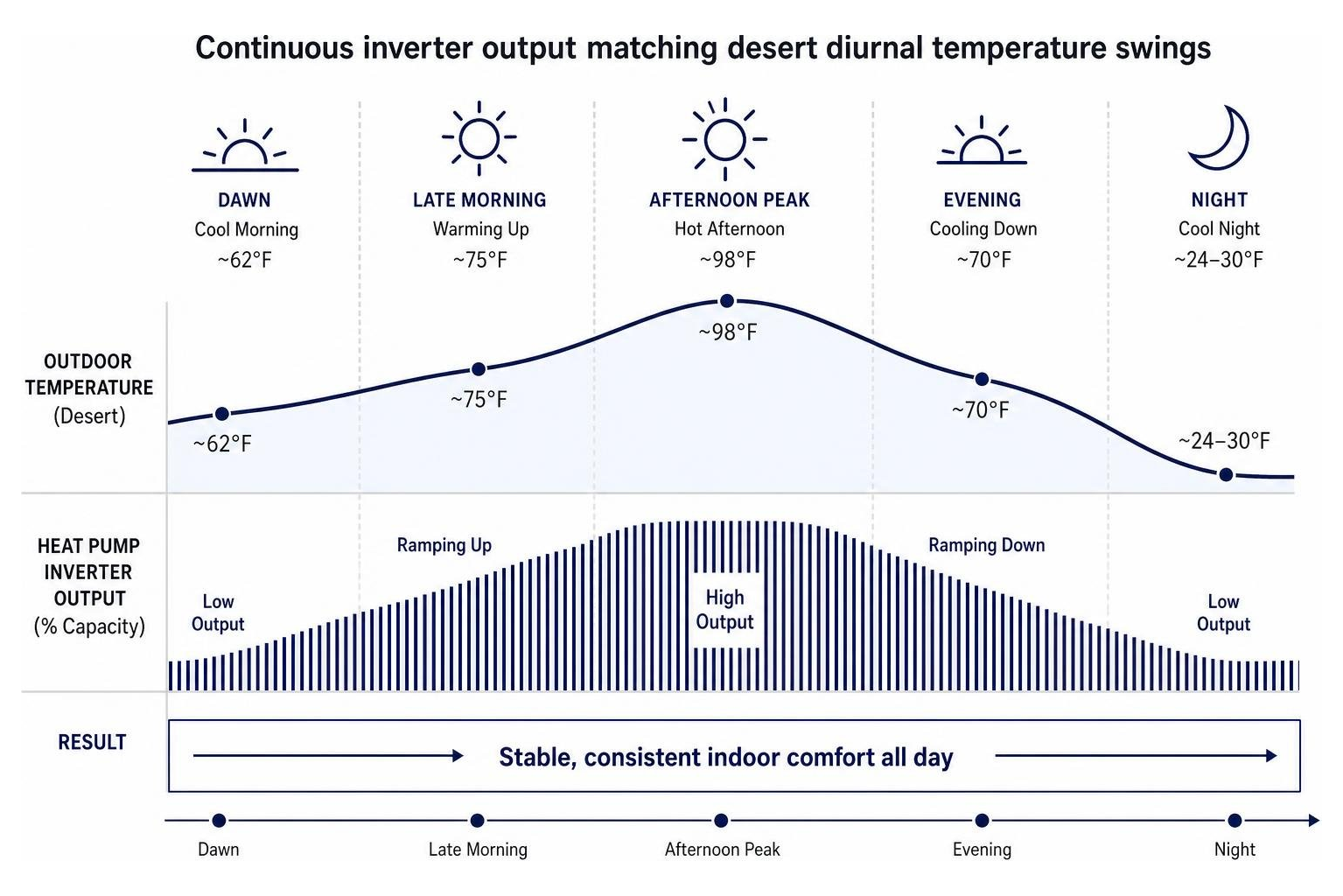
Living in the high desert of Central New Mexico presents a unique climate challenge. Located in USDA Climate Zone 4B, the metro area experiences dramatic diurnal temperature swings where temperatures routinely shift by 30°F to 45°F within a single 24-hour period. A single summer day can start at a pleasant 62°F at dawn, surge past 98°F by late afternoon under relentless solar radiation, and plummet back into the mid-60s shortly after dusk. In winter, freezing midnight conditions near 24°F can give way to crisp, sunny afternoon highs in the 50s.
Traditional single-stage heating and cooling systems struggle under these rapid fluctuations. Older single-stage units operate like a simple light switch: they are either 100% on or completely off. On a mild spring or autumn afternoon, a single-stage system blast-cools the home for a few minutes, shuts off abruptly, and creates hot and cold spots throughout the floor plan.
Modern cold-climate systems overcome this issue using modulating variable-speed technology. When you utilize comprehensive Heat Pump Services Albuquerque NM, our team installs systems designed to continuously match the dynamic thermal load of desert living, maintaining stable indoor temperatures regardless of sharp daily shifts outside.
Variable-Speed Inverters and How Heat Pumps Handle the Wide Temperature Swings of the Albuquerque High Desert
The primary mechanism allowing heat pumps to master high desert climate shifts is the inverter-driven variable-speed compressor. To picture how an inverter compressor works, compare it to driving a vehicle. A traditional single-speed compressor is like a driver who can only floor the accelerator to 100 mph or slam on the brakes. An inverter compressor, by contrast, operates like a smooth accelerator pedal, fine-tuning motor speed anywhere between 30% and 120% capacity in tiny increments.
During cool high-desert mornings or mild transitional days, the compressor hums along quietly at low speed, consuming minimal electricity while providing continuous, gentle air circulation. As the sun climbs over the Sandia Mountains and radiant heat penetrates your roof, the inverter smoothly ramps up its capacity to maintain your exact indoor setpoint.
To conquer freezing winter nights, modern cold-climate heat pumps feature Enhanced Vapor Injection (EVI) technology. EVI creates a specialized bypass circuit within the refrigeration cycle, injecting additional vaporized refrigerant back into the compressor. This boosts mass flow rate and maintains high heating output even when outdoor temperatures dip well below freezing down to -13°F. Rather than relying on energy-intensive auxiliary heat strips, variable-speed systems extract free thermal energy directly from sub-zero ambient air.
High Altitude Sizing and How Heat Pumps Handle the Wide Temperature Swings of the Albuquerque High Desert
Albuquerque sits at an average elevation of 5,312 feet above sea level, with surrounding foothills in areas like Cedar Crest and Tijeras reaching even higher. Elevation plays a massive role in HVAC physics that many out-of-state sizing rules fail to account for:
- Reduced Air Density: Atmospheric pressure in the Duke City is approximately 83% of sea-level pressure. Thinner air contains fewer molecules per cubic foot.
- Lower Thermal Capacity: Because air molecules carry heat, thinner air transfers thermal energy less effectively across indoor and outdoor coils.
- Capacity Derating: Standard factory ratings from manufacturers are measured at sea level. At 5,300 feet, standard heat pump equipment experiences an automatic capacity loss ranging from 10% to 17% in both heating and cooling modes.
Proper system selection requires an altitude-corrected Manual J load calculation. If a contractor sizes your system based strictly on floor area without applying local altitude derating factors, your system will lack sufficient heating capacity on peak winter nights and fall short during scorching summer heat waves.
To review equipment options configured for our region’s altitude and air density, review our comprehensive High Efficiency Heat Pumps Albuquerque Guide.
Arid Climate Advantages: Low Humidity, Defrost Cycles, and Monsoon Cooling
While altitude presents a sizing challenge, our dry climate offers distinct operational advantages for air-source heat pumps compared to humid coastal regions.
With average relative humidity hovering between 20% and 45% for most of the year, heat pumps operate at peak mechanical efficiency across both heating and cooling seasons.
Defrost Cycle Frequency in Arid Winter Air
In humid winter climates, air-source heat pumps face a frequent operational hurdle: ice accumulation on the outdoor coil. When ambient air passes over an outdoor coil operating below freezing, moisture in the air condenses and turns to frost. To clear this frost, traditional systems must periodically reverse into cooling mode, using internal energy to melt the ice while engaging auxiliary heating elements inside to prevent chilly indoor drafts.
In our arid high-desert environment, low relative humidity means there is very little airborne moisture to freeze onto the outdoor coil. During winter nights, outdoor coils remain relatively clear of frost for extended intervals.
Fewer defrost cycles mean:
- Higher Seasonal COP: The system spends more time delivering heat to your home and less time melting ice on the outdoor cabinet.
- Lower Energy Usage: Energy is used for heating living spaces rather than running defrost cycles.
- Consistent Heating Comfort: Indoor temperatures stay stable without temporary cooling dips caused by frequent cycle reversals.
If you ever notice heavy ice buildup or persistent defrost cycling on your outdoor equipment, it typically points to an underlying airflow restriction or refrigerant imbalance rather than local weather conditions. Read more about identifying these symptoms in our guide on Why Your Heat Pump Cools Slowly.
Heat Pumps vs. Evaporative Coolers During Monsoon Season
For decades, many local residences relied on evaporative “swamp” coolers for summer comfort. While swamp coolers can perform adequately when relative humidity sits near 15% in May and June, they suffer a severe drop in performance during the July and August monsoon season.
During the summer monsoon, moist tropical air surges northward into the Rio Grande Valley. As relative humidity creeps upward, evaporative cooling efficiency drops sharply. Swamp coolers pump muggy, moisture-laden air into the home, making indoor spaces feel humid and sticky while risking indoor mold growth and warping wood finishes.
Inverter-driven heat pumps operate on a true vapor-compression refrigeration cycle that provides precise sensible (temperature) and latent (humidity) cooling. During monsoon season, a heat pump extracts moisture from indoor air while chilling it, delivering crisp comfort regardless of outdoor humidity.
If you are considering upgrading from an outdated evaporative cooler to year-round electric comfort, explore our Heat Pump Replacement Albuquerque Guide.
System Configurations for New Mexico Homes: Mini-Splits, Hybrids, and Adobe Retrofits
Local architecture ranges from classic historic adobe and Pueblo-style residences in Old Town and Corrales to modern ranch homes in Rio Rancho and custom builds in Placitas. Matching the right heat pump configuration to your home’s architectural structure is critical for optimal heating and cooling performance.
| System Configuration | Ideal Home Type | High Desert Advantage | Key Installation Consideration |
|---|---|---|---|
| Ductless Mini-Split Systems | Historic Adobe, Pueblo Revival, Homes without Existing Ductwork | Multi-zone control; eliminates duct heat losses; preserves architectural integrity | Requires precise placement on thick exterior walls for clean line-set passage |
| Dual-Fuel Hybrid Systems | Draftier Homes, Central Ducted Residences, High Elevation Foothills | Combines heat pump efficiency with gas furnace backup for sub-zero snaps | Requires dual-fuel smart thermostat calibration and gas line integration |
| Central Ducted Cold-Climate Heat Pumps | Modern Homes with Existing Ductwork, Whole-Home Replacement | Seamless single-system heating and cooling using existing supply registers | Airflow volume must be verified to support lower heat pump supply air temperatures |
Ductless Mini-Splits for Adobe and Pueblo Architectural Styles
Traditional adobe and Pueblo-style homes present unique thermal characteristics. Built with thick earthen mass walls, these structures store heat during sunny desert days and slowly release it inward as temperatures drop at night. However, many historic adobe homes in neighborhoods like Nob Hill or Corrales were built without central ductwork. Modern duct retrofits can be complex and damage historic architectural features.
Ductless mini-split heat pumps offer an ideal solution for earthen construction:
- Non-Invasive Installation: A single 3-inch wall penetration connects outdoor inverter condensing units to indoor wall mounts, preserving original adobe walls.
- Zoned Temperature Control: Each room or zone has its own independent thermostat control. You can direct heat or cooling precisely where needed, allowing thermal mass walls to naturally temper adjacent spaces.
- Zero Duct Loss: Standard uninsulated ductwork running through hot attics can lose up to 30% of cooling energy. Ductless systems deliver 100% of conditioned air directly into the living space.
Homeowners retrofitting historic or custom architectural properties can learn more about preserving home character by reading about Navigating Heat Pump Installation Historic Nob Hill.
Dual-Fuel Hybrid Systems for Extreme Winter Cold Snaps
For central ducted homes, especially draftier residences or properties situated in higher-elevation areas like Sandia Park, Tijeras, or Cedar Crest, a dual-fuel hybrid configuration offers maximum versatility.
A dual-fuel system pairs an electric heat pump with an existing or new natural gas furnace. A smart control system automatically switches operating modes based on outdoor temperatures:
- Primary Heating Mode: During mild winter days and average nights (above 30°F), the ultra-efficient heat pump handles 80% to 90% of your total seasonal heating demand.
- Auxiliary Heating Mode: When extreme Arctic cold snaps push temperatures down near zero degrees, the system automatically transitions to the gas furnace. This ensures rapid heating response without engaging electric resistance heat strips.
Financial Incentives, Tax Credits, and Utility Rebates
Upgrading to an advanced cold-climate heat pump system is an investment in long-term comfort, property value, and energy efficiency. To support home decarbonization and grid reliability, local utilities and government programs offer valuable financial incentives to help offset upfront equipment investments.
- PNM Utility Rebates: PNM (Public Service Company of New Mexico) offers substantial mail-in and instant rebates for residential customers upgrading to qualified high-efficiency heat pumps and ductless mini-splits. Rebate amounts scale based on equipment efficiency ratings (SEER2 and HSPF2).
- Federal Energy Efficiency Incentives: Homeowners exploring clean energy improvements may qualify for federal tax incentives through updated programs under the Inflation Reduction Act (IRA), covering up to 30% of qualifying equipment and installation investments.
- USDA REAP Grants for Rural Properties: For agricultural operations, small rural businesses, and qualifying commercial properties in nearby communities such as Bernalillo, Placitas, or rural Bernalillo County, the USDA Rural Energy for America Program (REAP) provides grant funding to support clean technology transitions.
When replacing old equipment, stacking utility rebates with federal tax programs can significantly maximize long-term savings. For a deeper look at maximizing these savings, review our overview on Albuquerque Heat Pump Replacement Smart Savings for Your Home.
Frequently Asked Questions About Heat Pumps in Albuquerque
Can a heat pump keep up with Albuquerque’s 24°F winter nights?
Yes. Modern cold-climate heat pumps equipped with variable-speed inverter compressors and Enhanced Vapor Injection (EVI) technology extract usable thermal energy from outdoor air well below freezing. Top-tier cold-climate units maintain up to 100% of their rated heating output at 5°F and operate reliably down to -13°F or lower—far below our average January low of 24°F.
How does 5,300 feet of elevation affect heat pump performance?
At 5,300 feet, lower atmospheric pressure reduces air density, resulting in roughly 10% to 17% less mass flow across heat exchanger coils compared to sea-level conditions. This lowers net heating and cooling capacity. Experienced local contractors compensate for elevation by performing altitude-corrected Manual J load calculations and adjusting fan speed profiles to deliver proper indoor airflow.
Why are heat pumps better than swamp coolers during July and August?
Evaporative swamp coolers depend on dry outdoor air to absorb moisture and reduce supply temperatures. During July and August monsoon periods, elevated humidity prevents evaporative cooling from working effectively, resulting in warm, humid indoor air. Inverter heat pumps use closed-loop refrigeration that extracts indoor humidity while providing consistent cooling, keeping your home dry and comfortable regardless of monsoon storms outside.
Conclusion
Understanding how heat pumps handle the wide temperature swings of the Albuquerque high desert empowers you to choose a year-round comfort system built for our unique climate. By combining variable-speed inverter technology, precise altitude sizing, and smart airflow design, modern heat pumps deliver reliable cooling during scorching summer afternoons and steady, efficient warmth on freezing winter nights.
With over 25 years of experience serving homeowners across Albuquerque, Rio Rancho, Placitas, Corrales, Cedar Crest, Tijeras, and Bernalillo, Wolff Heating, Cooling, and Plumbing provides expert system selection, honest estimates, and quality installations tailored specifically to New Mexico high-desert living.
Ready to experience superior high-desert comfort? Schedule your professional heat pump installation consultation with our team today!