
 Menu
Menu
Why Hard Water Is a Hidden Threat to Your AC Drainage System in Albuquerque
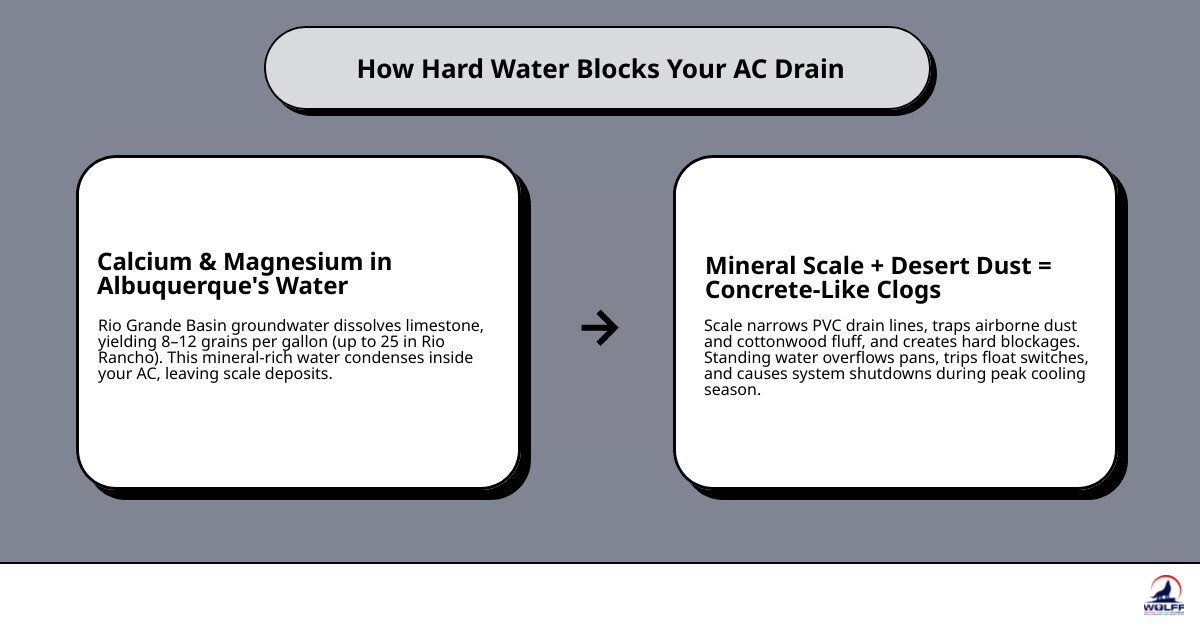
How Albuquerque hard water affects condensate lines and drain pans comes down to one core problem: the minerals in your water supply — primarily calcium and magnesium — build up inside your HVAC drainage system over time, narrowing and eventually blocking the lines that carry water away from your system.
Here’s a quick summary of the key effects:
- Mineral scale accumulates inside condensate drain lines, gradually restricting water flow
- Drain pans fill with standing water when blocked lines can’t drain fast enough
- Float switches trip, cutting power to your AC or thermostat unexpectedly
- High-desert dust mixes with scale, forming concrete-like clogs that are harder to clear
- Drain pans corrode or crack faster when exposed to mineral-laden standing water
- Mold and algae growth accelerates in pans that stay wet due to slow drainage
- Mini-split condensate pumps fail sooner when scale restricts pump inlets and outlets
- Dehumidifier reservoirs clog during monsoon season when the system runs hardest
Albuquerque’s water is classified as extremely hard, measuring roughly 8 to 12 grains per gallon depending on your neighborhood — with Rio Rancho reaching as high as 25 grains. That mineral load doesn’t just damage faucets and water heaters. It quietly works its way into every part of your home’s water-handling systems, including the condensate drain lines and drain pans inside your air conditioner, mini-split, and dehumidifier.
Most homeowners don’t think about their AC producing water. But on a hot Albuquerque summer day — when temperatures push past 95°F and the monsoon humidity spikes — your air conditioner can pull significant amounts of moisture out of the air. All of that water has to go somewhere. When scale, dust, and debris block the path, it backs up into the drain pan and eventually overflows, causing water damage, mold growth, and system shutdowns at the worst possible time.
The Science of Albuquerque’s Hard Water and HVAC Systems
To understand why our cooling systems struggle so much, we have to look beneath our feet. The geological history of the Rio Grande Basin and our surrounding aquifers is rich with deep limestone deposits. As groundwater trickles through this dry, mineral-heavy New Mexican terrain, it dissolves and absorbs high concentrations of calcium and magnesium.
By the time this water reaches municipal wells and flows out of your taps, it is packed with these dissolved minerals. In Albuquerque, our water averages about 12 grains of hardness per gallon, while our neighbors in Rio Rancho deal with water that can reach up to an incredible 25 grains. In fact, approximately 95% of households in our service area — which includes Albuquerque, Rio Rancho, Placitas, Corrales, Cedar Crest, Tijeras, and Bernalillo — have moderately hard to extremely hard water.
While we usually think of hard water as a plumbing issue that leaves white crusty spots on faucets, it has a massive impact on your home’s heating and cooling systems. For instance, local evaporative coolers (or “swamp coolers”) rely heavily on a constant stream of water to saturate their cooling pads. As this water evaporates into the dry desert air, it leaves behind every single ounce of its mineral load. This scale cakes onto the pads, clogs the water distribution “spider” lines, and burns out the water pump.
Similarly, local water heaters are highly sensitive to these minerals. If you are dealing with Tankless Water Heater Scale Issues, you already know that heating hard water causes calcium carbonate to rapidly precipitate out of solution, forming a thick, insulating barrier over heat exchangers that ruins efficiency and causes premature system failure.
But how does this hard water find its way into your refrigerated air conditioning system’s condensate lines and drain pans, which are supposed to handle pure, condensed water vapor? The answer lies in the physics of condensation and our unique high-desert environment.
How Albuquerque Hard Water Affects Condensate Lines and Drain Pans
When your air conditioner runs, its primary job is to cool your indoor air by blowing it across a freezing-cold evaporator coil. A natural byproduct of this process is dehumidification. Moisture in your indoor air hits the cold metal coils and condenses into liquid water droplets — exactly like the condensation that forms on the outside of a cold glass of sweet tea on a hot July afternoon.
Under normal circumstances, this condensed water is essentially distilled water, meaning it is pure and free of minerals. However, your air handler does not operate in a vacuum.
Here is how hard water minerals actually enter your condensate drainage system:
- Airborne Hard Water Dust: When you use tap water in household humidifiers, spray hoses near your outdoor intake, or even when hard municipal water evaporates on your lawn and xeriscaping, tiny mineral particles become airborne. This fine, calcified dust is drawn into your home’s return air vents.
- Evaporative Cooler Carryover: Many homes in our area have converted from swamp coolers to refrigerated air, or use both systems. Residual mineral dust from old swamp cooler pads can linger in ductwork for years, eventually blowing across your new AC’s wet evaporator coil.
- Flushing and Cleaning: When homeowners or inexperienced technicians flush out condensate pans using hard tap water during routine cleaning, they inadvertently introduce a heavy load of calcium and magnesium directly into the system.
Once these minerals settle into the indoor drain pan, they undergo a process called mineral precipitation. Because the drain pan is designed to collect water and let it flow out slowly via gravity, water often sits in the pan for extended periods. In our dry climate, this standing water evaporates quickly when the AC cycles off, leaving behind a concentrated, crusty layer of calcium carbonate (lime scale) at the bottom of the pan and along the inner walls of the PVC drain line.
Over time, this scale acts like plaque in an artery. It narrows the internal diameter of your 3/4-inch PVC condensate line, creating a rough, jagged surface that restricts water flow. As the flow slows down, water backs up into the indoor drain pan. If your system is already struggling with drainage, you may start noticing signs that lead to major headaches, which we discuss in our guide on Why Your AC is Dripping Water Inside.
How Albuquerque Hard Water Affects Condensate Lines and Drain Pans in Mini-Splits
Ductless mini-split systems have exploded in popularity across Rio Rancho, Corrales, and the East Mountains because they offer highly efficient, zoned comfort. However, their unique design makes them incredibly vulnerable to hard water scale and drainage failures.
Unlike central air handlers that sit in a spacious closet or attic, a mini-split’s indoor unit is mounted directly on your wall. Inside that sleek plastic cover is a tiny, shallow condensate drain pan and an incredibly narrow drain line — often measuring only 1/2 inch in diameter.
Because space is limited, many mini-split installations cannot rely solely on gravity to drain water. Instead, they utilize tiny, internal condensate pumps to lift the water up and out to an exterior drain.
When hard water mineral dust mixes with the condensation in a mini-split:
- Float Switches Get Stuck: These pumps rely on a tiny mechanical float switch to tell them when to turn on. Scale buildup coats the float mechanism, pinning it in the “off” position. The pump never runs, and water quickly overflows down your drywall.
- Pump Impellers Seize: The internal components of mini-condensate pumps are highly delicate. Calcium deposits can crystallize on the pump’s impeller spinning shaft, causing the motor to seize and fail prematurely.
- Gravity Lines Block Instantly: If your mini-split does use gravity drainage, the tiny 1/2-inch line has almost zero margin for error. A thin layer of scale can restrict the line completely, causing water to pool inside the wall-mounted unit.
How Albuquerque Hard Water Affects Condensate Lines and Drain Pans in Dehumidifiers
Whole-house dehumidifiers are essential for keeping local homes comfortable, especially during the humid monsoon season that stretches from July through September. These systems extract gallons of water from your indoor air every day to protect your wood floors, structural framing, and drywall from mold and rot.
Because dehumidifiers operate at high-altitude conditions in areas like Cedar Crest and Tijeras, their drainage efficiency is already slightly altered by local atmospheric pressure. When you add hard water mineral dust to the mix, the problems compound:
- Reservoir Scaling: Dehumidifiers utilize an internal reservoir to collect moisture before routing it to a floor drain or condensate pump. Hard water scale coats the bottom of these reservoirs, creating a rough texture that traps biological growth.
- Monsoon Overload: During the dry spring, these mineral deposits lie dormant and dry out, hardening into a stubborn, cement-like crust. When the monsoon humidity arrives in July, the sudden influx of water cannot drain past these hardened blockages, leading to rapid reservoir overflows.
The Compounding Threat: High-Desert Dust and Mineral Scale
If hard water scale were the only issue, your AC drainage system might survive a bit longer. However, Albuquerque’s environment introduces a second, highly destructive element: fine high-desert dust.
Our spring months are famous for howling winds that carry fine particulate silica, dirt, and organic debris like cottonwood fluff across the valley. Because our air is so dry, this dust easily bypasses standard air filters over time and settles onto the wet evaporator coils of your air conditioner.
When this fine desert dust washes off the coils, it flows down into the drain pan and mixes directly with the calcium and magnesium scale.
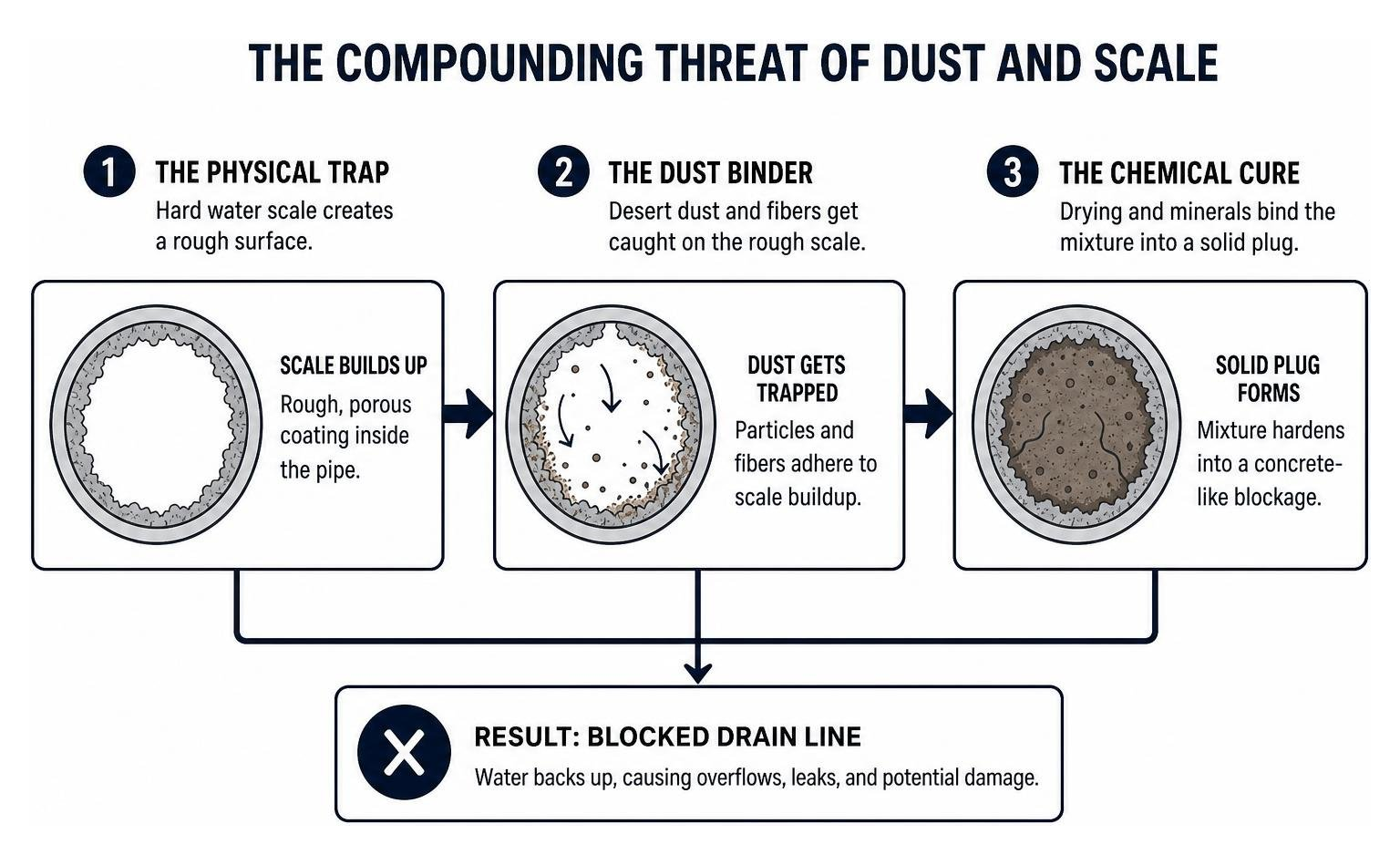
This combination creates a compounding threat:
- The Physical Trap: Hard water scale forms a rough, sandpaper-like coating inside your PVC pipes.
- The Dust Binder: As muddy desert dust and cottonwood fibers slide down the line, they get caught on the rough scale deposits.
- The Chemical Cure: As the AC cycles off and the pipe warms up, the mixture dries out. The calcium acts as a binding agent, curing the dust and organic fibers into a solid, concrete-like plug.
These concrete-like clogs are incredibly stubborn. Unlike simple biological clogs (which are soft and can easily be flushed out with water), mineral-and-dust cement cannot be dissolved by standard chemical cleaners. If left unchecked, they will completely choke off your line, requiring professional intervention. To learn more about how we handle these tough blockages in local main lines and secondary drains, check out our comprehensive Drain Cleaning Albuquerque NM Guide.
Signs of Hard Water Damage in Your AC Drainage System
Because your AC’s indoor unit is usually hidden away in a dark utility closet, basement, or attic, drainage issues can easily go unnoticed until they cause major structural damage. Fortunately, your system will usually give you a few warning signs that scale is taking over.
Keep an eye out for these common symptoms:
- A Blank Thermostat Screen: Modern AC installations include a safety float switch installed on the condensate drain pan or inline with the PVC drain pipe. When a scale clog causes water to rise, the float rises and cuts the 24V power to your thermostat. If your thermostat screen suddenly goes completely blank on a 95°F day, a clogged drain line is the primary suspect.
- System Short Cycling: If your AC turns on, runs for 10 to 15 minutes, and then abruptly shuts off — only to turn back on 30 minutes later — you may have a slow-draining partial clog. Water slowly trickles past the scale blockage, lowering the float switch just enough to let the system restart, only for it to trip again as soon as more condensation accumulates.
- Musty, Damp Odors: Standing water in a scaled-up drain pan is a breeding ground for bacteria, mold, and mildew. When your system turns on, the blower fan pushes these musty odors through your ductwork and into your living spaces.
- Water Stains on Ceilings or Walls: If your air handler is located in an attic or upper-floor closet, an overflowing drain pan will quickly soak through your drywall, leaving unsightly yellow or brown water rings on your ceilings and walls.
To help you diagnose what is going on inside your system, we have put together this handy comparison table to help you distinguish between mineral scale and biological growth:
| Feature | Mineral Scale Buildup | Biological Algae & Mold Growth |
|---|---|---|
| Appearance | White, gray, or chalky light-brown crust | Green, black, or brown slimy sludge |
| Texture | Hard, rough, and rock-like | Soft, slippery, and gelatinous |
| Primary Cause | Evaporation of mineral-rich water and dust | Standing water, darkness, and organic spores |
| Location | Bottom of pan and joints of PVC lines | Entire length of drain line and wet pan surfaces |
| Removal Method | Acidic descaling flush or manual scraping | Chlorine tablets, vinegar, or pressurized blowouts |
Preventative Maintenance and Solutions for Hard Water Scale
When it comes to protecting your home from water damage, proactive maintenance is always your best defense. Because mineral scale hardens over time, letting it sit through the winter will make it twice as difficult to clear when spring rolls around.
Here are the most effective steps you can take to keep your condensate lines flowing freely:
1. Flush the Line with Vinegar
Every month during the cooling season, pour one cup of distilled white vinegar down your condensate drain line access T-pipe. The mild acetic acid in vinegar helps break down early-stage calcium deposits before they can harden into scale. Note: Avoid using harsh chemical drain cleaners or bleach, as they can degrade PVC glue, damage plastic drain pans, and emit toxic fumes into your indoor air.
2. Use a Wet-Dry Vacuum
If you suspect a slow drain, you can attach a wet-dry vacuum to the outdoor exit point of your condensate line. Seal the connection with a rag, turn the vacuum on for 10 to 15 seconds, and pull out any accumulated dust, scale flakes, and sludge.
3. Install a Whole-Home Water Softener
While a water softener won’t change the fact that your AC condenses pure water vapor, it protects your system in other ways. Soft water prevents mineral dust from forming in your home when you use faucets or humidifiers, keeping that calcified dust out of your indoor air and evaporator coils. Additionally, if you or a technician use household water to flush the lines during maintenance, using softened water ensures you aren’t adding new minerals to the pan.
4. Schedule Professional Maintenance
The absolute best way to ensure your system survives the summer is to schedule professional care. During a routine visit, our licensed technicians will thoroughly clean your evaporator coils, inspect your safety float switches, and flush your drainage system using professional-grade descaling solutions. For complete peace of mind, explore our AC Maintenance Albuquerque services to keep your system running at peak efficiency.
Frequently Asked Questions
How often should I clean my AC condensate line in Albuquerque?
In our dusty, high-mineral environment, we highly recommend inspecting and flushing your condensate line at least twice a year. The first cleaning should take place in the spring as part of your pre-summer startup routine to clear out any hardened winter debris. The second flush should occur in late summer, right after the monsoon season, to clear out the heavy mixture of desert dust, cottonwood fluff, and minerals that accumulated during our humid months.
Can a water softener protect my AC condensate drain line?
Yes, but indirectly. Your AC evaporator coil condenses pure water vapor from the air, which does not contain minerals. However, a whole-home water softener prevents hard water mineral dust from being created by your faucets, showers, and humidifiers. This dramatically reduces the amount of calcified dust floating through your indoor air and settling into your drain pan. It also ensures that any water used to flush or clean your system during maintenance is free of scale-forming minerals.
What should I do if my AC drain pan is overflowing?
If you discover standing water overflowing from your drain pan, take these steps immediately:
- Shut Off the System: Turn your AC off at the thermostat or flip the breaker in your electrical panel to stop the system from producing more water.
- Clear Standing Water: Use a wet-dry vacuum or towels to remove as much standing water from the pan and surrounding floor as possible to minimize structural damage.
- Do Not Pour Harsh Chemicals Down the Line: Avoid using commercial plumbing drain openers, as they can melt your PVC pipes and destroy your plastic drain pan.
- Call a Professional: Contact a licensed technician to safely clear the blockage and inspect your system for electrical or water damage.
Conclusion
Albuquerque’s unique high-desert climate and mineral-rich geology make hard water scale an inevitability for local homeowners. From the chalky deposits that narrow your PVC lines to the concrete-like blocks formed when mineral scale mixes with desert dust, your AC’s drainage system is under constant attack.
At Wolff Heating, Cooling, and Plumbing, we have spent over 25 years helping families across Albuquerque, Rio Rancho, Bernalillo, and the surrounding areas keep their homes cool, dry, and comfortable. Our experienced, licensed, and bonded technicians understand the exact challenges our local water and wind present to your HVAC equipment.
Don’t wait for a clogged line to ruin your ceilings or shut down your air conditioning in the middle of a summer heatwave. Schedule expert AC repair and maintenance in Albuquerque with us today, and let our family take care of yours!