
 Menu
Menu
How Tree Root Intrusion Damages Sewer Lines in Older Albuquerque Neighborhoods — And What to Do About It
How tree root intrusion damages sewer lines in older Albuquerque neighborhoods follows a predictable pattern that catches many homeowners completely off guard. Here is a quick breakdown of what is actually happening underground:
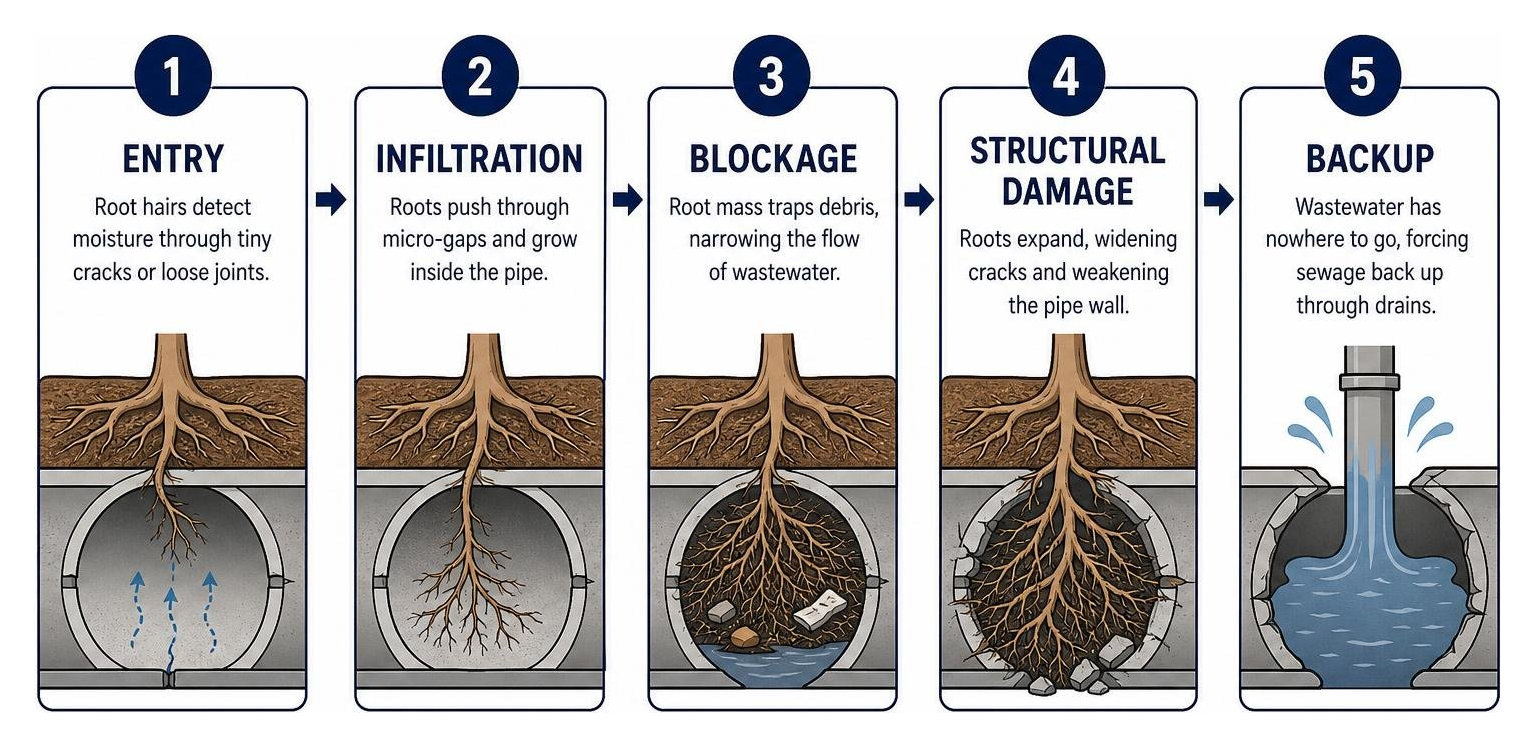
The root intrusion damage cycle at a glance:
- Entry — Fine root hairs as thin as 0.5mm detect warm, humid vapor escaping from tiny cracks or loose joints in aging clay tile or cast iron sewer pipes.
- Infiltration — Roots push through those micro-gaps and branch out inside the pipe, where warm water and nutrients accelerate their growth.
- Blockage — The expanding root mass acts like a strainer, catching grease, tissue, and debris — narrowing flow far faster than root growth alone.
- Structural damage — Roots exert outward pressure on the pipe walls, widening existing cracks and eventually causing sections to collapse entirely.
- Backup — Wastewater has nowhere to go, forcing sewage back up through the lowest drains in the home.
This process can go from a minor infiltration to a complete pipe collapse in a matter of months — and in Albuquerque’s older neighborhoods, the conditions are almost perfectly engineered to make it happen. Homes built during the city’s postwar boom in the 1940s and 1950s — especially in areas like Nob Hill, the UNM Area, and the North Valley — still rely on original clay tile or cast iron sewer laterals that are now 60 to 80 years old. Those pipes were already past their expected lifespan before the first root hair ever found them. Add mature Siberian elms lining the streets, Rio Grande cottonwoods pushing in from the bosque corridor, and Albuquerque’s expansive clay soil shifting with every monsoon season and temperature swing, and you have a recipe for recurring, escalating sewer failures.
I’m Joe Wolff, and after 25 years of serving Albuquerque homeowners, I’ve seen this problem more times than I can count — so let me walk you through everything you need to know to protect your home.
Why Older Albuquerque Neighborhoods Face High Sewer Line Risks
Albuquerque is a city defined by its history, character, and beautiful mature tree canopies. However, beneath the historic streets of our most beloved neighborhoods lies an aging, invisible infrastructure under constant biological attack. If you live in Nob Hill, the UNM Area, Downtown, or the lush North Valley, your home is situated in a high-risk zone for sewer line failures.
During the city’s rapid postwar growth in the mid-20th century, thousands of homes were connected to municipal sewer systems using the standard plumbing technology of the era. Decades later, these neighborhoods feature stunning, mature tree canopies that shade our streets but also harbor massive, water-hungry root systems. In an arid high-desert environment, these root networks are biologically programmed to seek out any source of moisture.
Because the soil in these historic districts is frequently subjected to shifting and compaction, the aging pipes underneath have developed tiny structural vulnerabilities. When you combine decades-old pipe materials with massive, thirsty trees, sewer line emergencies become a matter of “when,” not “if.” To understand how to protect your property, it helps to look at our local Plumbing/Albuquerque Nm/ history and see exactly what materials are buried in your yard.
The Vulnerability of Aging Pipe Materials
The type of sewer pipe buried on your property is the single greatest predictor of whether you will experience root intrusion. If your home was built before 1980, it is highly likely that your lateral line is constructed from one of three vulnerable historic materials:
- Clay Tile Pipes: Standard in Albuquerque homes built from the 1940s through the 1970s, clay tile was laid in short two-to-four-foot sections. These sections were sealed together with concrete or basic rubber gaskets. Over 50 to 60 years of thermal cycling and soil movement, these joints inevitably degrade, crack, and separate. This creates joint gaps where fine root hairs can easily slip inside. Clay tile joints fail to root intrusion at a documented rate that far exceeds modern, seamless PVC or HDPE pipes.
- Cast Iron Pipes: Often used for the portion of the sewer line closest to the home’s foundation, cast iron was built to be sturdy. However, cast iron corrodes from the outside in when exposed to damp soil, and from the inside out due to acidic wastewater. This corrosion creates a rough, scaled interior surface that snags debris, and eventually leads to pinhole leaks and structural perforations that roots exploit.
- Orangeburg Pipes: Made of wood pulp bound with coal tar pitch, Orangeburg was a cheap, lightweight pipe material used occasionally during postwar supply shortages. It has a lifespan of only about 30 to 50 years. Over time, the constant moisture causes Orangeburg to flatten, deform, and delaminate. Once the structural integrity of Orangeburg is compromised, tree roots can push right through the soft, soggy walls.
If you suspect your home still relies on these materials, contacting an experienced Plumbing Repair Company Albuquerque/ is the best way to assess your system’s current condition before a catastrophic failure occurs.
Homeowner vs. City Responsibility for Sewer Laterals
A common and costly misconception among Albuquerque homeowners is that the city is responsible for repairing any sewer line that runs beyond their property line. Under the Uniform Plumbing Code (UPC) and local municipal regulations, the legal distinction is very clear:
- The Property Owner’s Responsibility: You, the homeowner, are responsible for the entire “sewer lateral.” This is the pipe that runs from your home’s interior plumbing all the way to the connection point at the public sewer main. This responsibility typically extends past your property line, underneath the sidewalk, and sometimes even into the middle of the street where the main line resides.
- The City’s Responsibility: The Albuquerque Bernalillo County Water Utility Authority is only responsible for the public sewer main itself. If a backup is caused by a blockage in the main line under the street, the city will clear it. However, if the blockage or structural failure is located anywhere within your lateral line—even if it is physically located under a public sidewalk—all diagnostic, excavation, and repair costs fall squarely on your shoulders.
Understanding this boundary underscores the importance of proactive maintenance and timely Plumbing/Albuquerque Nm/Plumbing Services/ to avoid sudden, massive out-of-pocket expenses.
How Tree Root Intrusion Damages Sewer Lines in Older Albuquerque Neighborhoods

To a tree, your sewer line does not look like a waste pipe; it looks like a premium, underground buffet. In our arid New Mexico climate, moisture is the ultimate luxury. Because sewer pipes carry warm, nutrient-rich water, they constantly emit a low-level “vapor plume” through microscopic structural imperfections, loose joints, or tiny cracks.
Tree roots do not randomly stumble into your plumbing. They are biological sensors designed to follow moisture gradients and temperature differences. When a tree’s lateral roots detect the warm, humid vapor escaping a pipe, they grow directly toward the source.
Once a root tip reaches the pipe, it exploits any gap larger than 0.5 millimeters. Once inside, the environment is ideal: a constant supply of water, oxygen, and organic nutrients. What starts as a single hair-thin fiber quickly develops into a complex, destructive network. If left unaddressed, this biological invasion will inevitably lead to complete structural pipe failure and a major plumbing emergency. If you are already experiencing slow drains, consulting a comprehensive Drain Repair Albuquerque Guide/ can help you understand the immediate steps needed to address the issue.
The Biological Mechanics: How Tree Root Intrusion Damages Sewer Lines in Older Albuquerque Neighborhoods
The physical destruction of your sewer line happens through a combination of biological growth and mechanical pressure:
- Microscopic Penetration: Fine, hair-thin feeder roots (often less than 0.5mm wide) slip through degraded clay joints or rust perforations.
- Radial Expansion: Once inside the pipe, the root has access to unlimited nutrients. As the root cells multiply, the root grows thicker. This radial expansion acts like a slow-motion hydraulic wedge, exerting immense physical pressure on the surrounding pipe material.
- Joint Separation and Cracking: The outward pressure of the expanding root splits clay tile joints apart, fractures brittle cast iron, and shatters aging pipe sections.
- The Strainer Effect: Inside the pipe, the root system branches out into a dense, fibrous mat that looks like a ponytail. This root mass acts as a physical strainer. It catches toilet paper, kitchen grease, wet wipes, and organic waste.
- Accelerated Clogging: This combination of root growth and trapped debris restricts water flow much faster than the roots would grow on their own, quickly leading to a total system blockage.
Regularly scheduling a professional Drain Cleaning Albuquerque Nm Guide/ can clear out these early-stage root masses before they have the chance to expand and shatter your pipes.
Recognizing the Warning Signs: How Tree Root Intrusion Damages Sewer Lines in Older Albuquerque Neighborhoods Over Time
Because sewer lines are buried deep underground, root intrusion is an invisible threat. However, your home’s plumbing will exhibit several clear warning signs before a complete backup occurs. Recognizing these early indicators can save you from a catastrophic cleanup:
- Multiple Slow Drains: If only your kitchen sink is draining slowly, it is likely a localized grease clog. However, if your kitchen sink, bathroom tubs, and laundry lines are all draining sluggishly at the same time, the main sewer lateral is restricted.
- Gurgling Toilets and Floor Drains: When you run the washing machine or empty a bathtub, do you hear a wet, bubbling, or gurgling sound coming from your toilets? This happens because air is trapped in the line by an accumulating root mass, forcing sewer gas back up through your traps.
- Sewer Gas Odors: A persistent smell of rotten eggs or raw sewage in your yard, basement, or near floor drains indicates that wastewater is escaping the pipe or backing up behind a blockage.
- Unusually Lush, Green Patches in Your Xeriscaping: In our dry climate, most yards are xeriscaped with gravel, native shrubs, or dry grasses. If you notice a specific patch of grass or a section of your yard that is suddenly vibrant, green, or soft and spongy to step on, you likely have a cracked sewer line leaking nutrient-rich water into the surrounding soil.
If you are noticing any of these red flags, reading up on how Common Plumbing Problems Solved/ can help you identify the root cause before calling in the professionals.
High-Risk Trees and Soil Conditions in the Duke City
Albuquerque’s unique high-desert geography and climate create a perfect storm for sewer line damage. Unlike coastal or humid regions where soil moisture is relatively consistent, our local environment experiences extreme cycles of drought and sudden, intense moisture.
This moisture disparity forces local trees to adapt by growing incredibly aggressive, far-reaching root systems. Underground, a tree’s root network routinely extends two to three times the width of its visible canopy. In extreme conditions, native and adapted desert trees will send out lateral roots up to 100 feet away from the trunk in a desperate search for water.
Compounding this biological drive is our highly volatile local soil. From the sandy loam of the Valley to the dense clay of the Heights, Albuquerque’s ground is constantly moving. For a buried sewer line, this means enduring continuous physical stress. If you suspect that shifting soil has already cracked your pipe and invited root growth, utilizing advanced Leak Detection Albuquerque/ services is the most reliable way to pinpoint the damage.
Problematic Albuquerque Tree Species
While we love the shade and beauty that trees bring to our homes, certain species common to older Albuquerque neighborhoods are notorious for targeting sewer systems. If you have any of the following trees planted on or near your property line, your risk of root intrusion is significantly elevated:
- Siberian Elm (Ulmus pumila): Introduced widely in the mid-20th century, Siberian elms are incredibly hardy, drought-tolerant, and aggressive. They produce massive, shallow root networks that excel at locating and cracking old clay sewer lines. They are the primary culprit behind sewer backups in Nob Hill and the UNM Area.
- Rio Grande Cottonwood (Populus deltoides wislizeni): A native giant of the Middle Rio Grande Valley, cottonwoods require massive amounts of water to survive. If you live in the North Valley, South Valley, or near the bosque, these trees will aggressively extend their roots dozens of yards to tap into the steady stream of wastewater flowing through your lateral.
- Willows (Salix species): Commonly planted in older, low-lying neighborhoods with high water tables, willows have highly invasive, water-seeking root architectures that can easily penetrate even the smallest joint offsets in cast iron or clay pipes.
High Desert Clay, Temperature Swings, and Monsoon Cycles
Our local climate and geology place unique physical demands on buried plumbing infrastructure:
- Expansive Clay Soils: Large portions of the Albuquerque metro area, particularly the Northeast Heights and parts of the West Mesa, feature high-desert clay soils. This clay is highly expansive—it swells significantly when wet and contracts sharply when dry. This constant cycle of swelling and shrinking exerts immense physical pressure on buried pipes, causing rigid clay tile and cast iron to crack or misalign.
- Extreme Daily Temperature Swings: Albuquerque routinely experiences daily temperature swings of 30 to 40 degrees. This rapid atmospheric temperature change causes the ground to expand and contract. This thermal cycling places continuous stress on the joints of older sewer lines, gradually pulling them apart.
- Monsoon Flash Flooding: During our summer monsoon season (July through September), dry soils are suddenly saturated with torrential rainfall. This rapid influx of water causes the surrounding clay to swell violently, shifting buried pipes and opening up new micro-gaps that tree roots will exploit as soon as the ground dries out again.
Clearing vs. Lining: Modern Solutions for Root-Damaged Pipes
When tree roots invade your sewer line, you have a choice to make: do you temporarily clear the blockage, or do you permanently repair the pipe? Understanding the difference between these two approaches is crucial for protecting your home and your wallet.
Temporary clearing methods, such as mechanical snaking or hydro jetting, cut away the existing root mass to restore water flow. However, because these methods do not seal the entry points, the roots will inevitably grow back—often thicker and faster than before—because the warm, humid moisture beacon remains active.
Permanent solutions, such as trenchless pipe lining or pipe bursting, actually seal the structural entry points or replace the pipe entirely, preventing future root intrusion. To help you weigh your options, we have compiled a comparison of these common methods:
| Feature | Mechanical Root Cutting / Snaking | Hydro Jetting | Trenchless Pipe Lining (CIPP) | Pipe Bursting & Replacement |
|---|---|---|---|---|
| Primary Action | Cuts a temporary path through the root mass | Scours pipe walls clean using high-pressure water | Creates a seamless, resin-coated “pipe-within-a-pipe” | Pulls a new, seamless HDPE pipe through the old one |
| Permanence | Temporary (Roots return in 6-12 months) | Temporary (Roots return in 12-18 months) | Permanent (50+ year expected lifespan) | Permanent (100+ year expected lifespan) |
| Landscaping Impact | None | None | Minimal (Requires small access points) | Minimal (Requires two small access pits) |
| Structural Integrity | Does not repair cracks or joint leaks | Does not repair cracks or joint leaks | Seals all cracks, holes, and joint separations | Completely replaces the old, damaged pipe |
What To Expect During a Professional Sewer Camera Inspection
Before any repairs or clearing can begin, we must perform a professional sewer camera inspection. This is the only way to eliminate guesswork and see exactly what is happening inside your buried pipe. During an inspection, you can expect the following process:
- Accessing the Line: Our technician will locate an outdoor cleanout cap. If your older home lacks an accessible cleanout, we may need to access the line by temporarily removing a toilet or going through a roof vent.
- Feeding the Camera: A high-definition, waterproof camera attached to a flexible, push-rod cable is fed into the sewer lateral.
- Real-Time Video Feed: The camera transmits a real-time color video feed to a monitor, allowing both the technician and you to see the interior of the pipe.
- Structural Assessment: We will identify the exact location and density of any root intrusion, pinpoint cracks, offsets, or collapses, and determine the pipe material.
- Developing a Plan: Based on the visual evidence, we will recommend either a thorough cleaning or a structural repair.
Regularly scheduling Regular Plumbing Inspections/ is the single most effective way to catch root intrusion early, long before it causes an emergency backup.
Mechanical Root Cutting and Hydro Jetting
If your sewer line is currently backed up, our immediate priority is restoring flow. We achieve this using two main clearing techniques:
- Mechanical Root Cutting (Snaking): This traditional method involves feeding a steel cable with a spinning, sharp cutting blade through the sewer line. The blades chop up the thick root masses, and the debris is flushed down into the municipal main. While effective at clearing an immediate blockage, snaking only punches a hole through the roots; it does not clean the pipe walls completely, and it leaves the root systems intact to regrow.
- Hydro Jetting: This advanced cleaning method uses a specialized nozzle to blast highly pressurized water (up to 4,000 PSI) through the pipe. Hydro jetting scours the internal walls clean, carving through dense root masses, grease, and hard water mineral scale. It is far more thorough than snaking, but because it does not seal the physical cracks in the pipe, it remains a temporary maintenance tool.
In an emergency, knowing who to call is vital. Our team of Emergency Plumber Albuquerque/ specialists is available to quickly clear your line and prevent major property damage.
Trenchless Pipe Lining (CIPP) and Pipe Bursting
If a camera inspection reveals that your older clay or cast iron pipe is structurally compromised by recurring root intrusion, we highly recommend a permanent, trenchless repair. These modern methods allow us to restore your sewer line without destroying your beautiful yard, driveway, or xeriscaping:
- Cured-in-Place Pipe (CIPP) Lining: This innovative process involves inserting a flexible, epoxy-saturated felt liner into the existing damaged pipe. Once in place, a bladder is inflated inside the liner, pressing the wet epoxy against the old pipe walls. The resin cures and hardens over several hours, creating a seamless, jointless “pipe-within-a-pipe.” Because it has no joints, tree roots can never enter the line again.
- Pipe Bursting: If the old pipe is too collapsed or deformed for CIPP lining, we use pipe bursting. We dig two small access pits at either end of the lateral. A heavy steel bursting head is pulled through the old pipe, fracturing it outward into the surrounding soil while simultaneously pulling a new, seamless, high-density polyethylene (HDPE) pipe in behind it.
To explore these permanent, stress-free repair options, contact our Plumbing/Albuquerque Nm/Plumbing Repair/ experts today.
Frequently Asked Questions about Albuquerque Sewer Line Damage
Does homeowners insurance cover tree root damage to sewer lines?
In most cases, standard homeowners insurance policies do not cover the cost of repairing or replacing a sewer line damaged by tree roots. Insurance companies generally view root intrusion and pipe deterioration as “wear and tear” or maintenance issues that are the homeowner’s responsibility to prevent.
However, if a sudden sewer backup causes water damage inside your home, your policy might cover the cost of the interior cleanup and property restoration—but only if you have a specific “sewer backup rider” added to your policy. We highly recommend contacting your insurance agent to add this affordable rider (typically costing $50 to $250 annually) before an emergency occurs, as out-of-pocket restoration costs for a major backup can easily exceed $10,000.
How can I prevent tree roots from entering my sewer line?
The best way to handle root intrusion is to prevent it from starting. Homeowners in established Albuquerque neighborhoods can take several proactive steps:
- Strategic Planting Distances: Keep any new trees or large shrubs planted at least 10 to 15 feet away from the path of your sewer lateral. For aggressive species like elms or cottonwoods, maintain a distance of at least 30 feet.
- Physical Root Barriers: Install heavy-duty plastic or metal root barrier sheets vertically in the soil between your trees and the sewer line path to redirect root growth downward and away from your pipes.
- Chemical Root Inhibitors: Periodically applying professional-grade foaming root inhibitors (such as copper sulfate or dichlobenil-based products) down your toilets can kill off invading root hairs inside the pipe without harming the tree itself.
- Routine Maintenance: Keep your home’s plumbing healthy by investing in Preventive Plumbing Maintenance/ plans that include regular cleanings.
How often should I have my older Albuquerque sewer line inspected?
If you own a home built before 1980 in Nob Hill, the UNM Area, Downtown, or the North Valley, we recommend scheduling a professional sewer camera inspection every two to three years. This allows us to catch minor root intrusion and joint separation early, before the roots can expand and shatter the pipe.
Additionally, we strongly advise getting a pre-purchase sewer camera inspection before buying any older home in the Albuquerque metro area. Discovering a collapsed, root-choked clay sewer line before you close on a property can save you from inheriting a major plumbing emergency. If you are preparing to buy a home or want to check your current system, our team of licensed Plumbers Albuquerque Nm/ is here to help.
Conclusion
How tree root intrusion damages sewer lines in older Albuquerque neighborhoods is a complex challenge shaped by our local history, climate, and geology. From the aggressive, water-seeking roots of mature Siberian elms to the constant shifting of our high-desert clay soils, older plumbing systems are under continuous stress.
At Wolff Heating, Cooling, and Plumbing, we have spent over 25 years helping homeowners in Albuquerque, Rio Rancho, Corrales, Placitas, and surrounding areas navigate these unique local challenges. As a fully licensed, bonded, and insured plumbing company, we pride ourselves on providing honest estimates, superior workmanship, and state-of-the-art trenchless sewer repair solutions that protect your property and your peace of mind.
Do not wait for a catastrophic backup to tell you what the roots underground already know. If you are experiencing slow drains, gurgling toilets, or simply want to check the health of your historic home’s plumbing, explore our Sewer Line Repair Albuquerque Guide/ and contact us today to schedule a professional sewer camera inspection. Let our family take care of yours!